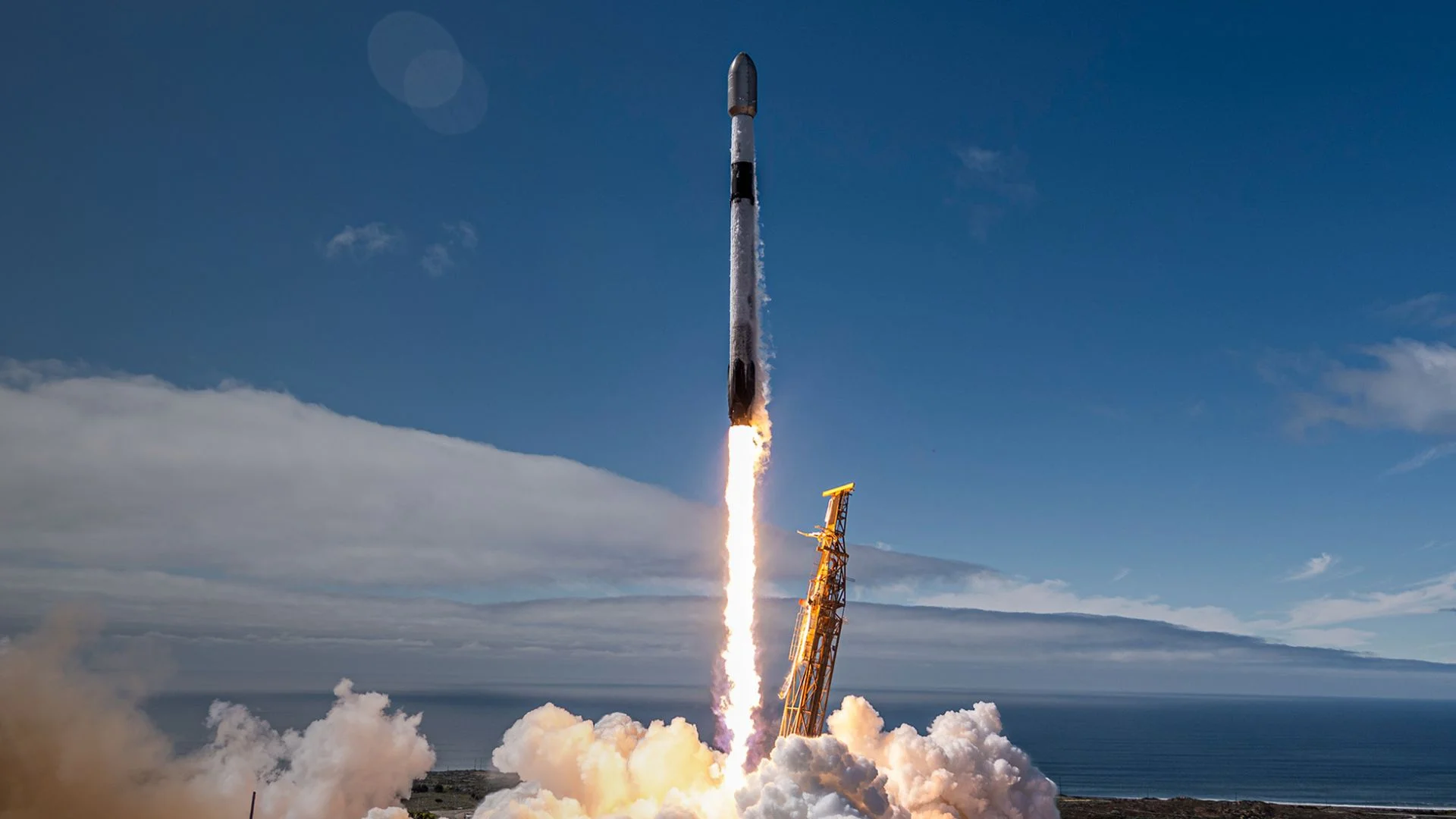
A leftover part of a SpaceX Falcon 9 rocket is expected to strike the Moon on August 5, 2026.
The object is known by its catalog name, 2025-010D. It is the upper stage of the rocket, the part that carries the spacecraft beyond Earth’s orbit.
This stage launched on January 15, 2025. It helped launch two private lunar missions. After completing its job, it continued drifting in space. For over a year, it has been orbiting far from Earth, slowly influenced by gravity and sunlight.
Astronomer Bill Gray has been tracking the object using software from Project Pluto. He says the rocket stage is now on course for a lunar impact.
READ ALSO: Rocket Lab Marks Second Successful Launch For JAXA: What Made This Stand Out?
“We’ve been tracking it since launch,” Gray explains. “Its orbit has changed over time, and now it is heading for the Moon.”
The impact is expected within minutes of 06:44 UTC. It will likely occur near the Moon’s near side, close to the edge visible from Earth.
The rocket carried important payloads during its mission. One was the Blue Ghost lander from Firefly Aerospace. Blue Ghost Mission 1 successfully landed on March 2, 2025, in Mare Crisium. It marked a milestone as the longest-running commercial mission on the Moon.
Another payload was the Hakuto-R Mission 2 lander from ispace. This lander, called Resilience, attempted a landing in June 2025. However, it failed just 90 seconds before touchdown due to a laser rangefinder issue. It crashed into the lunar surface.
Meanwhile, the Falcon 9 upper stage continued its journey alone. It did not return to Earth or escape into solar orbit. Instead, it stayed in a high Earth orbit, slowly pulled by the Moon’s gravity.
WATCH ALSO: Apple launches iPhone 17 lineup with contoured edges, and thinner borders
The rocket stage is about the size of a five-story building. When it hits the Moon, it will create a new crater. Scientists expect it to be similar in size to past impacts.
A comparable event happened in 2022, when debris from China’s lunar mission struck the Moon. That impact created two craters, around 16 to 18 meters wide.
The upcoming collision will likely produce a flash of light. It may also throw lunar dust and rocks into space. However, experts say it may be hard to see from Earth.
Gray points to an earlier mission, LCROSS, which deliberately crashed into the Moon in 2009. “Even then, nothing was clearly visible,” he says. “This impact will happen in sunlight, so it may not stand out much.”
Still, some astronomers plan to observe the event with telescopes. This impact poses no danger to people on Earth. It also poses a very low risk to spacecraft around the Moon.
“There’s lots of space,” Gray says. “The chance of debris hitting another spacecraft is very small.”
However, he adds that the event highlights a growing concern. “It shows a certain carelessness in how leftover space hardware is handled,” he says.
READ ALSO: Battlefield AI: Startups Compete to Shape Future of Military Technology
As more missions head to the Moon, this issue may become more serious. Future lunar bases, astronauts, and satellites could face greater risks if space junk is not properly managed.
Tracking this object was not simple. Objects this far from Earth are hard to monitor using radar. Instead, astronomers rely on telescopes. They observe faint moving points of light and calculate their paths.
Gray and his team collected over 1,000 observations of the object. Using this data, they predicted the impact date back in 2025.
However, one factor makes predictions difficult: sunlight. Solar radiation pressure pushes objects slightly as they move. Over time, this small force can change its path.
“The motion is mostly predictable,” Gray explains. “But sunlight adds some uncertainty.”
Even so, scientists are confident the impact will happen close to the predicted time and place.
This is not the first time human-made objects have hit the Moon. During the Apollo era, NASA intentionally crashed rocket stages into the lunar surface. These impacts helped scientists study moonquakes. In 2009, the LCROSS mission also created a controlled impact to search for water ice.
WATCH ALSO: World’s first motorbike backflip between two moving trucks successfully completed
Natural impacts happen even more often. Small asteroids regularly strike the Moon, creating its many craters. So, in many ways, this event is not unusual. While this single impact is harmless, the larger issue is space debris. Thousands of objects orbit Earth today. Many are inactive satellites or leftover rocket parts.
Some of these objects re-enter Earth’s atmosphere and burn up. Others stay in orbit for years. There are growing concerns about pollution in the upper atmosphere from burned debris. Astronomers also worry about the night sky. Increasing numbers of satellites make it harder to observe stars and galaxies.
Another risk is collisions. Spacecraft sometimes need to change course to avoid debris. The International Space Station has done this many times. A worst-case scenario is known as the Kessler Syndrome. In this situation, collisions create more debris, which in turn creates even more collisions. Experts say we are not there yet. But the risk is growing.
There are ways to avoid such events. One method is to send rocket stages into orbit around the Sun after their mission. This keeps them away from Earth and the Moon for long periods.
The European Space Agency has been working on such strategies for years. Some recent missions have already used this approach. Even SpaceX has started placing certain upper stages into solar orbit.
READ ALSO: Chile’s ALMA Telescope Captures Sharpest Image of Milky Way’s Chaotic Heart
However, this method only works for missions going beyond Earth orbit. Most satellites do not have enough energy to escape Earth’s gravity. This makes space junk a complex problem with no simple solution.
The upcoming Moon impact is a quiet event. It will not cause harm or major changes. But it serves as a reminder. As space activity grows, so does the need for responsibility.
Managing space debris is no longer optional. It is becoming essential for the safety of future missions, on Earth, in orbit, and on the Moon itself.