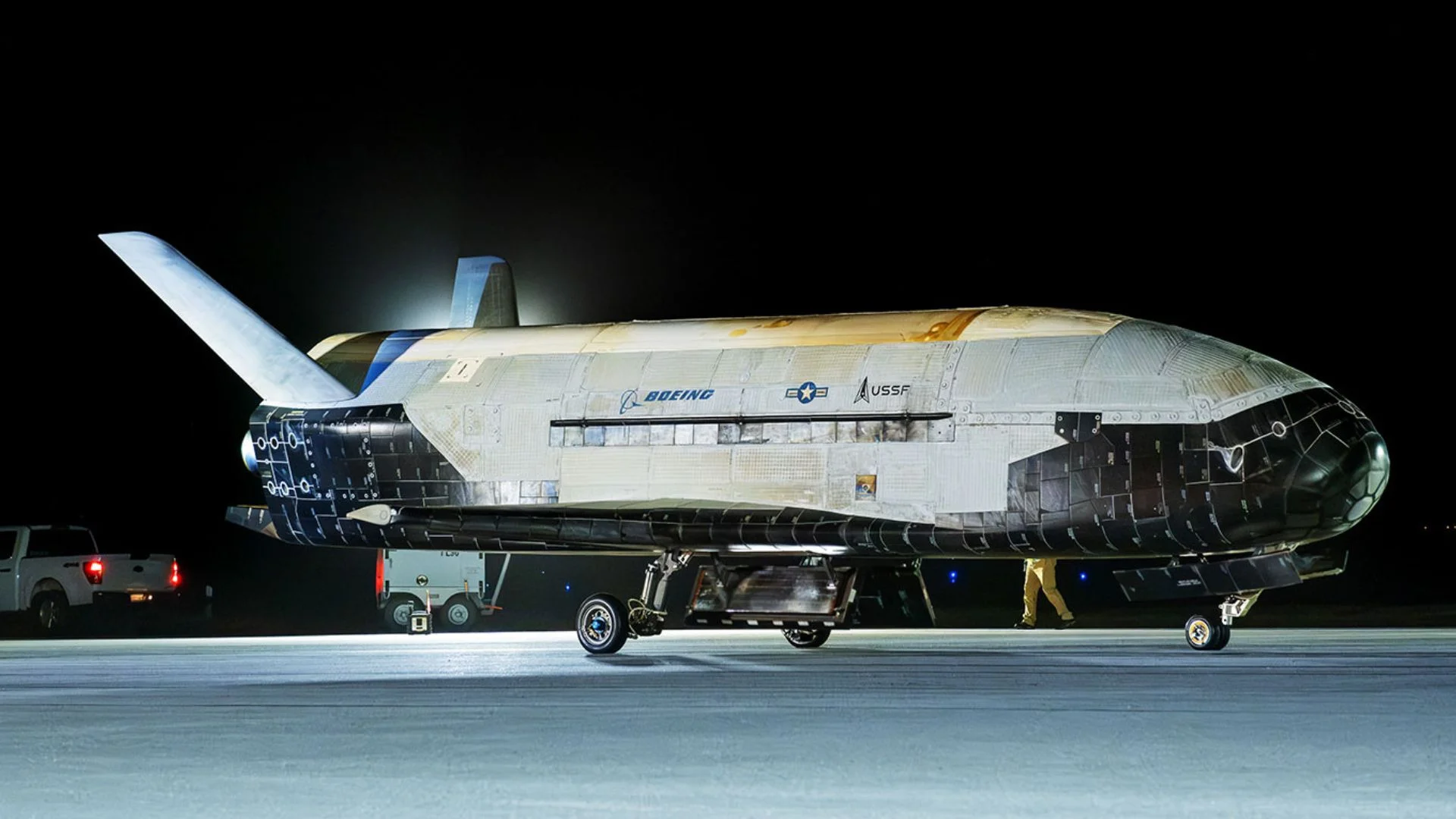
More than 230 days after launch, the X-37B Orbital Test Vehicle continues to circle Earth, supporting experiments that may shape the future of space technology.
Built by Boeing, the reusable spaceplane is once again proving its value as a flexible and reliable platform for testing new ideas in real space conditions.
This ongoing mission, known as OTV-8, reflects a shift in how space programs operate. Instead of waiting years for results, engineers and mission planners are now testing technologies directly in orbit, learning faster, and improving systems with each flight.
The spaceplane works closely with partners such as the US Space Force and the Air Force Rapid Capabilities Office. Together, they are using the X-37B to push the limits of what can be tested and improved in space.
READ ALSO: Skydio’s $3.5 Billion, 5-Year Push Signals a New Phase in US Drone Power
Boeing’s Spaceplane X-37B Mission
The current mission carries several advanced experiments that highlight the growing complexity of space operations.
One of the key tests involves laser communications. This technology aims to move large amounts of data faster and more securely across space networks. As satellites become more connected, faster data transfer will become essential.
Another important payload is a quantum inertial sensor. This system can help spacecraft navigate even when GPS signals are weak or unavailable. In future missions, this could allow vehicles to operate in more challenging environments, including deep space.
The mission also includes NASA research. Scientists are studying how Zylon webbing behaves after prolonged exposure to space. These materials are part of inflatable heat shield systems, also known as HIAD technology. The findings could improve the spacecraft’s ability to survive extreme heat during planetary entry.
WATCH ALSO: Engineers from Australia have introduced a spray that enhances the fire-resistance of clothing
Each of these experiments is designed not just to test ideas, but to gather real-world data that can guide future missions.
X-37B Reusability
One of the strongest advantages of the X-37B is its ability to return to Earth after completing its mission. Unlike many spacecraft, it brings back hardware for direct inspection.
Holly Murphy, director of Boeing’s Experimental Systems Group, highlighted this strength. She said the rapid launch of OTV-8, just months after the previous mission, demonstrates the platform’s maturity. She added that the X-37B is not a one-time project but a reusable system designed for increasingly complex missions.
This cycle, launch, test, return, improve, creates a learning loop. Engineers can study how systems performed in space, fix issues, and upgrade technologies for the next flight.
The mission also builds on lessons from OTV-7. During that earlier flight, the spaceplane performed an aerobraking maneuver. This technique uses Earth’s atmosphere to change orbit while saving fuel. It showed that the X-37B can move more freely in space without relying heavily on propellant.
READ ALSO: Tufts University Creates Color-Changing Paint That Measures Impact Force Without Sensors
Kay Sears, vice president and general manager of Boeing Space, Intelligence & Weapon Systems, emphasized the importance of consistent performance. She said reusability matters only when it delivers value over time. She added that the X-37B provides partners with a trusted platform to test new technologies and turn those results into stronger systems.
Space missions today are becoming more dynamic. Operators need faster ways to test systems, adapt to changes, and solve problems. The X-37B meets this need by acting as a reusable testbed in orbit.
It allows experiments to run in real conditions, not just in simulations. It also ensures that results are not lost, since the hardware returns to Earth for detailed study.
Boeing continues to upgrade the spaceplane to handle more advanced missions. As new technologies emerge, the vehicle must keep up in terms of capacity, flexibility, and reliability.
The X-37B’s current mission shows how space exploration is evolving. It is no longer just about reaching orbit. It is about learning quickly, improving continuously, and building systems that can adapt to the future.
In that quiet orbit, far above Earth, the X-37B is doing more than testing technology. It is shaping how space missions will be designed for years to come.