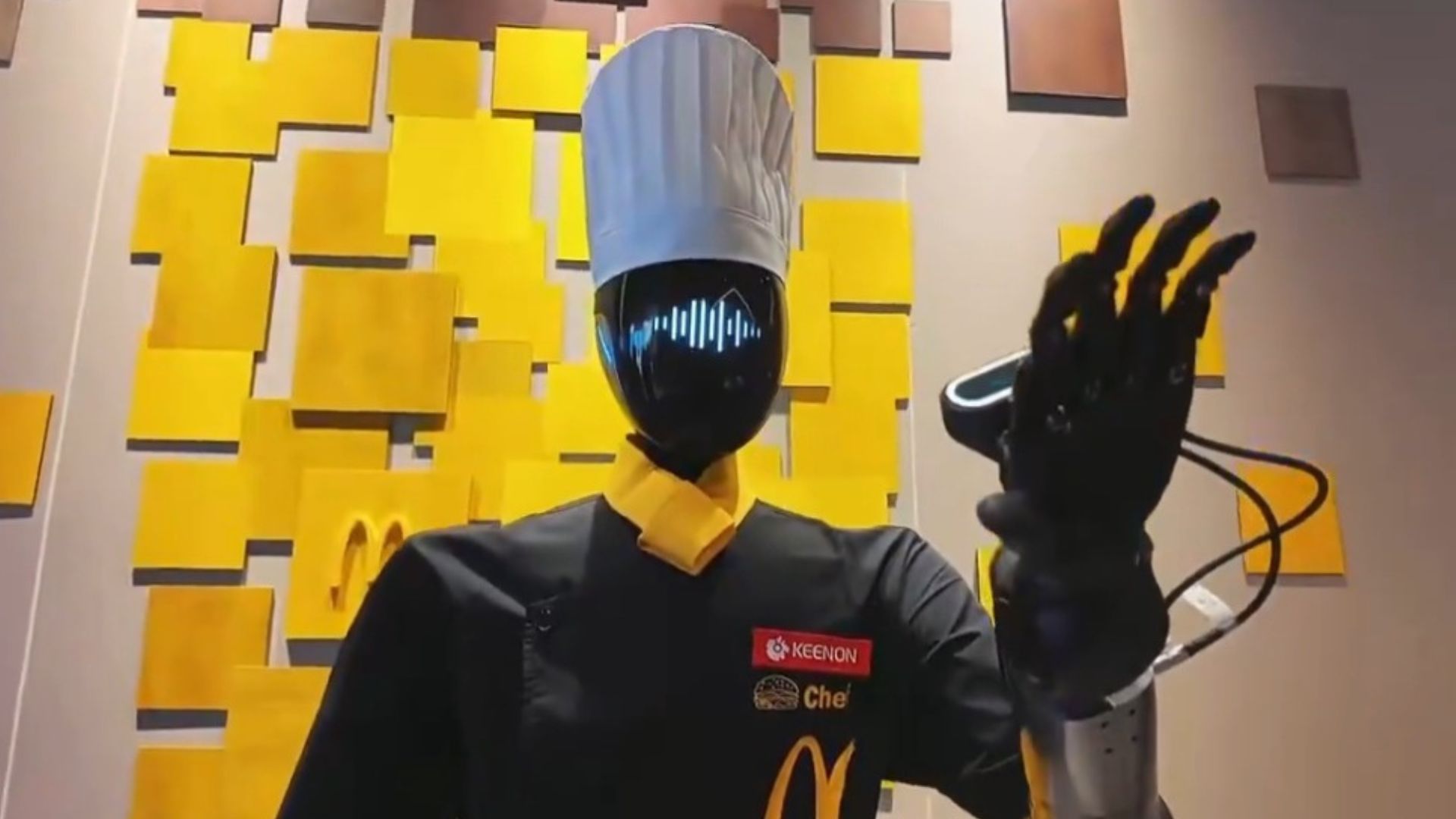
McDonald’s has tested humanoid robots at one of its outlets in Shanghai, drawing attention from customers and social media users.
The trial took place at a newly opened restaurant near the Shanghai Science and Technology Museum. It lasted for five days, from March 14 to March 19.
Videos online showed human-like robots dressed in McDonald’s red-and-yellow uniforms. They greeted customers, interacted with diners, and moved around the restaurant.
Some robots even delivered food trays, while others entertained children. A few machines were designed to look like animals, adding a playful touch to the experience.
READ ALSO: UF Builds First Liquid 550-Pound Rocket Engine, Achieves Historic Hot-fire Success
The robots were developed by Keenon Robotics for a short-term demonstration.
Despite appearances, McDonald’s clarified that the robots were not handling actual restaurant operations.
Jon Banner, a senior executive at the company, said the machines were only used for a temporary greeting. He added, “The robots were not involved in service or operational work. If you didn’t visit before, you missed them.”
The company used the robots mainly to attract attention during the restaurant’s grand opening.
WATCH ALSO: International Space Station crew wishes New Year 2026
The experiment reflects a growing trend of automation in the food industry. Companies are exploring how robots and artificial intelligence can improve customer experience.
However, the idea of robots replacing human workers continues to raise concerns worldwide.
For example, Amazon has already deployed over one million robots in its warehouses. Many of these machines handle heavy lifting, sorting, and packaging tasks.
Reports suggest that a large share of Amazon’s deliveries now involve some form of robotic assistance.
READ ALSO: China Files 82, US Just 22: What’s Inside Anti-Drone Patent Race
McDonald’s robot trial may have been short, but it highlights a bigger shift. Technology is slowly becoming part of everyday services.
For now, the robots are more about experience than efficiency. But in the future, they could play a larger role in how businesses operate.