In a major breakthrough in solar physics, scientists have traced the origin of the Sun’s powerful magnetic activity deep beneath its surface.
Researchers have found strong evidence that the Sun’s magnetic engine, known as the solar dynamo, operates nearly 200,000 kilometers below the visible surface.
This discovery helps explain the forces behind the Sun’s 11-year activity cycle and its impact on space weather.
The study was carried out by physicists at the New Jersey Institute of Technology (NJIT). It is based on nearly three decades of solar data.
The findings provide one of the clearest views yet into the hidden processes inside the Sun. These results could improve scientists’ ability to predict solar storms that affect Earth.
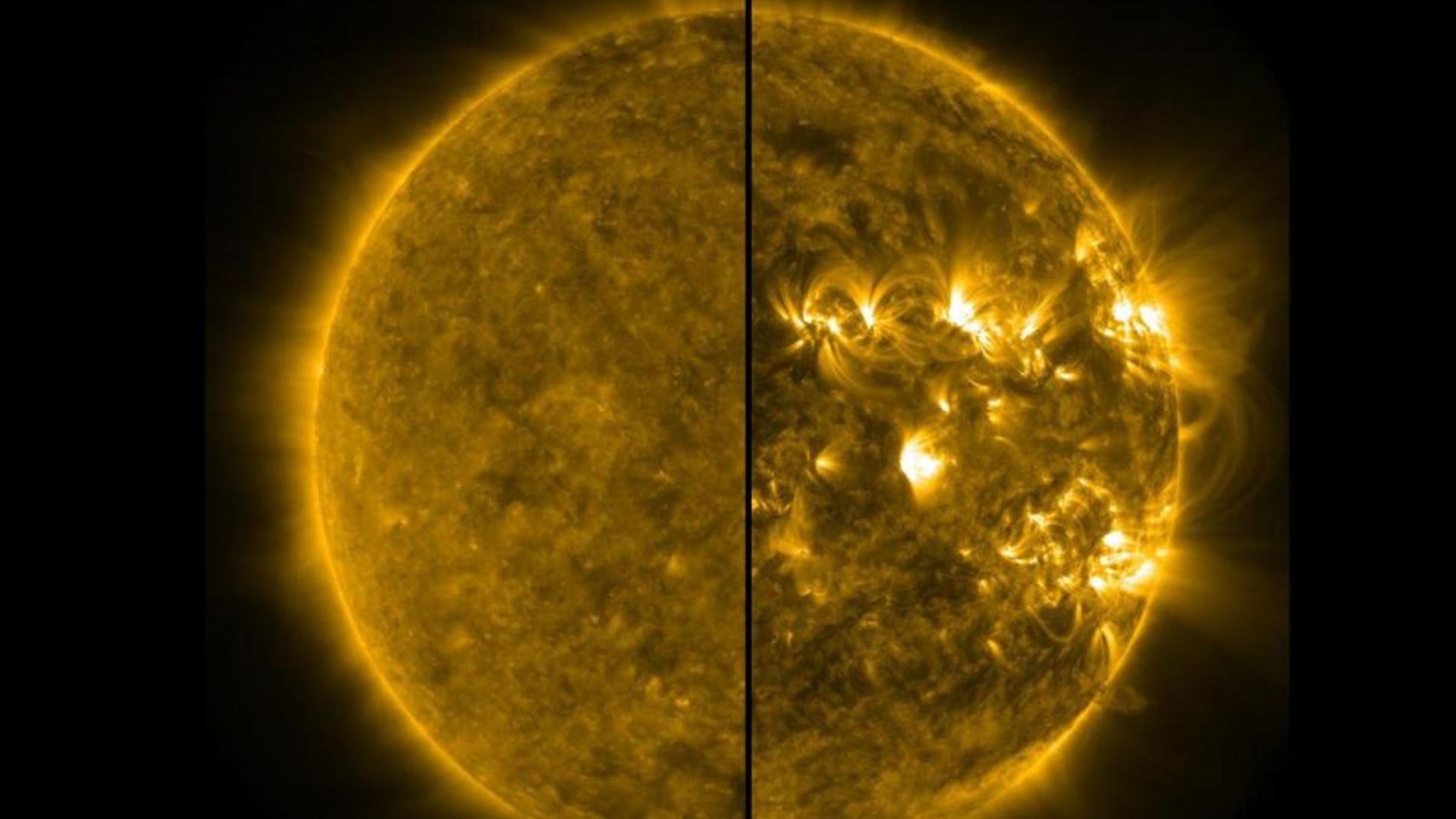
Every 11 years, the Sun goes through a cycle of magnetic activity. During this cycle, its magnetic field flips completely. Sunspots appear on the surface, starting at mid-latitudes.
Over time, they move toward the equator in a pattern that looks like butterfly wings. These sunspots are areas of intense magnetic activity. They are often linked to solar flares and eruptions.
While astronomers have observed this surface activity for centuries, the origin of the cycle has remained unclear. Scientists have long suspected that the answer lies deep inside the Sun.
However, direct observation of the Sun’s interior is not possible. This has made the problem difficult to solve.
To overcome this challenge, researchers used a method called helioseismology. This technique studies sound waves moving through the Sun. These waves are produced by the movement of hot plasma inside the star. By analyzing how these waves travel, scientists can understand what is happening beneath the surface.
WATCH ALSO: Explore Raytheon’s giant facility where it develops powerful naval radar SPY-6
The NJIT team combined data from multiple instruments. These included NASA’s Michelson Doppler Imager aboard the Solar and Heliospheric Observatory, the Helioseismic and Magnetic Imager on the Solar Dynamics Observatory, and the ground-based Global Oscillation Network Group. These instruments have been recording solar vibrations since the mid-1990s.
The researchers analyzed billions of data points collected over nearly 30 years. This allowed them to build one of the most detailed records of the Sun’s internal activity. With this long dataset, patterns began to emerge clearly.
Lead author Krishnendu Mandal explained the importance of this data. He said, “We did not have enough information earlier to identify where the Sun’s magnetic fields are organized. Now, we can see that the engine lies much deeper than the surface.”
The study revealed that bands of faster and slower rotation exist inside the Sun. These bands move over time and form patterns similar to the butterfly-shaped movement of sunspots seen on the surface. This link suggests that the processes deep inside the Sun are directly connected to what we observe on the surface.
The analysis pointed to a key region called the tachocline. This is a thin layer located between the Sun’s outer convection zone and its inner radiative zone. In this region, the Sun’s rotation changes sharply. This creates strong shearing forces.
These forces are believed to generate the Sun’s magnetic fields. The study shows that the solar dynamo likely operates near this tachocline layer. This confirms a long-standing theory in solar physics.
READ ALSO: How Lab-Made Ear Cartilage Brings New Hope for Microtia Patients
Mandal highlighted the importance of this discovery. He said, “The rotation bands start near the tachocline and take years to reach the surface. Tracking these movements helps us understand how the solar cycle develops.”
The findings also show a strong connection between deep interior flows and surface activity. The patterns observed in the data match closely with the movement of sunspots. This confirms that the Sun’s magnetic behavior is driven by processes deep inside.
Understanding the solar dynamo is important for many reasons. Solar eruptions, such as flares and coronal mass ejections, can affect Earth. They can disrupt satellites, communication systems, and power grids. Accurate predictions of these events are essential for modern technology.
Mandal emphasized this point. He said, “Our results show that models must include deeper layers like the tachocline. Many current models focus only on the surface, which is not enough.”
WATCH ALSO: U.S. lab advances demo microreactor as Project Pele gets nuclear fuel
Although the study does not yet allow precise predictions of solar cycles, it marks a major step forward. It provides a clearer picture of how the Sun’s magnetic system works. This can help scientists improve space weather forecasting in the future.
The implications of this research go beyond our Sun. Many stars show similar magnetic cycles.
However, they are too far away for detailed observation. By understanding the Sun, scientists can apply this knowledge to other stars.
Mandal explained this broader impact. He said, “The Sun is our closest example. By studying it, we can build models that apply to stars across the galaxy.”
The research team plans to continue its work. They aim to use longer datasets and improved simulations. This will help them track changes in the solar dynamo over time. It may also lead to better predictions of future solar activity.
READ ALSO: Iran Strikes Ships Near Strait of Hormuz, Global Oil Supply Faces Major Disruption Risk
The study was published in the journal Nature Scientific Reports.
It was supported by NASA and part of a larger collaboration involving multiple research institutions. The project focuses on understanding the flow of energy and magnetic fields inside and outside the Sun.
This discovery brings us closer to solving one of the biggest mysteries about our nearest star. As research continues, scientists hope to unlock even more secrets hidden beneath the Sun’s surface.