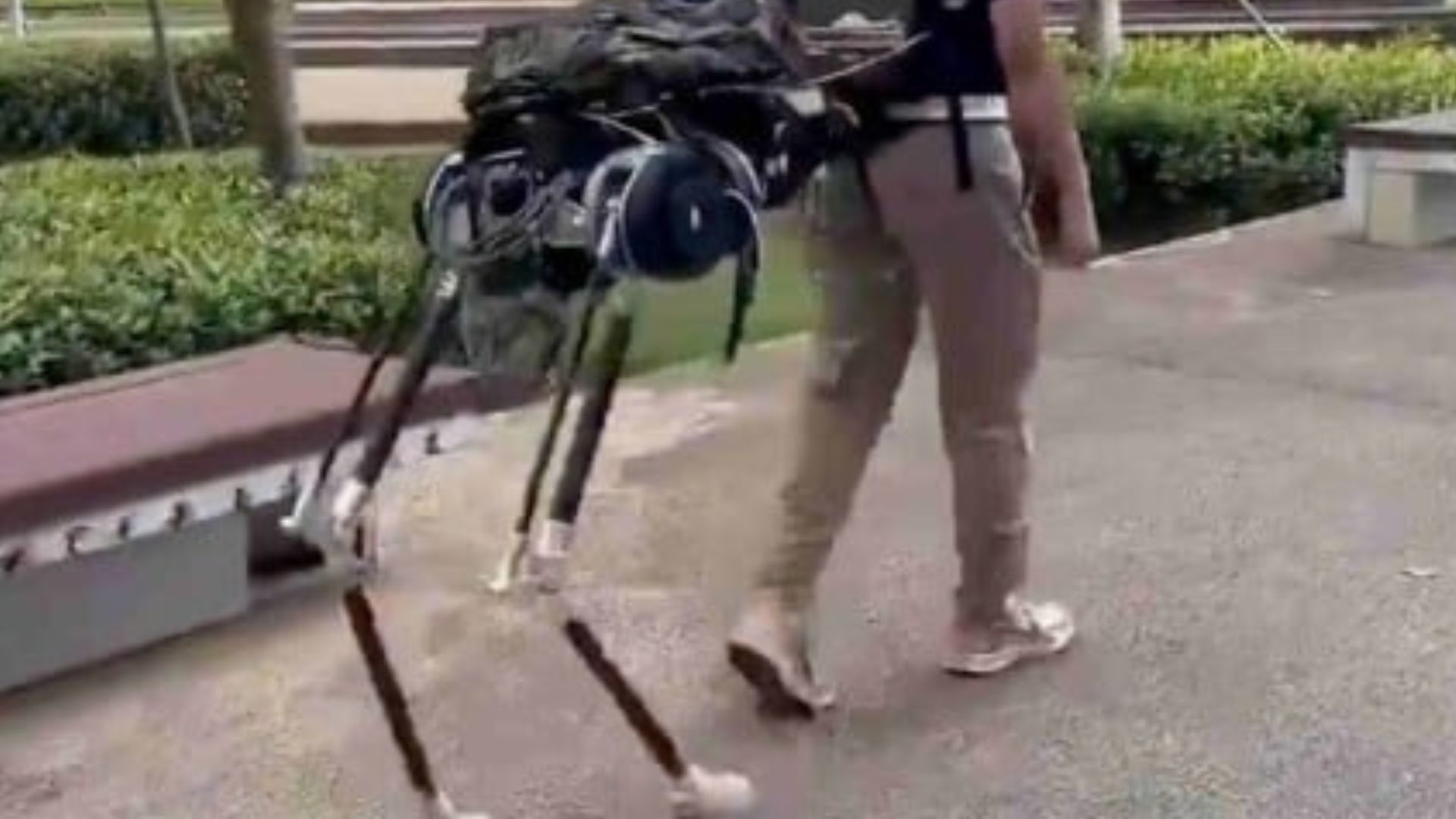
China is testing a new kind of wearable robot that could change how soldiers move in extreme environments.
The device combines human control with robotic support, creating what researchers call a centaur system.
The technology has been developed by scientists at the Southern University of Science and Technology in Shenzhen. It is designed to help users carry heavy loads and move more easily across rough terrain.
Centaur: A Hybrid of Human and Machine
The system includes two robotic legs and a robotic torso. It attaches to the human body through an elastic interface. Together, the user and machine function like a four-legged unit.
Unlike traditional exoskeletons, this device does not simply support the legs. Instead, it acts as an additional pair of limbs. The human decides movement, while the robot follows and assists.
The design allows the system to move in all directions. It can go forward, backward, and sideways without needing manual commands.
Early tests show strong results. When a user carried a 20 kg load, the device reduced energy consumption by 35%. It also cut foot pressure by more than half.
This means users can walk longer distances with less fatigue. The system also improves balance and stability on uneven ground.
The robot uses sensors to detect the user’s motion. It then adjusts its movement in real time. This makes the experience smoother and more natural.
WATCH ALSO: Skid AI to boost development of its robotic intelligence platform, raises USD 1.4 billion
Researchers say the system is useful in extreme conditions. These include mountainous regions, high-altitude zones, and disaster-hit areas.
In such places, even walking without a load can be difficult. Low oxygen levels and rough terrain increase physical stress.
Fu Chenglong, who led the research team, explained the design concept. He said, “We drew inspiration from quadrupeds because the fastest and strongest land animals have four legs.”
He added, “In extreme environments, even walking without a load becomes hard. Two extra legs can reduce the effort significantly.”
The system also improves safety. It does not blindly push the user forward. For example, if the user approaches a cliff, the robot adjusts its movement rather than forcing it.
China’s military, the People’s Liberation Army, has already introduced exoskeleton suits. These systems help soldiers carry equipment and reduce strain on the body.
However, the new centaur system aims to go further. Traditional exoskeletons are attached directly to the legs. Their force is often applied at angles that are not fully efficient.
Fu explained the difference. He said, “Conventional exoskeletons push at a wide angle. Our system aligns the force more closely with movement direction.”
This makes the assistance feel like a push from behind, especially when climbing slopes.
READ ALSO: Turkey’s New Kamikaze Can Carry 200-kg Warhead, Attack Enemy 2,000 kms Away
The new system also consumes less power. Compared to a standard four-legged robot, it uses about four times less energy. This allows it to operate for up to eight hours.
Despite its advantages, the system has sparked debate online. Some users question whether the design is practical.
Critics suggest that a separate four-legged robot could carry loads instead. Others argue that wheeled carts or simpler tools may be more efficient.
Fu responded to these concerns. He said, “A four-legged robot without a load can run for only about two hours. With load, its endurance becomes even worse.”
He also pointed out the limits of wheeled systems. Such devices struggle on steep slopes, stairs, and uneven ground.
WATCH ALSO: The Future of Work: Robots That Think, Move, and Learn Like Humans
The research team believes the technology has uses beyond defence. It could help in rescue missions after earthquakes or natural disasters.
Emergency workers often need to carry heavy equipment in difficult conditions. The centaur system could reduce their physical burden.
The study was published in the International Journal of Robotics Research after more than four years of development.
READ ALSO: Is UK’s Nuclear Shield Too Dependent on the US? Ed Davey Sparks Major Defense Debate
While the technology is still evolving, it shows how human-robot integration is advancing. Instead of replacing humans, such systems aim to enhance their abilities.
For now, the idea of an “army of centaurs” remains more a concept than a reality. But the technology highlights a growing trend in modern warfare and rescue operations where humans and machines work side by side to overcome physical limits.