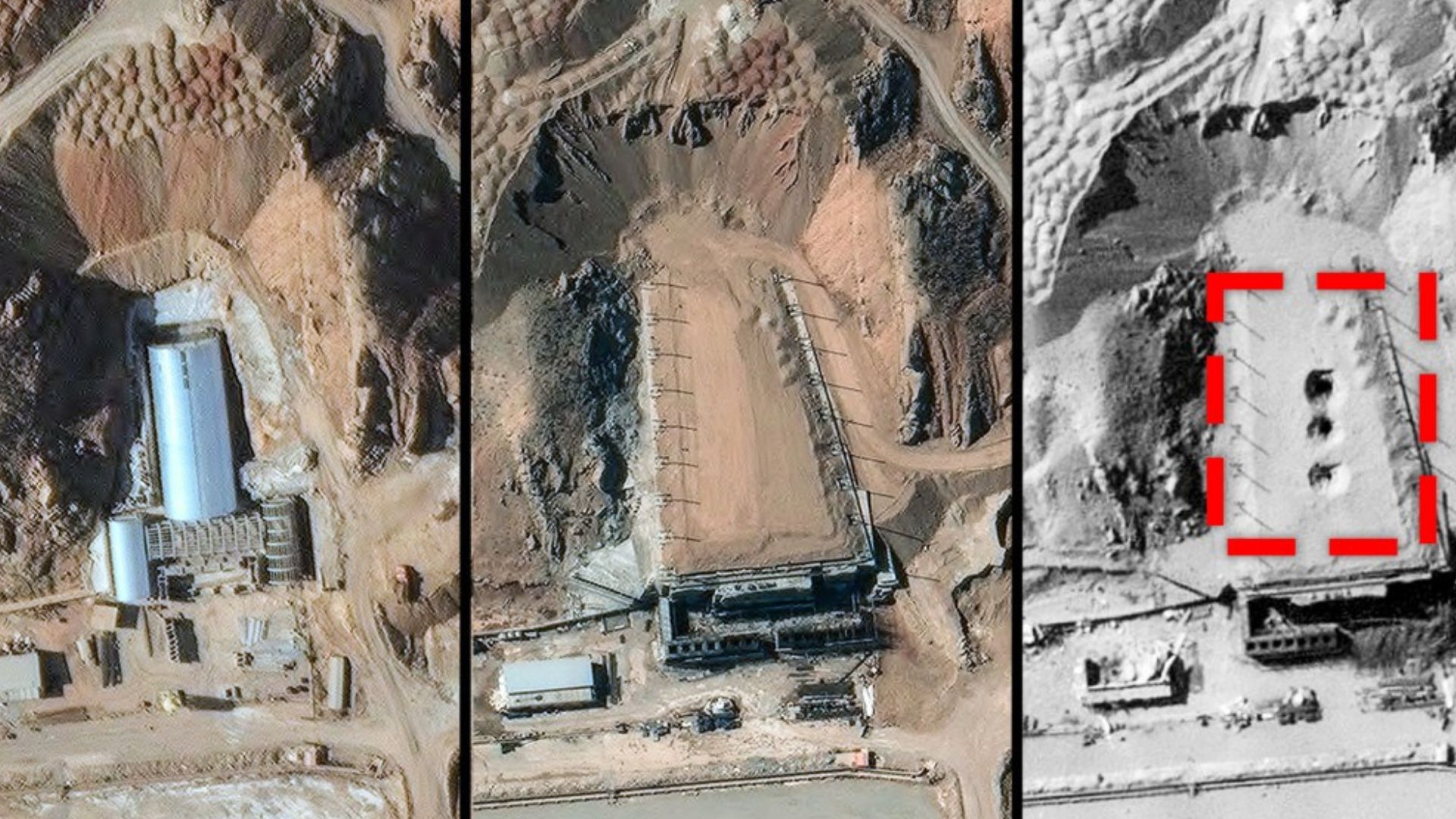
Fresh satellite images have revealed heavy damage at a sensitive Iranian facility long linked to the country’s suspected nuclear weapons program.
The images show large impact craters at the Taleghan-2 site inside Iran’s Parchin military complex, raising new questions about whether the US used its most powerful non-nuclear bomb during recent strikes.
The scale and shape of the craters suggest the possibility that the site was hit by the GBU-57 Massive Ordnance Penetrator (MOP), a 30,000-pound bunker-buster designed to destroy deeply buried targets. If true, the strike would represent one of the most powerful conventional attacks ever carried out against Iran’s nuclear infrastructure.
Satellite imagery captured shortly after the strike shows three large and precisely placed impact points on the roof of the Taleghan-2 facility.
The images were released by commercial satellite company Vantor and analyzed by several independent research groups.
Earlier images taken on March 6, 2026, show the building intact, though other parts of the Parchin complex were struck that day. The new photos taken after the March 9–10 attacks reveal that the structure is heavily damaged.
READ ALSO: US Johns Hopkins Uses Wine Waste to Recycle Battery Metals
Researchers from the Middlebury Institute and the Institute for Science and International Security said the damage pattern appears consistent with very large bunker-busting bombs.
Analysts said the size and penetration pattern resemble previous strike sites in Iran where the Massive Ordnance Penetrator was used.
However, officials have not confirmed which weapon was used in the attack.
A Facility Long Linked to Nuclear Weapons Research
The Taleghan-2 building is located within the Parchin military complex, southeast of Tehran. For years, international inspectors and intelligence agencies have suspected that Parchin hosted research related to nuclear weapons development.
In its November 2011 report, the International Atomic Energy Agency (IAEA) identified the site as a location where Iran may have conducted hydrodynamic experiments. These tests use high explosives to simulate the compression of nuclear material in an implosion-type nuclear weapon. Such experiments are considered a key step in the design of nuclear warheads.
READ ALSO: Robotic Hand Achieves 91% Success Grasping Fragile Objects on First Attempt
Iran has repeatedly denied the allegations and has insisted its nuclear program is strictly for peaceful purposes. But controversy surrounding Parchin intensified in 2018 when Israel released thousands of documents captured from Iran’s nuclear archive.
Israeli officials said the documents showed that the site played a role in Iran’s former nuclear weapons program known as the Amad Plan.
Satellite images from late 2025 and early 2026 show that Iran had recently taken steps to strengthen the Taleghan-2 facility.
By mid-January, the building had been encased in a thick concrete shell. In the weeks before the conflict began, workers also added a layer of soil to the structure. The work was intended to protect the facility from air strikes.
The rapid reinforcement suggests Iranian authorities expected the site could become a target. “This level of hardening indicates a clear effort to shield the building from attack,” one researcher said.
The additional protection may also explain why a much more powerful bomb could have been required to destroy it.
WATCH ALSO: US firm successfully demonstrates ship-based Sea Launcher for autonomous underwater vehicle ops
The GBU-57
The GBU-57 Massive Ordnance Penetrator is the largest non-nuclear bomb in the US arsenal.
The weapon weighs about 30,000 pounds and is designed to penetrate extremely deep underground before exploding. It can punch through dozens of meters of rock or up to around 200 feet of reinforced concrete.
The bomb was developed specifically to destroy deeply buried nuclear facilities. Only one aircraft in the US military is currently capable of delivering the weapon: the B-2 Spirit stealth bomber.
Each B-2 can carry two MOP bombs during a mission. During a previous US operation known as Operation Midnight Hammer, B-2 bombers reportedly dropped multiple MOP bombs on Iran’s Fordow and Natanz nuclear facilities.
Satellite imagery from those strikes showed crater patterns similar to what analysts are now seeing at Taleghan-2.
The US has not confirmed whether the Massive Ordnance Penetrator was used in the latest attack. When asked about the strike, US Central Command declined to comment on the specific weapons involved.
READ ALSO: Nearby Galaxies Hint at a Slower Expanding Universe and Surprising Dark Matter Clues
Officials also did not confirm whether American forces participated in the attack on the Parchin complex. However, B-2 bombers have reportedly been operating in the region since the first days of the current conflict.
These aircraft can fly extremely long distances and strike heavily defended targets while remaining difficult to detect. Some reports suggest that B-2 bombers flew from Whiteman Air Force Base in Missouri to carry out long-range strike missions.
The Israeli military has publicly stated that it carried out the overnight strike on the Taleghan-2 facility. However, Israel does not possess the Massive Ordnance Penetrator.
The largest bunker-buster bombs known to be in Israel’s arsenal weigh around 2,000 pounds. Reports have suggested Israel may have sought heavier bunker-busting weapons in the past, but it remains unclear whether those systems were ever acquired.
Because of this, analysts believe the scale of the damage could indicate support from US forces. Others argue that multiple smaller bunker-buster bombs could also create similar damage if dropped repeatedly on the same target.
Why Taleghan-2 Matters
The facility is important because it may have produced specialized explosives used in nuclear weapons. These high-precision explosives are needed to compress nuclear material evenly during a detonation.
If the facility was still active, destroying it could slow Iran’s ability to develop nuclear weapons. But the long-term impact of the strike remains uncertain.
Iran has previously rebuilt parts of the Parchin complex after earlier attacks. The site was targeted in 2024 and again during last year’s 12-day conflict. In both cases, Iran restored damaged buildings.
The attack on a suspected nuclear weapons research facility could mark a major escalation in the ongoing conflict.
Until now, many strikes in the region have focused on military bases, missile systems, or infrastructure. Targeting a nuclear-related site changes the stakes.
READ ALSO: The Secret War Tool Hiding on Your Street: Security Cameras
The strike could influence how Iran responds to the conflict and how other countries view the threat posed by Iran’s nuclear program. Destroying suspected nuclear facilities could push Iran to rebuild the program secretly.
Removing key infrastructure could delay any attempt to produce a nuclear weapon. For now, it remains unclear how badly the Taleghan-2 facility was damaged.
Satellite imagery confirms significant structural impact, but it is difficult to determine whether underground sections of the complex were destroyed. Deeper tunnels or chambers may still exist beneath the surface. Whether the strike permanently disabled the site may only become clear after further analysis or new satellite images.
What is certain is that the attack has renewed global attention on Iran’s nuclear program and raised new questions about the weapons used to target it. As the conflict continues, governments and intelligence agencies around the world will be closely watching the aftermath of the strike and its potential consequences for regional and global security.