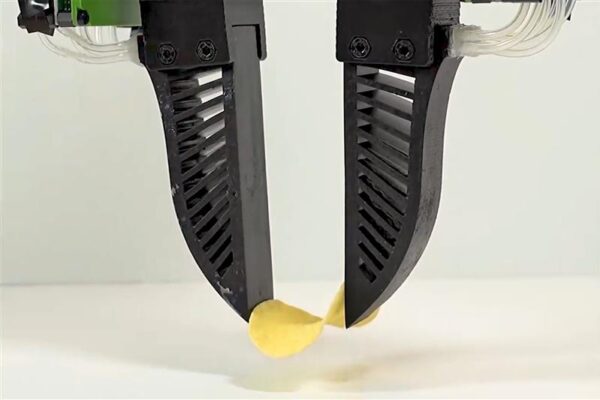
Researchers have developed a robotic hand with such delicate touch that it can pick up extremely fragile objects without damaging them.
The new technology enables robots to safely hold items like potato chips and raspberries.
This comes from scientists at the University of Texas at Austin, who designed a robotic gripping system that combines soft materials with advanced touch sensing. The system helps robots feel objects and adjust their grip in real time, much like a human hand.
The new technology is called Fragile Object Grasping with Tactile Sensing (FORTE). It aims to solve one of the biggest challenges in robotics: giving machines a reliable sense of touch.
Robots can now perform large tasks, such as moving objects or folding clothes. However, they often struggle with delicate actions. Picking up fragile items without crushing them is still difficult for most robotic systems.
“Right now, robotics can perform big movements around the house, but it still struggles with delicate tasks,” says Siqi Shang, the lead author of the research paper. Shang is a doctoral student in the Cockrell School of Engineering.
READ ALSO: IBM and Team Create New Molecule, Prove Its Existence With Quantum Computer
“Robots can fold a shirt, but they may struggle to pick up your glasses carefully or unpack fruit from grocery bags,” Shang explains. “We believe sensing signals will give robots a sense of touch so they can handle these objects safely.”
The research findings were published in IEEE Robotics and Automation Letters.
Robotic Hand Inspired by Nature
The robotic fingers used in the system were inspired by the structure of fish fins. This design principle is known as the fin-ray effect. Fish fins bend naturally when they touch objects, allowing them to adapt to different shapes.
Researchers used advanced 3D printing techniques to create the robotic fingers based on this idea. The fingers contain internal hollow channels filled with air.
These air channels act like tiny sensors. When the robot touches an object, the channels change shape and air pressure shifts inside them. Small sensors detect these pressure changes and send signals to the robot.
READ ALSO: Dimona: Inside Israel’s Secret Nuclear Site That Iran Threatens to Target in Escalating War
This process provides the robot with real-time feedback on the force it is applying. If the object begins to slip, the sensors immediately detect the change. The robot can then quickly adjust its grip to prevent the item from falling.
The research team tested the robotic gripper on 31 different objects to evaluate its performance. The objects included fragile items such as raspberries and potato chips. They also tested slippery items, such as jam jars and billiard balls. Everyday objects such as soup cans and apples were also included.
The system achieved a 91.9 percent success rate in grasping objects on the first attempt. This performance is better than many traditional robotic grippers that rely mainly on visual sensors.
The system also detected slipping objects with remarkable accuracy. It recognized 93 percent of slip events with perfect precision, meaning it never falsely detected slipping when it did not occur.
WATCH ALSO: China Sets World Record with 700 km/h Maglev
This precision is important because it prevents the robot from applying too much force. Too much pressure could crush fragile objects. “Humans pick up objects with just the right amount of force,” says Lillian Chin, an assistant professor of electrical and computer engineering at UT Austin.
“If you apply too much force, you will crush the object. If you apply too little, it will slip,” Chin explains. “Most existing sensors are not fast or accurate enough to provide that level of control. Our sensors operate closer to the speed of human touch.”
Another advantage of the technology is durability. Many experimental robotic sensors wear out quickly after repeated use. However, the new sensors last longer because they are built from flexible materials using 3D printing.
The design also allows researchers to easily customize finger shapes for different tasks. This flexibility could make the system useful across many industries.
The researchers believe the new robotic hand could improve many real-world applications that require delicate handling.
WATCH ALSO: Wing expanding drone delivery to additional Walmart stores in US city
In food processing industries, robots often need to handle fragile items such as fruits, vegetables, and baked goods. Sensitive robotic hands could reduce food damage and minimize waste.
In healthcare, robots could handle delicate medical instruments or biological samples more safely. This could improve accuracy in laboratories and medical procedures.
Manufacturing industries could also benefit from the technology. Robots equipped with sensitive hands could assemble delicate electronic components or handle fragile glass products.
The research team has publicly released the hardware designs and algorithms used in the project. They hope other scientists and engineers will build on their work and develop even better robotic systems. The project also involved Yuke Zhu and doctoral researcher Mingyo Seo.
The team is now working to further improve the technology. One goal is to make the sensors less sensitive to temperature changes. Another goal is to enhance the robot’s ability to react quickly when objects begin to slip.
Although robots are already common in factories and warehouses, giving them a human-like sense of touch remains a major challenge. The FORTE system represents an important step toward robotic hands that can handle objects with the same care and precision as human hands.