Science

US Brookhaven Lab Builds ‘Cloud in a Box’ to Study Weather

Brookhaven National Laboratory has built a custom “cloud in a box”—a convection cloud chamber that lets scientists create and study clouds under controlled conditions. The one-cubic-meter chamber allows repeatable experiments on how clouds form, why some produce rain, and how aerosols affect them. The work addresses one of the biggest uncertainties in weather and climate models.

Read More...
Microscopic image showing a tiny QR code pattern engraved into a ceramic surface

Austria’s TU Wien Sets World Record for Smallest QR Code

Austria’s TU Wien has set a Guinness World Record by creating the smallest QR code ever, measuring just 1.98 square micrometers—smaller than most bacteria. Working with industry partner Cerabyte, researchers engraved the code into durable ceramic material using focused ion beams. The technology could lead to ultra-dense, long-term data storage that lasts centuries without energy.

Read More...

University of Florida Finds Why Antarctica Has Weakest Gravity

University of Florida scientists have solved the mystery of Antarctica’s “gravity hole”—a region where gravity is weaker than anywhere else on Earth. Using earthquake waves and computer models, they traced its formation back 70 million years. The research shows a connection between deep underground rock movements and the growth of Antarctica’s massive ice sheets.

Read More...

SETI Institute Scientists Say Saturn’s Moon Titan Was Born from a Violent Moon Merger

Scientists at the SETI Institute have a new idea about Saturn’s giant moon Titan. It might have formed when two smaller moons crashed together and merged. The violent collision would explain Titan’s few craters, its strange orbit, and even the age of Saturn’s famous rings. NASA’s Dragonfly mission heading to Titan in 2034 could prove this theory right.

Read More...
A researcher holds black soldier fly larvae in a laboratory at Texas A&M University, part of a project using insects, sensors, and robots to clean contaminated land.

Texas A&M Uses Black Soldier Fly Larvae to Clean Polluted Land in Multi-Million Dollar Project

Texas A&M University researchers are using black soldier fly larvae to clean polluted soil in a multi-million dollar project. The larvae consume waste and break down toxins while sensors, robots, and AI automate the work. If successful, the method could restore lost farmland, clean industrial sites, and even help future astronauts grow food on Mars.

Read More...

UK’s Shadow Robot Develops Dexterous Hand That Handles Objects With 40 Tendons

London-based Shadow Robot has spent 30 years perfecting a robotic hand that moves with human-like precision. Using 40 metal tendons pulled by small motors, their hand helps universities and tech firms study dexterity. But making hands that are affordable, durable, and sensitive enough for real-world use remains one of robotics’ biggest challenges.

Read More...

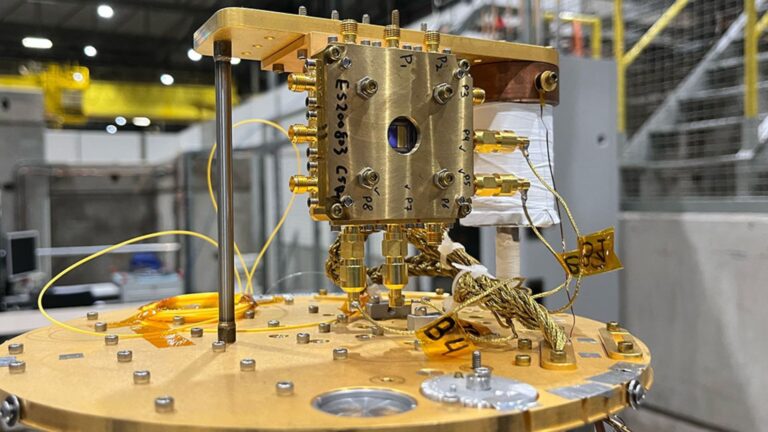
Chinese Scientists Build 3,700 km Quantum Network Prototype, Eliminating Security Relay Nodes

Chinese researchers from Peking University have demonstrated a quantum communication prototype capable of spanning 3,700 kilometers using fingernail-sized optical comb chips. Published in Nature, the system eliminates vulnerable relay nodes and achieves a 97.5 per cent operational success rate across 20 users, bringing scalable, ultra-secure quantum networks closer to reality.

Read More...
University at Buffalo professor Dr. Noreen von Cramon-Taubadel holds human mandible specimen for PLOS One study on chin evolution as evolutionary spandrel.

U.S. University at Buffalo Study Finds Human Chin Evolved as Evolutionary Accident, Not Adaptation

University at Buffalo anthropologist Dr. Noreen von Cramon-Taubadel and team have shown the human chin—unique to Homo sapiens—is an evolutionary spandrel, not an adaptation for chewing or speech. Published in PLOS One, the study tested neutral evolution against selection models and found chin traits fit the byproduct hypothesis. The research challenges adaptationist assumptions and reframes how distinctive fossil features are interpreted.

Read More...
ArianeGroup Ariane 64 rocket assembly Les Mureaux France with Vulcain 2.1 engine and four P120C boosters for February 2026 Kourou launch.

Europe’s ArianeGroup Prepares Ariane 64 Rocket for Historic Maiden Launch from French Guiana

ArianeGroup is set to launch the first four‑booster Ariane 64 on February 12, 2026, from French Guiana, deploying 32 Amazon Kuiper satellites. Twice as powerful as Ariane 62, the €4 billion program involves 13 ESA nations and 600 subcontractors. CTO Hervé Gilibert called it “something new for us on Ariane 6” as Europe challenges SpaceX with halved operating costs and a 30‑launch order book.

Read More...