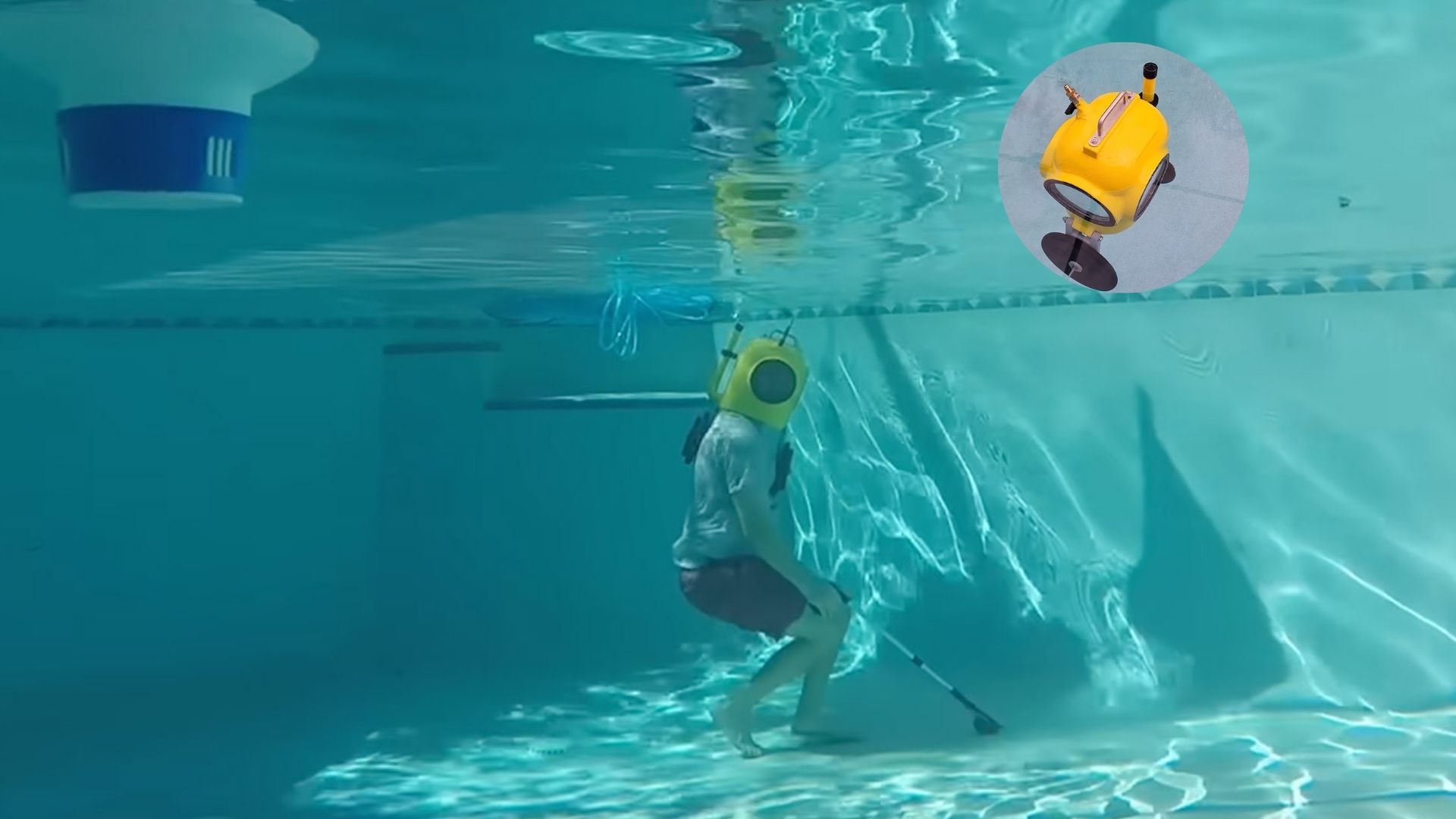
A creative YouTuber has built a working dive helmet using a 3D printer, fiberglass, and a floating air supply system.
The project, developed by creator Hyperspace Pirate, revives the concept of traditional surface-supplied diving gear in a modern DIY form.
The helmet allows a diver to keep their head dry underwater while receiving air from above the surface. Although the system is experimental, it has successfully worked during shallow dives in a swimming pool.
Designing the Helmet
The project started with simple measurements drawn on cardboard. The helmet was designed to be 7.5 inches wide, 9.75 inches deep, and 11.25 inches high.
These measurements were then used to create a digital design in Onshape modeling software. To fit the build plate of a Prusa MK3S 3D printer, the helmet was divided into four separate parts.
READ ALSO: Japan Sets Record With 12.28% Efficient Indium-Free Copper Gallium Selenide Solar Cell
The pieces were printed in ABS with varying layer thicknesses. This helped balance printing speed with structural strength. After printing, the parts were bonded together.
To strengthen the structure, the entire helmet was wrapped in fiberglass and coated with epoxy resin.
Visibility and Structural Design
TThree transparent acrylic windows were added to the helmet. One is located at the front and two are on the sides. These windows allow the diver to see clearly underwater.
The panes were press-fitted into place and sealed using silicone caulk. Water pressure helps push the panes inward, which naturally tightens the seal during dives.
The helmet also includes a carry handle on top. Small fittings allow the user to mount lights or cameras if needed.
Air Supply System
Air enters the helmet through a small SAE fitting at the top. A check valve prevents air from flowing back if the supply stops.
WATCH ALSO: China’s military showcases modern battlefield capabilities in new exercise
Extra air exits through a long hollow PVC pipe at the back. This creates a steady stream of bubbles while the diver breathes normally inside the helmet.
The system uses a quiet MAC100Q oilless compressor. It can deliver around 40 liters of air per minute at up to 2 bar pressure. This airflow is enough to support dives of up to 10 meters (about 33 feet) under ideal conditions.
Floating Power Platform
The air supply equipment is mounted on a floating platform. The setup uses a pool inner tube, topped with a sheet of plywood for stability.
The compressor runs on a 12-volt, 35-amp-hour lead-acid battery, connected to a 2-kilowatt pure-sine-wave inverter. A diver-down flag is also installed on the float to signal activity in the water.
Balancing Helmet Underwater
To keep the helmet submerged, the builder installed ballast weights on both sides. The weights are secured with steel plates.
Initial testing used 30 pounds of ballast, but an additional 10 pounds were added to reach neutral buoyancy. A neoprene pad was placed around the neck area to prevent pressure discomfort.
Pool Testing and Performance
The helmet was first tested on land to check airflow and fit. After that, underwater trials were carried out in a swimming pool.
The diver was able to move around comfortably while the airflow kept the inside cool and dry. The continuous airflow also helped prevent fogging on the acrylic windows. The compressor worked smoothly throughout the tests.
READ ALSO: AI-Driven 3D-Printed Prosthetic Limb Socket Developed At SFU
One small quirk appeared during testing. The exhaust pipe sometimes produced a gurgling sound, but it did not affect performance.
Safety Considerations
Safety was a key focus during the build. Using an oilless compressor prevents oil vapor or engine fumes from entering the helmet. A check valve was also installed to prevent sudden pressure loss if the air supply stops.
However, the creator emphasized that the device is still experimental.
Hyperspace Pirate cautioned that the helmet should only be used in controlled, shallow-water environments. It is not designed for open water or deeper dives without additional safety systems and backup air supply.
For now, the project demonstrates how modern 3D printing and DIY engineering can bring new life to classic diving technology.