

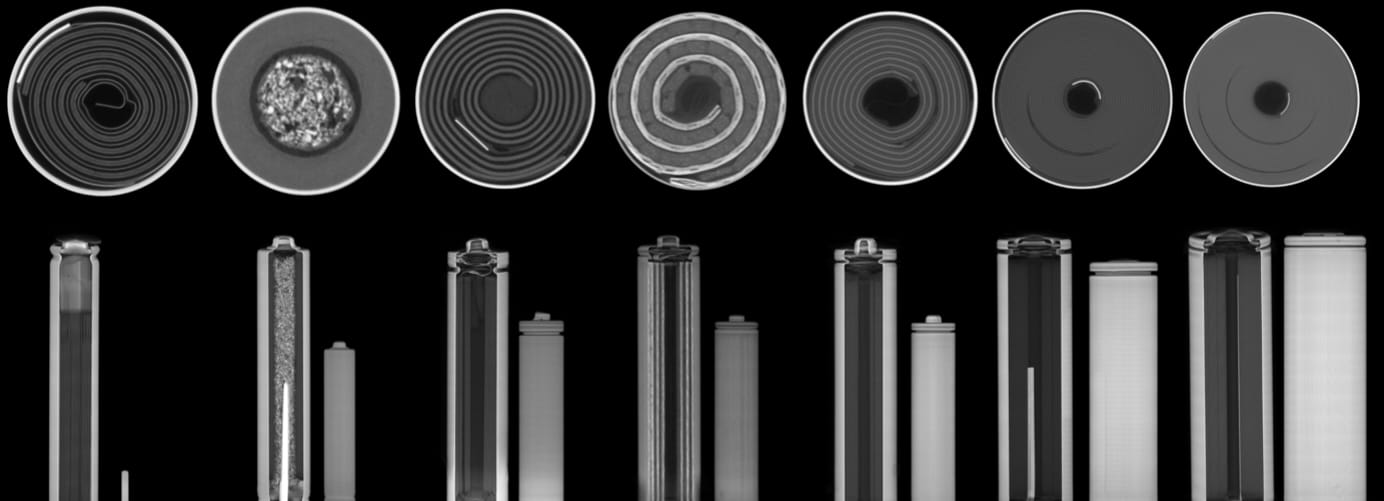
Scientists from the UK and other countries have helped launch the world’s first open-access battery imaging library, giving researchers free access to more than 4.5 terabytes of experimental data.
The Battery Imaging Library brings together images of batteries captured using 13 different imaging methods at synchrotrons and national laboratories. Its creators say the resource will help scientists improve battery analysis, develop computational models and advance research into safer and more efficient energy storage.
The library was created through an international collaboration led by Dr. Antony Vamvakeros, a Royal Society Industry Fellow at Imperial College London and research and development lead at Finden Ltd.
The company is co-located with Diamond Light Source and the ISIS Neutron and Muon Source at the Harwell Science and Innovation Campus in the UK. The project involved 48 scientists from 18 institutions around the world, who worked together to collect experimental data across different imaging techniques and length scales.
READ ALSO: https://modernmechanics24.com/post/byd-62mwh-gc-block-grid-storage/
The Battery Imaging Library (BIL) is designed to address a common challenge in scientific research. Valuable experimental data often remain stored on private computers or within individual research groups, making them difficult for other scientists to locate and reuse.
BIL instead provides access to both raw experimental files and reconstructed images, allowing researchers to examine existing results without having to repeat every experiment.
The library covers multiple imaging methods that reveal different features inside a battery. Some techniques provide information about the overall structure of a cell, while others help researchers study specific materials or changes during operation. By combining these sources, scientists can develop a more complete understanding of how batteries are built and how their internal components behave.
X-Ray Imaging Reveals Battery Structures
Diamond Light Source contributed high-resolution imaging data through its I12-JEEP beamline. The facility operates the UK’s flagship high-energy X-ray imaging and diffraction beamline, which supports detailed studies of materials and complex structures. Researchers used it to collect static and dynamic X-ray micro-computed tomography (micro-CT) measurements.
Micro-CT creates detailed three-dimensional images of an object by combining X-ray measurements taken from different angles.
Static scans show the internal structure at a particular moment, while dynamic measurements capture changes as conditions vary. These capabilities allow scientists to investigate battery components and study how their internal structures respond during operation.
The team scanned commercial cylindrical lithium-ion batteries, LiFeS2 batteries and alkaline batteries. The resulting images reveal internal morphological structures that are difficult to examine from the outside.
Genoveva Burca, principal beamline scientist at I12, said the beamline provides unique capabilities for investigating battery structures and welcomed the release of the dynamic X-ray micro-CT data for researchers worldwide.
WATCH ALSO: https://modernmechanics24.com/post/gen-1-5-robots-one-shot-learning-ai/#google_vignette
Neutron Data Adds New Detail
The ISIS Neutron and Muon Source also contributed to the library through its IMAT neutron imaging beamline. Researchers used the facility to collect neutron computed tomography data, which offer information that complements X-ray imaging. Such neutron data are particularly valuable because they remain relatively uncommon in battery research.
X-rays and neutrons interact with materials in different ways. X-ray imaging is useful for examining many dense structural components, while neutron imaging provides complementary contrast for lighter elements and materials. In lithium-ion batteries, this distinction helps researchers investigate lithium-based electrolytes and study the distribution of lithium species within a cell.
The inclusion of neutron imaging expands the range of questions that researchers can explore using the library. Instead of relying on one imaging method, scientists can compare data from several techniques to understand different parts of the same battery. This multi-modal approach is especially useful when a single imaging method cannot provide all the information needed for a detailed analysis.
Data Supports Research And Learning
The creators of BIL have identified three main goals for the open-access resource. The first is to widen access to experimental data for researchers at all career stages, including students and early-career scientists who may not have access to advanced imaging facilities. The second is to support the development and testing of imaging and image-analysis methods using realistic experimental data.
The third goal is to strengthen education and training. Students and professionals can use the files to practise scientific workflows, explore battery structures and learn how imaging data are processed. Access to real experimental measurements also gives researchers a practical way to evaluate computational tools under conditions that are closer to those found in laboratory work.
READ ALSO: https://modernmechanics24.com/post/uss-arizona-virginia-payload-module/
The library is accompanied by a dedicated website developed by Ronan Docherty, lead author of the related publication and a Ph.D. student in the Centre for Doctoral Training for the Advanced Characterisation of Materials at Imperial College London.
The website helps users browse different imaging modalities and find data relevant to their research. Docherty said the platform was designed to address the difficulty of locating suitable experimental datasets and make them easier to access and reuse.
Open Data For Battery Innovation
The project also has implications for the development of artificial intelligence in materials research.
Dr. Sam Cooper, professor of AI for materials design at Imperial College London’s Dyson School of Design Engineering and chief scientist at Imperial spinout Polaron, said open data is important for training AI models that support scientific discovery.
He also noted that the infrastructure for sharing data has existed for some time, while broader adoption of open-data practices has progressed more slowly.
Vamvakeros said the team aims to make complex imaging datasets available to the wider scientific community. He explained that researchers can use the collection to develop machine-learning methods for tasks such as data denoising, super-resolution and data fusion. These methods can help improve image quality, recover useful details and combine information from different imaging sources.
The accompanying publication is titled Battery Imaging Library: Multi-length scale and multi-modal synchrotron and laboratory battery imaging data for all.
Vamvakeros coordinated the international team and carried out much of the synchrotron and neutron experimental work with former Imperial Ph.D. students Dr. Sam Riley and Dr. John Morley. The library now provides a shared foundation for researchers studying battery materials, imaging techniques and computational analysis.
As battery technology expands across transport, renewable energy and grid storage, access to detailed experimental data remains important for research and development.
BIL brings together measurements that would otherwise be distributed across different institutions and facilities. By making these datasets available for reuse, the initiative establishes a resource that can support future battery imaging research, computational modelling and machine-learning development.














One Response