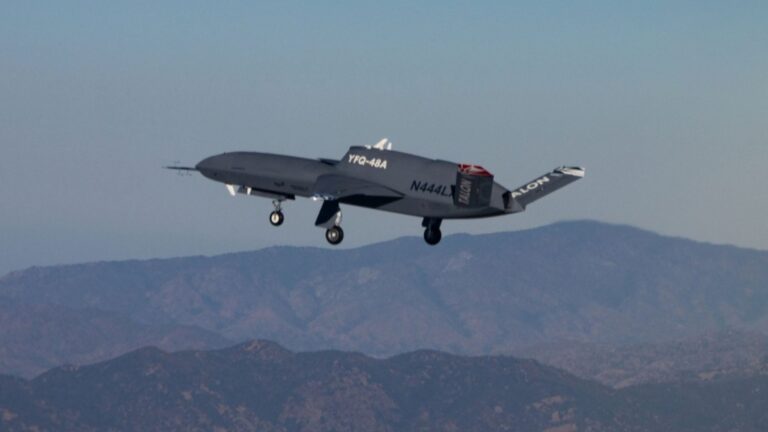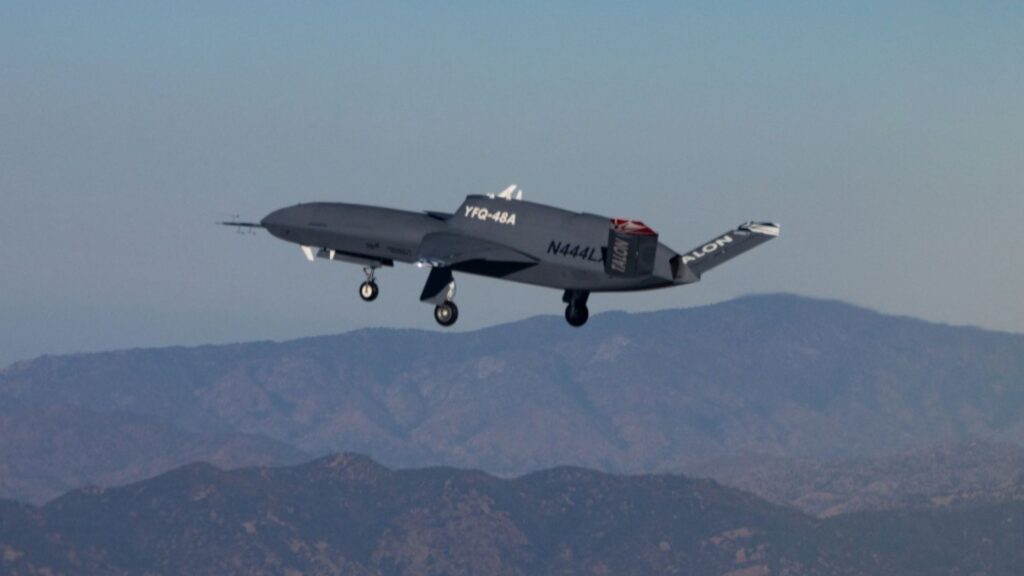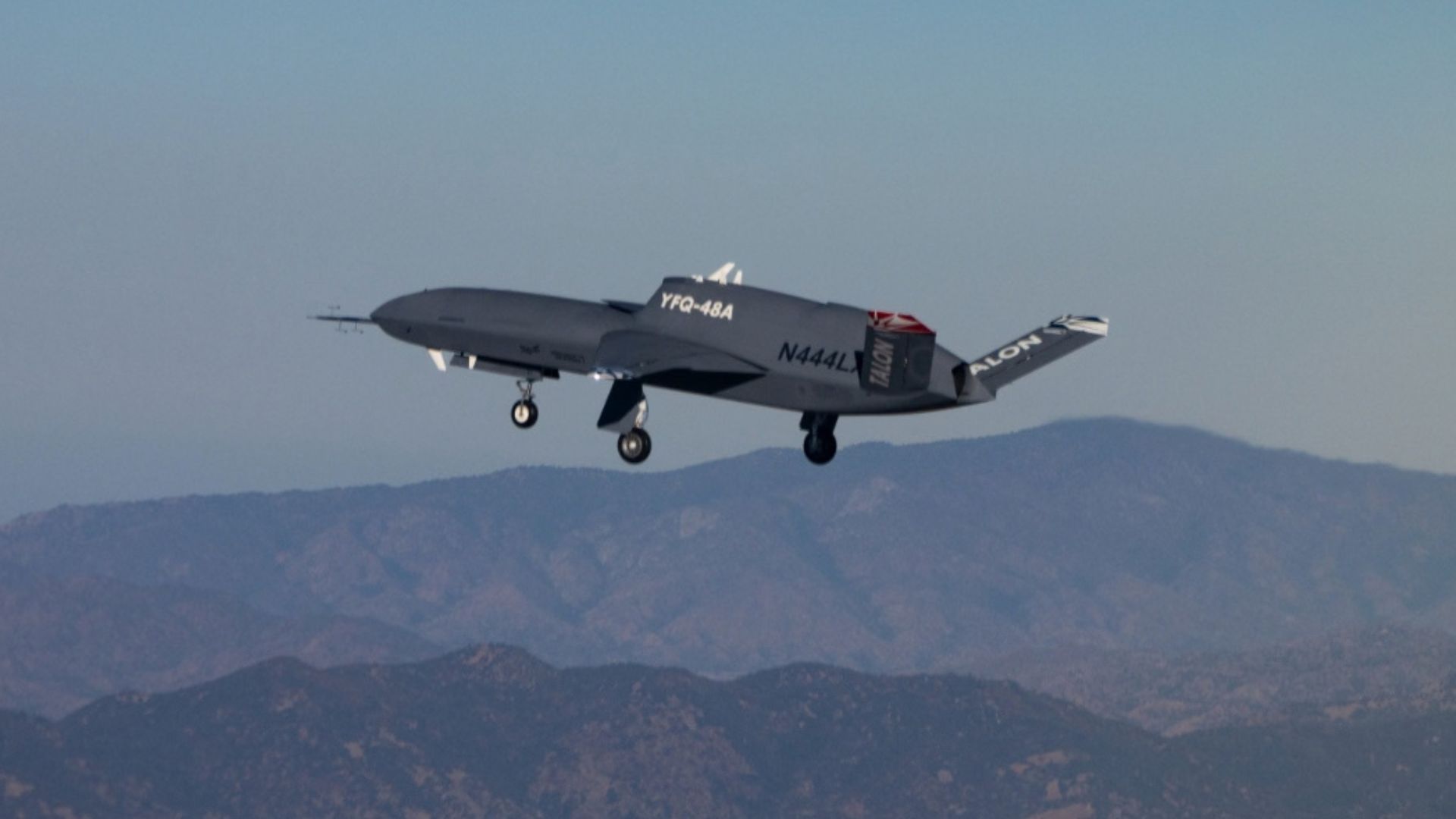
Northrop Grumman’s YFQ-48A Talon Blue has completed its first flight in Mojave, California, becoming the company’s first airborne test of its self-funded design for the US Air Force’s Collaborative Combat Aircraft program.
The uncrewed aircraft taxied, took off, performed flight maneuvers, and landed without remote pilot control. Northrop Grumman announced the flight on October 3 but did not disclose the test date, duration, altitude, or speed.
Talon Blue is intended to operate with aircraft such as the F-35 and F-22, as well as the future F-47.
Its design includes an internal weapons bay, a high-mounted engine intake and widely spaced landing gear. Northrop Grumman says these features give the aircraft flexibility across different missions for the US and its allies.
The company has placed autonomy at the center of the aircraft’s development. During its first flight, Talon Blue did not rely on a pilot to steer it from the ground. Its ability to manage the complete flight sequence from taxi to landing gives Northrop Grumman a platform for further testing of autonomous operations.
Focus On Cost And Production
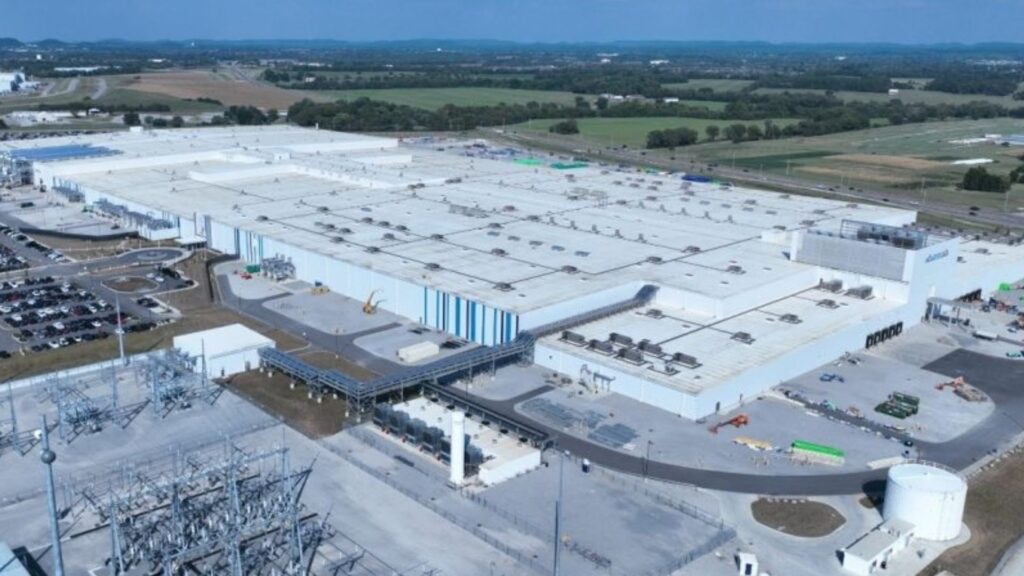
Northrop Grumman is also using manufacturing efficiency as a major part of its Talon Blue approach. The company says it redesigned the aircraft to reduce both the number of parts and its overall weight. It has previously stated that Talon uses composite structures and about half the number of parts used in earlier designs.
Craig Woolston, Northrop Grumman’s vice president and general manager for research and advanced design, said customers want autonomous aircraft that can enter service faster and at lower cost. He said the company adjusted its approach after hearing those requirements from potential users.
The emphasis on simpler production is relevant to the CCA program because the Air Force is seeking large numbers of uncrewed aircraft.
A design that requires fewer parts and less manufacturing work can reduce production time and simplify maintenance. Northrop Grumman has therefore positioned Talon Blue around both autonomous capability and a manufacturing process intended to support faster output.
READ ALSO: https://modernmechanics24.com/post/north-korea-hypersonic-missile-tracking/
Race For Next CCA
Northrop Grumman began developing Talon Blue with its own funding after it was not selected for the first phase of the Air Force’s CCA competition. The effort was initially known as Project Lotus before becoming Project Talon.
In December 2025, the Air Force assigned the aircraft the YFQ-48A prototype designation and described it as a strong contender, although that designation did not provide Northrop Grumman with a production contract.
The first CCA competition has already produced two selected aircraft. The Air Force chose General Atomics’ FQ-42A Dark Merlin and Anduril’s FQ-44A Fury for Increment 1. In June, the service ordered both designs into production, while the two companies announced in late July that production aircraft were already emerging from their manufacturing lines.
The two selected aircraft also have an earlier testing lead. General Atomics’ and Anduril’s drones first flew in August and October 2025, respectively. Talon Blue’s first flight therefore comes after those aircraft had already entered flight testing and moved into production.
Increment Two Remains Open
Northrop Grumman’s main opportunity is the next stage of the program, known as Increment 2.
The Air Force has not yet selected a design for this phase or established production plans. A service spokesperson said in December that nine companies were developing Increment 2 concepts, but the Air Force did not identify the companies or confirm whether Northrop Grumman was among them.
The Talon Blue flight gives Northrop Grumman an aircraft that can now move through a wider test program. The company can use flight testing to assess the design, autonomy functions, and other systems before seeking a larger role in the Air Force’s future CCA plans. The first flight alone does not establish a production contract or guarantee selection for Increment 2.
Talon Blue is part of a wider Northrop Grumman effort called Project Talon. Another element is Talon IQ, an airborne testbed based on Scaled Composites’ Model 437 aircraft. It uses Northrop Grumman’s Prism mission autonomy software and provides a separate platform to test and refine autonomous functions.
Scaled Composites is a Northrop Grumman subsidiary based in Mojave and specializes in experimental aircraft development. The relationship gives Northrop Grumman a test environment for autonomy technology while Talon Blue moves through its own flight program.
The first autonomous flight puts Talon Blue into a new stage of development, but major questions remain around its performance, weapons integration, mission systems, and production plans.
The next tests will show how the aircraft handles more demanding operations and whether Northrop Grumman can turn its self-funded prototype into a serious contender for the Air Force’s next CCA phase.