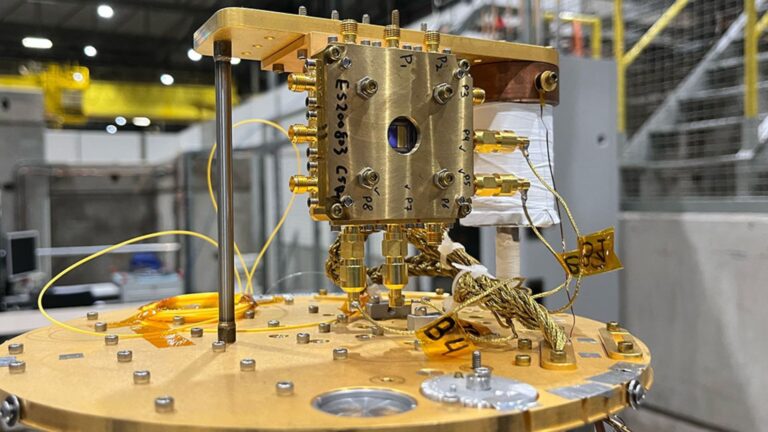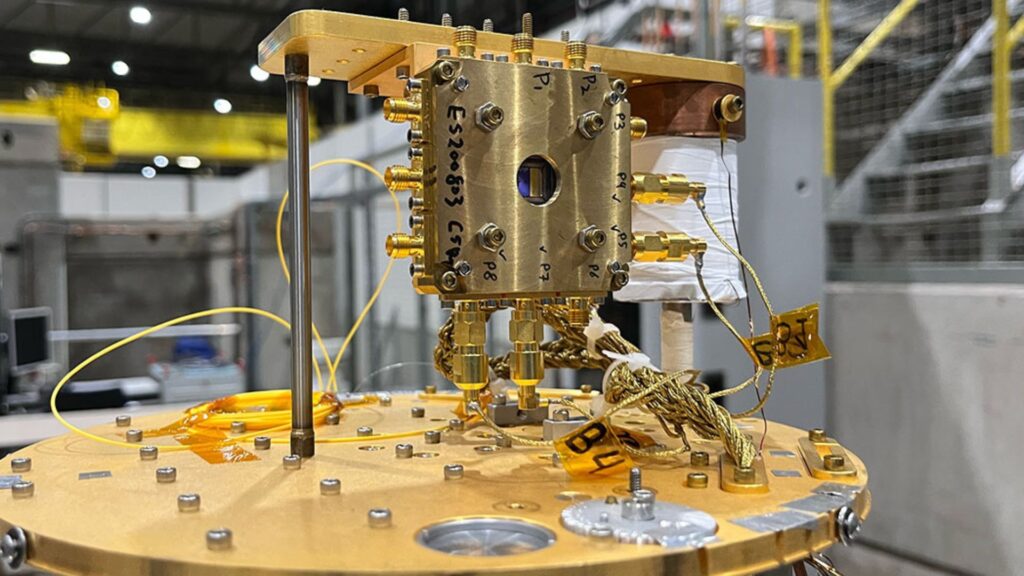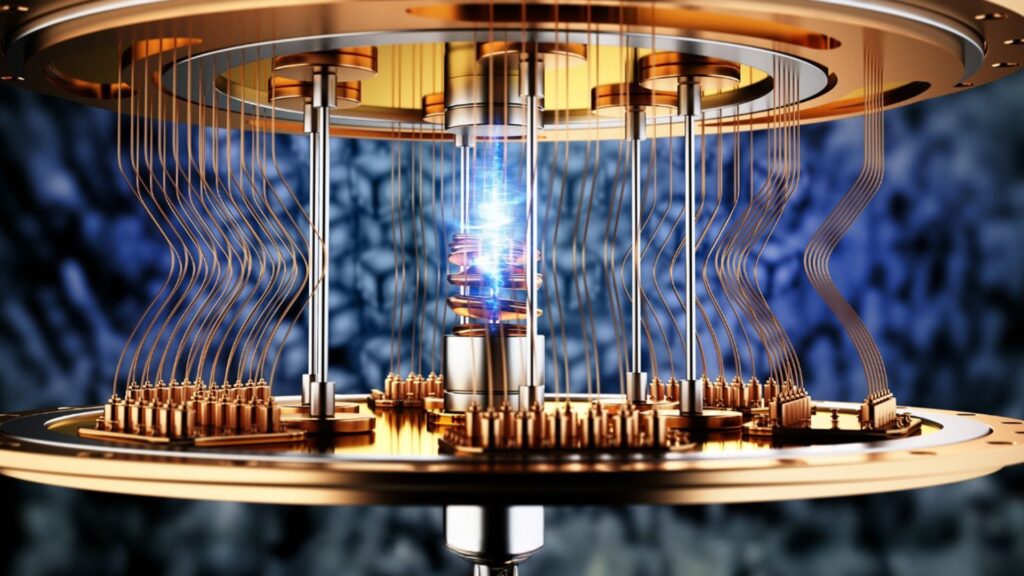

An international collaboration centered at CERN has assembled the first prototype slice of the High-Granularity Calorimeter (HGCAL), a revolutionary detector that will be the largest silicon-based sensor system ever built. Designed for the High-Luminosity LHC (HL-LHC) era starting in 2030, this “5D” calorimeter will tackle the unprecedented onslaught of 200 simultaneous particle collisions occurring 40 million times per second, a crucial upgrade to probe the deepest secrets of the universe.
In a quiet corner of the CERN campus, nature and cutting-edge science share a peculiar symmetry. Teams of bees construct perfect hexagonal honeycombs, a marvel of natural efficiency. Nearby, a global hive of scientists and engineers has just completed a similar feat, piecing together high-tech hexagons to form the first prototype “cassette” for a machine that will redefine the frontiers of particle physics.
This work is for the CMS experiment’s new High-Granularity Calorimeter (HGCAL). The core problem this product solves is one of overwhelming data. The upcoming HL-LHC will be a collision factory of unimaginable intensity, creating particle pileups that would completely overwhelm existing detectors. The HGCAL is engineered to not just survive this environment but to dissect it with phenomenal precision.
READ ALSO: https://modernmechanics24.com/post/humanoid-robot-100km-walk-across-china/
The basic function of the HGCAL is to act as an ultra-high-definition camera for particle showers. When particles from collisions fly into its endcaps, the calorimeter will capture their energy, pinpoint their location in 3D space, and timestamp their arrival with resolutions down to a few hundred picoseconds. “HGCAL is effectively a 5D calorimeter: it performs 3D spatial reconstruction, energy reconstruction, and has very high timing resolution,” explains HGCAL physicist Dr. Dimitra Tsionou of National Taiwan University, one of the key scientists behind the project’s design.
Leading this monumental effort requires a fusion of vision and practical engineering. The innovator and research lead is the collective brain trust of the CMS collaboration, with physicists like Dr. Tsionou defining the groundbreaking specifications. The engineers and builders are a truly global team, spanning assembly centers from IHEP in Beijing and NTU in Taipei to Fermilab in the United States and CERN in Switzerland, each fabricating the intricate hexagonal silicon modules that form the detector’s core.
WATCH ALSO: https://modernmechanics24.com/post/american-firm-tests-ground-stormbreaker/
A significant current limitation, however, is the sheer ambition and scale of the undertaking. As HGCAL physicist and logistics manager Dr. Ludivine Ceard (also of National Taiwan University) notes, “It’s the first time that a detector using this technology will be built on this scale and have to operate in such tough conditions.” The project pushes material science, robotics, and global logistics to their absolute limits, with years of assembly and testing ahead before the 2030 deadline.
The final product will be staggering in scale. Each of the two endcaps will have a sensor area of 500 square meters—nearly two tennis courts—packed with over 6 million detector channels across 47 layers. The front 26 layers, forming the electromagnetic section for catching electrons and photons, are being assembled at CERN. The rear 21 hadronic layers for measuring particles like protons are being constructed at Fermilab, with mechanical structures produced in places like Pakistan.
READ ALSO: https://modernmechanics24.com/post/samsung-odyssey-6k-3d-gaming-monitors/
The overall value and summary of the HGCAL is profound: it is the enabling technology for the next decade of discovery. By cleanly separating the fog of simultaneous collisions, it will allow physicists to spot ultra-rare subatomic processes hidden until now. This isn’t just an upgrade; it’s a complete paradigm shift in detection, moving from a 2D image to a precise, time-stamped 3D movie of particle interactions.
“There’s so many challenging aspects,” emphasized Dr. Ceard. Yet, these challenges are the price of entry to a new realm of physics. The prototype cassette is more than a test component; it is the first physical proof that this audacious vision can be built. It signifies that when the HL-LHC finally roars to life, the eyes watching the subatomic world will be sharper, faster, and more discerning than ever before.
WATCH ALSO: https://modernmechanics24.com/post/spacex-sends-science-cargo-to-space-station/