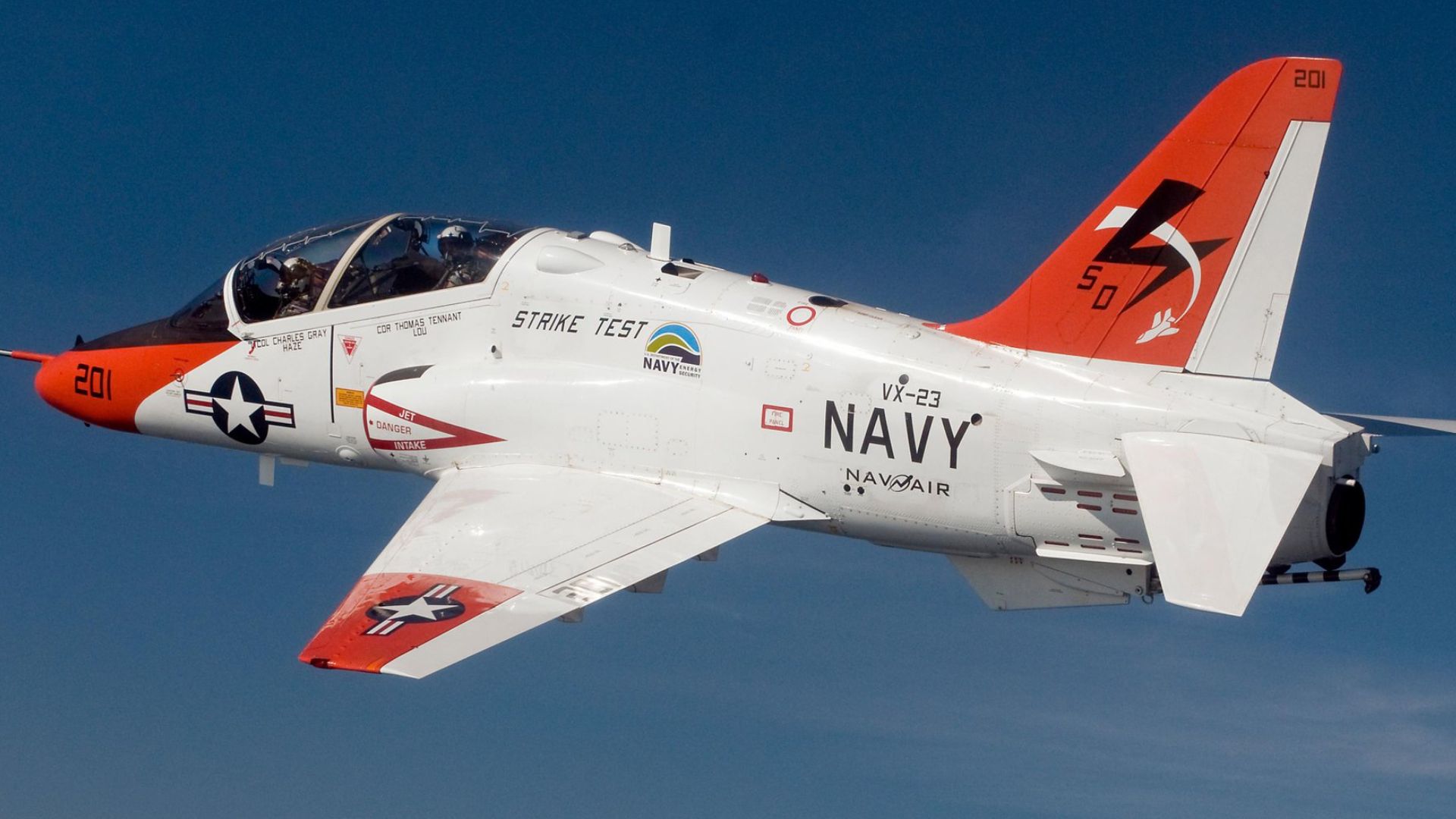
The US Navy confirmed that its next jet trainer will not be required to perform carrier landing touch-and-go operations.
In its latest draft requirements for a replacement of the T-45 Goshawk, the Navy has made clear that the new aircraft will not conduct full carrier-style landings during training. The decision signals a firm fundamental shift from long-standing practices that have defined naval aviation for decades.
Aviation Week first reported on the updated draft requirements for the program, now known as the Undergraduate Jet Training System (UJTS). The Navy plans to buy 216 new jet trainers to replace just under 200 T-45 aircraft currently in service. After years of delays, the service aims to launch a formal competition soon, with a final contract award expected by mid-2027.
Several major aerospace companies are preparing bids to compete for UJTS. These include Boeing with a naval version of its T-7 Red Hawk, Lockheed Martin and Korea Aerospace Industries with the TF-50N, Textron and Leonardo with the M-346N under the Beechcraft brand, and Sierra Nevada Corporation’s Freedom jet.
READ ALSO: https://modernmechanics24.com/post/neutron-scattering-hidden-reactor-fuel/
The latest UJTS draft proposal confirms a major change to carrier qualifications and Field Carrier Landing Practice(FCLP). Traditionally, FCLP training is conducted at land bases but closely mirrors real aircraft carrier landings. It includes repeated touch-and-go landings that simulate the stress and precision required to land on a moving ship at sea.
Under the new plan, future UJTS aircraft will only perform “FCLP to wave off” eradicating touch-and-go components. This means student pilots will fly the approach profile but will abort the landing before touchdown.
“The Naval Aviation Enterprise has determined that the UJTS air vehicle will conduct FCLP to wave off,” a Naval Air Systems Command spokesperson said. “FCLP to touchdown will be trained via other means in the UJTS system of systems.”
The Navy has not yet explained in detail what those other means will include or how they will be used to support continued FCLP-to-touchdown training requirements. TWZ has requested further clarification from Naval Air Systems Command and the Chief of Naval Air Training (NAVAIR).
WATCH ALSO: https://modernmechanics24.com/post/iss-crew-new-year-2026-wishes/
This change follows earlier decisions by the Navy to remove carrier qualification requirements from the training pipeline for pilots headed to fly the F/A-18E/F Super Hornet, F-35C Lightning II, and EA-18G Growler. As of last year, carrier qualifications remained part of training for E-2 Hawkeye pilots and international students.
“Field Carrier Landing Practice landings ashore are still required for graduation,” a Navy spokesperson said in August 2025, though it was not specified whether this included touchdown landings.
The new approach has significant implications for the UJTS competition. Without the need for carrier-capable training aircraft, the Navy no longer requires reinforced landing gear and airframes designed to withstand the extreme forces of carrier operations. This opens the door to lighter, land-based trainer designs.
At present, only Sierra Nevada Corporation’s Freedom jet is explicitly designed to support carrier touch-and-go operations. The company has emphasized the importance of keeping those skills in early training. Other competitors are offering modified versions of existing land-based trainers.
READ ALSO: https://modernmechanics24.com/post/gwr-uk-first-battery-passenger-train/
“The strategic decision to move carrier qualifications to fleet replacement squadrons was driven by increased technological capabilities and the need to reduce training pipeline times,” a Navy spokesperson said last year. “This enables the fleet to receive qualified pilots faster. After earning their initial qualifications after graduation, naval aviators in the strike pipeline are required to complete touch-and-goes and carrier landings at sea during their assignment at the Fleet Replacement Squadrons (FRS).”
Under the new model, student pilots will earn their wings without landing on a carrier. They will complete touch-and-go training and carrier landings later, during assignments with Fleet Replacement Squadrons, where they transition to frontline aircraft.
The Navy points to advances in flight simulation and automated landing systems as key reasons for the shift. Technologies such as the Magic Carpet landing aid have significantly reduced pilot workload during carrier approaches.
An argument for cost-benefit must also be provided. Reducing developmental risk and lowering the cost of any future T-45 replacement could be achieved by eliminating the features necessary for carrier-based operations. With less time and money needed for a student pilot to gain their wings, the overall adjustments to the training curriculum will have an influence on costs as well.
However, the potential downstream effects of removing components that have long been regarded as essential to naval aviation training have drawn criticism and worries. Although the capabilities of virtualised aviation training environments have advanced significantly in recent years, they still cannot fully replicate the live training experience.
WATCH ALSO: https://modernmechanics24.com/post/chinas-humanoid-robot-embroidery-skills/
“Carrier qualification is more than catching the wire,” a Navy strike fighter pilot told TWZ in 2020. “It’s about handling stress, communication, and the environment. That experience is one of our competitive advantages.”
The Navy has not yet released final requirements for the UJTS program. However, the latest draft makes one thing clear. The service is committed to reshaping how future naval aviators learn to fly and when they first face the challenge of landing on a carrier at sea.