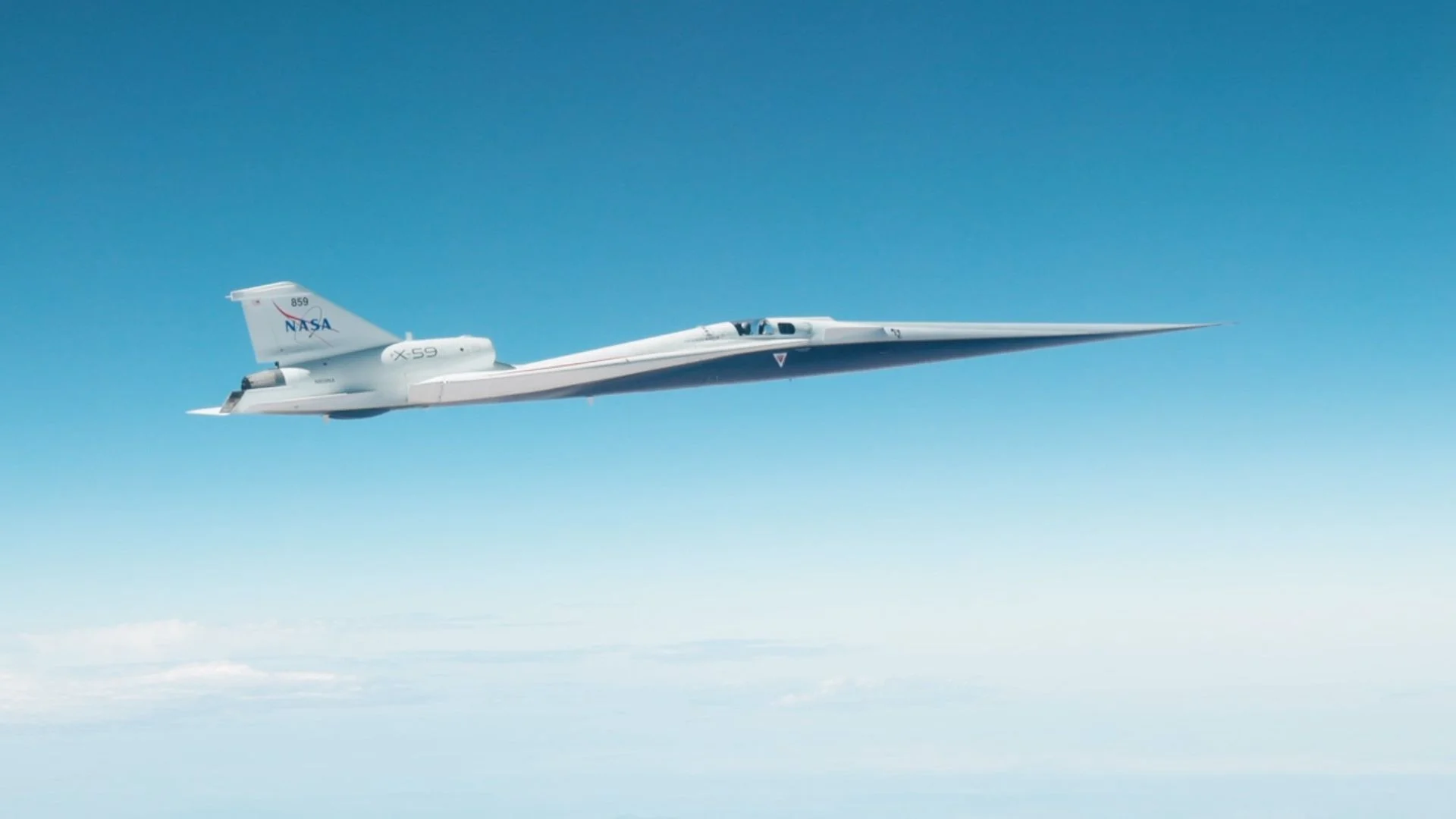
NASA’s X-59 experimental aircraft reached Mach 1.4 and 55,000 feet in another test flight as the agency moves closer to demonstrating quiet supersonic travel over populated areas.
The aircraft is designed to fly faster than the speed of sound while reducing the loud sonic boom traditionally associated with supersonic flight. The latest milestone brings NASA closer to collecting public feedback that could help shape commercial supersonic aviation.
X-59 Reaches Mission-Test Conditions
NASA’s X-59 achieved a major milestone at approximately 925 miles per hour, or 1,488 kilometers per hour, matching the flight conditions planned for future community testing campaigns.
The successful flight followed another key achievement the previous week. On June 5, the X-59 broke the sound barrier for the first time.
During that earlier mission, the aircraft reached about Mach 1.1. That speed is roughly 713 miles per hour, or 1,147 kilometers per hour.
The latest test represented more than a speed increase. It allowed engineers to evaluate how the aircraft performs under planned operational conditions for future data collection flights.
NASA considers these tests essential before moving to the next stage of the program. Each mission helps verify that the aircraft behaves as expected at supersonic speeds.
READ ALSO: Los Alamos Introduces PAS to Catch Vision-Language AI Hallucinations in Real Time
How NASA’s Supersonic Tech Works
The X-59 is the centerpiece of NASA’s Quiet Supersonic Technology. The goal is to reduce the disruptive noise produced when aircraft exceed the speed of sound.
Traditional supersonic aircraft generate a sonic boom. This is a loud shockwave produced when an aircraft travels faster than the speed of sound.
The noise can be powerful enough to rattle windows and disturb people on the ground. Because of these concerns, nonmilitary supersonic flights over land have been restricted in the United States for decades.
NASA designed the X-59 with a long, narrow shape. Its unique structure helps spread shockwaves, reducing the sharp boom heard by people below.
Instead of an explosive sound, researchers expect the aircraft to create a quieter noise often described as a sonic thump. The sound is intended to be far less disruptive than a traditional sonic boom.
During recent test flights, the public has not yet heard this quieter signature. A NASA F-15 chase aircraft accompanied the X-59 and produced its own sonic boom, masking the experimental aircraft’s sound.
The F-15 played another important role during testing. It monitored the X-59’s performance and helped engineers collect valuable flight data.
Future flights will see the F-15 carrying specialized shock-sensing equipment. These instruments will measure the X-59’s shockwave patterns and provide additional performance information.
Before flying over communities, NASA plans to continue extensive testing. Engineers are currently conducting envelope expansion.
READ ALSO: From Waste to Nylon: Scientists Turn Lignin Into High-Value Adipic Acid With Higher Yield
This phase involves operating the aircraft under a wide range of speeds, altitudes, and flight conditions. The goal is to understand how the aircraft performs across its operating range.
After completing those evaluations, NASA will begin acoustic validation testing. Researchers will measure the aircraft’s sound signature to confirm it produces the expected sonic thump.
Once validation is complete, the X-59 will begin flying over selected communities across the US. Residents will be asked to share feedback about what they hear during the flights.
NASA intends to use that information alongside technical measurements. The combined data will help regulators better understand acceptable noise levels for future supersonic aircraft.
The project has been in development for nearly a decade. NASA awarded Lockheed Martin a $247.5 million contract to build the X-59 as part of its effort to advance quieter supersonic flight.
The broader objective is to support the return of faster commercial air travel. If future regulations change, airlines could eventually operate supersonic aircraft over land without major noise disturbances.
WATCH ALSO: Engineers from Australia have introduced a spray that enhances the fire-resistance of clothing
That outcome would significantly reduce travel times on many long-distance routes. It would also mark one of the most important changes in commercial aviation since the retirement of earlier supersonic passenger jets.
NASA’s latest success shows steady progress toward that goal. As testing continues, the X-59 is moving closer to proving that faster-than-sound travel and quieter skies can exist together.