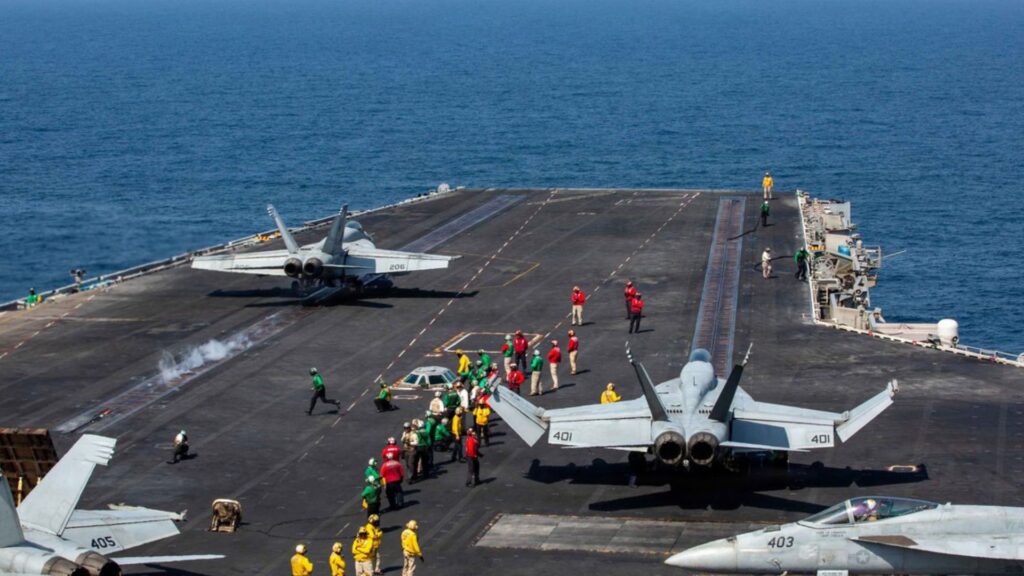
Recent satellite images show Iran reinforcing key nuclear and missile sites. The US is building up forces in the Middle East. The US-Israel has already launched strikes. The stakes are high.
The question is back at the center of global tension. Was Iran really building a nuclear bomb? Or is the threat being amplified amid rising military escalation?
Satellite Images Raise Fresh Questions
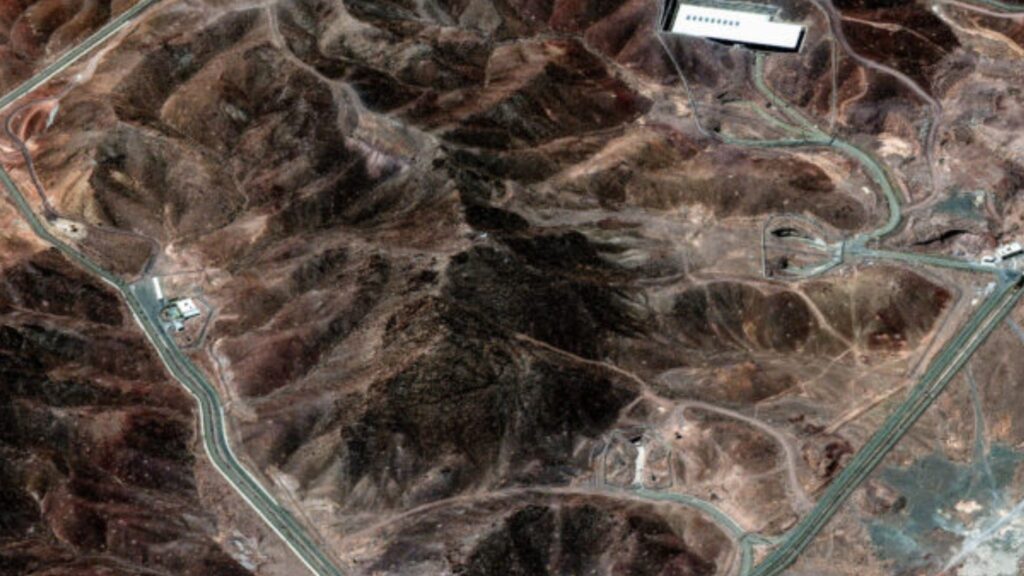
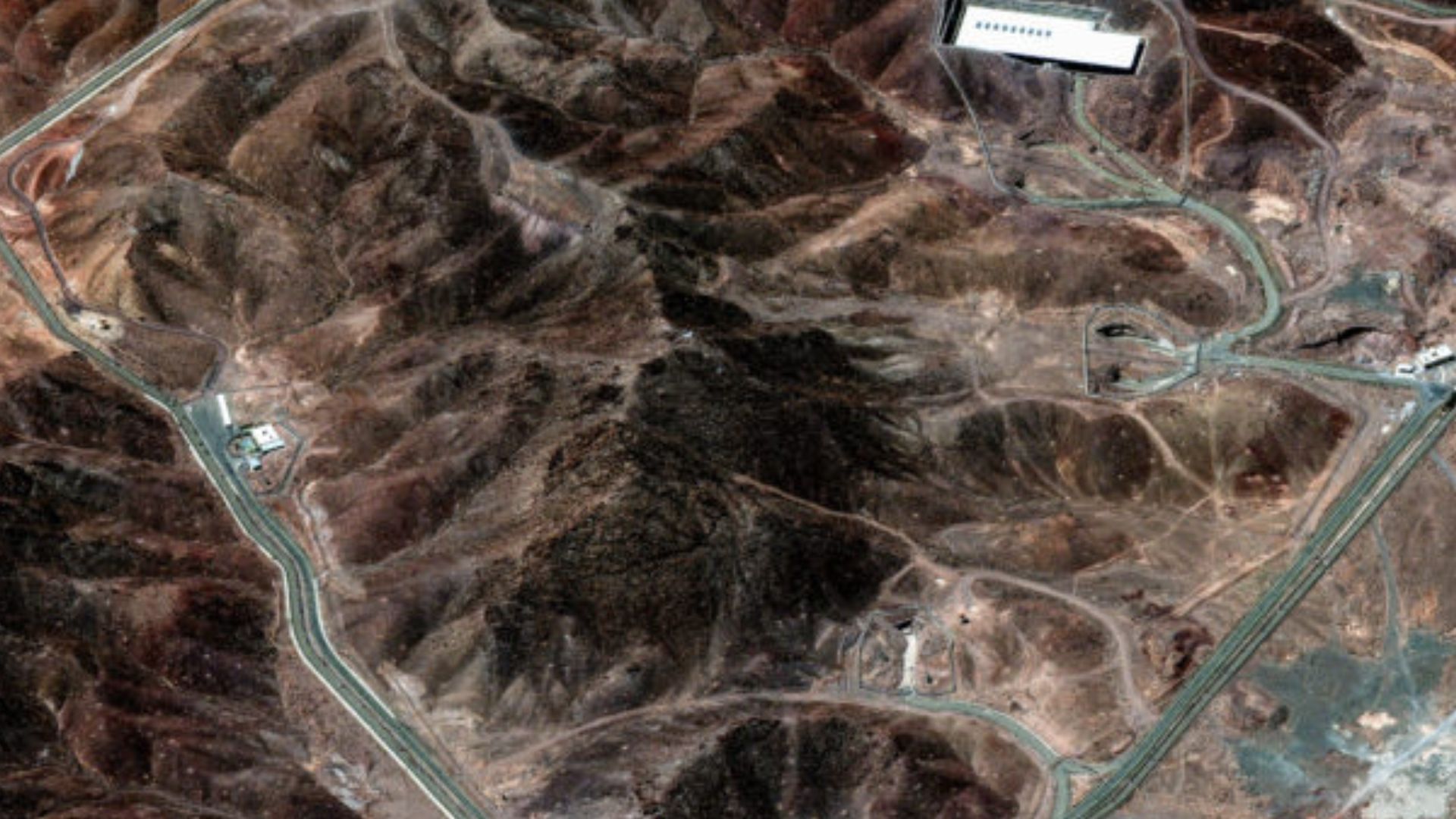
New satellite imagery revealed reconstruction and fortification work at several sensitive Iranian sites. Analysts said Iran was adding concrete shielding, burying tunnel entrances, and strengthening mountain facilities. These sites included Parchin, Isfahan, and areas near Natanz.
The moves came as Washington kept military options on the table and pushed Tehran to return to negotiations.
White House press secretary Karoline Leavitt said, “Iran would be very wise to make a deal with President Trump and with his administration.” She stressed that the US approach combines diplomacy with deterrence.
Parchin: A Concrete Shield Over a Sensitive Site
About 30 kilometres southeast of Tehran lies the Parchin military complex. It is known as one of Iran’s most sensitive defense sites. In the past, agencies claimed that explosive tests linked to nuclear weapons research were carried out there over two decades ago. Iran has always denied trying to build nuclear weapons.
In October 2024, Israel reportedly targeted the site. Satellite images taken before and after the strike showed heavy damage to a rectangular building inside the complex.
READ ALSO: https://modernmechanics24.com/post/uw-madison-nuclear-energy-future-tour/
But reconstruction began quickly. Images from late 2024 and early 2025 show steady rebuilding. By November, the skeleton of a large new structure had appeared, along with smaller nearby buildings. Weeks later, a metallic roof was installed over the facility.
WATCH: https://modernmechanics24.com/post/china-maglev-hits-700kmh-in-2-seconds/
By mid-December, the structure was partly hidden. By mid-February, it could no longer be clearly seen from above.
The Washington-based Institute for Science and International Security (ISIS) reported in January that Iran had built what it described as a “concrete sarcophagus” over the new facility, identified as Taleghan 2.
Earlier satellite images had shown a long cylindrical chamber inside the building. According to ISIS, it may be a high-explosives containment vessel. Such vessels are important in nuclear weapons development, though they can also be used for conventional military purposes.
Isfahan: Tunnel Entrances Sealed
The Isfahan nuclear complex is one of the three uranium enrichment sites targeted by the United States in June. It has also undergone major changes.
Apart from fuel-cycle facilities, Isfahan has underground storage areas where much of Iran’s enriched uranium stockpile has been stored.
READ ALSO: https://modernmechanics24.com/post/fission-power-moon-base-lunar-night/
Satellite images from late January show that Iran started filling two tunnel entrances with soil. By early February, a third entrance had also been sealed. According to ISIS, all tunnel access points were completely closed by February 10.
Experts say this step serves defensive purposes. Filling tunnel entrances can reduce the impact of air strikes. It can also make any ground operation more difficult, especially if the aim is to capture or destroy highly enriched uranium.
Near Natanz: Strengthening “Pickaxe Mountain”
Activity has increased near the Natanz nuclear facility, which houses two of Iran’s main uranium enrichment plants.
ISIS reports that satellite images show reinforcement work at two tunnel entrances in a mountain complex about two kilometres away. The site is informally called Pickaxe Mountain.
Since February 10, images show regular movement of dump trucks, cement mixers, and other heavy machinery. This suggests that Iran is strengthening underground structures to protect them from possible attacks.
Iran has not officially explained its plans for the facility. However, the scale and speed of construction suggest a clear effort to make key assets more secure.
Missile Bases: Repair Work Underway
Satellite images also show repair work at missile bases damaged during last year’s conflict.
Shiraz is identified by the Israel-based Alma research group as one of 25 main sites capable of launching medium-range ballistic missiles. South of the base, rebuilding is visible at a logistics and possible command compound. Comparing images from July 2025 and late January shows clearing and reconstruction activity.
WATCH: https://modernmechanics24.com/post/hyundai-atlas-humanoid-robot-win-prize/
William Goodhind said the compound has not yet fully returned to its operational level before the air strikes.
Further north, near Qom, another missile base suffered moderate above-ground damage. Satellite images from July 2025 and early February show a new roof placed over a previously damaged building. Repairs appear to have started in mid-November and were likely completed within about 10 days.
What Israel Claims
Israeli Prime Minister Benjamin Netanyahu had argued that Iran was moving toward a bomb.
After Israeli air strikes damaged facilities at Natanz Nuclear Facility, Netanyahu said Israel acted because, “If not stopped, Iran could produce a nuclear weapon in a very short time. It could be a year. It could be within a few months.”
The Israeli military said it had intelligence showing concrete progress in developing bomb components, including work related to a uranium metal core and a neutron initiator.
However, these claims have not been backed by publicly released detailed evidence.
What US Intelligence Says
The assessment from US intelligence agencies was more cautious. In March, US Director of National Intelligence Tulsi Gabbard told Congress that Iran’s enriched uranium stockpile is at its highest levels and unprecedented for a state without nuclear weapons.
But she also said, “The US intelligence community continues to assess that Iran is not building a nuclear weapon and Supreme Leader Ayatollah Ali Khamenei has not authorised the nuclear weapons programme that he suspended in 2003.”
READ ALSO: https://modernmechanics24.com/post/gene-edit-pig-liver-treat-liver-failure/
That statement is important. It suggests Iran has the capability to move quickly if it chooses. But it has not made the political decision to build a bomb. There is a difference between capability and intent.
The IAEA’s Findings
The International Atomic Energy Agency (IAEA) has investigated Iran’s nuclear activities for years.
A decade-long probe found that Iran conducted activities related to nuclear weapons research until 2003 under what was known as Project Amad. Some limited work may have continued until 2009.
But after that, the agency said it found no credible indications of an active weapons development programme.
Iran signed the 2015 nuclear deal, known as the JCPOA, agreeing to strict limits. It capped uranium enrichment at 3.67%, restricted centrifuges, and allowed international inspections.
However, then-US President Donald Trump withdrew from the deal in 2018. Sanctions were restored. Iran gradually breached enrichment limits in response.
Today, Iran enriches uranium up to 60% purity. Weapons-grade uranium requires about 90%. Technically, the gap is smaller than before. Politically, the step is massive.
Breakout Time vs. Building a Bomb
Experts often refer to breakout time. This means how long it would take Iran to produce enough fissile material for one bomb if it decided to do so.
Kelsey Davenport of the Arms Control Association said Iran has been at a near-zero breakout for months. But she added that there is no clear evidence that Iran is on the brink of weaponizing.
WATCH: https://modernmechanics24.com/post/india-drdo-akhash-ng-missile-success/
Producing fissile material is only one step. Building a deliverable nuclear weapon requires additional engineering, testing, and political authorization.
US intelligence agencies maintain that key weaponization work is not currently underway.
Damage from Israeli Strikes
Israel has targeted multiple nuclear-related sites. At Natanz, the IAEA confirmed that above-ground facilities were damaged, including centrifuge areas producing 60% enriched uranium. Electrical systems were hit. That likely disrupted operations.
At Isfahan, four buildings were destroyed, including parts of the uranium conversion facilities.
At Fordo Fuel Enrichment Plant, damage appears limited. The site is buried deep inside a mountain. It is heavily fortified.
IAEA Director Rafael Grossi said there was no change in off-site radiation levels.
But strikes can only slow infrastructure. They cannot erase technical knowledge.
Why Is Iran Fortifying Now?
Satellite images show Iran covering facilities with soil and concrete. Tunnel entrances are being sealed or reinforced.
This likely serves two purposes. First, protection from future air strikes. Second, safeguarding enriched uranium stockpiles from potential seizure or sabotage.
Defensive hardening does not prove offensive intent. But it signals that Tehran expects further attacks.
Was Iran Building a Nuclear Weapon?
Based on publicly available intelligence and IAEA assessments, there is no confirmed evidence that Iran is currently building a nuclear bomb.
However, Iran has expanded its uranium enrichment. It has reduced transparency. It has advanced centrifuge technology. This means it has shortened the technical pathway to a weapon if it chooses to move in that direction.
However, Iran insists its programme is peaceful and rooted in religious opposition to nuclear weapons.
There is no verified evidence that it has launched an active bomb-building programme. The evidence suggests preparedness, not proof of a bomb in production.