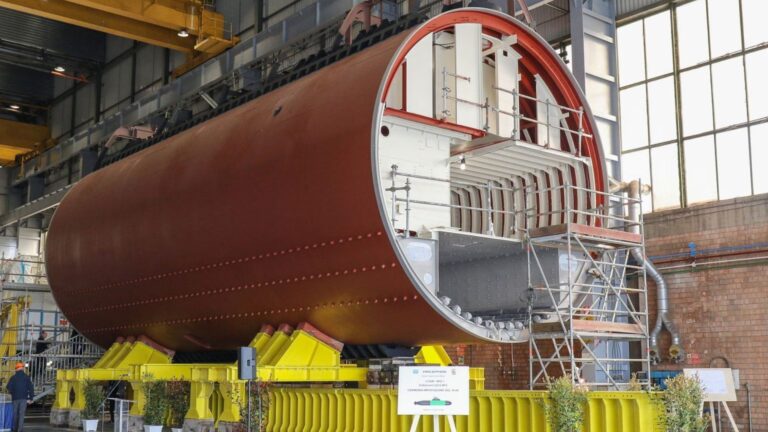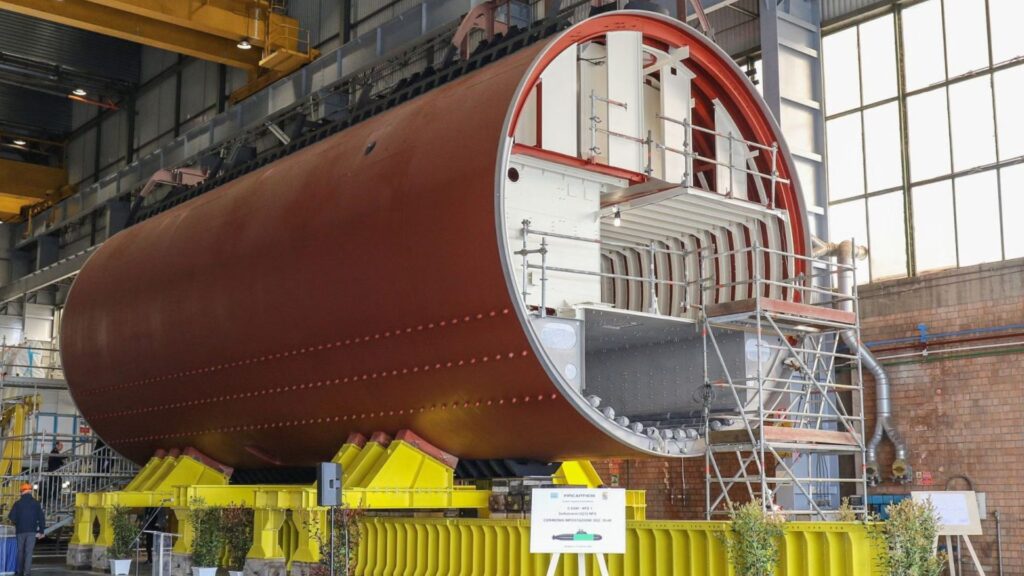
The French Navy has successfully started the nuclear reactor aboard its fourth Suffren-class (Barracuda-type) attack submarine, the De Grasse (S638), marking a critical step toward its entry into service. This milestone, known as “divergence,” was announced by the French Ministry of Defense on December 14, 2025, and transitions the vessel from construction to active testing, placing it on track for sea trials in the near future.
The moment of divergence is far more than a technical checkbox. It signifies the birth of the submarine’s independent power source—a controlled, self-sustaining nuclear chain reaction within its core. From this point forward, as detailed in the Ministry of Defense release, the reactor will be under the permanent, uninterrupted watch of nuclear propulsion officers until the submarine’s planned retirement in the 2060s. This nuclear heart, designed by the French Atomic Energy Commission (CEA), built by TechnicAtome, and integrated by Naval Group, must now perform flawlessly for decades beneath the world’s oceans.
The De Grasse is the fourth of six planned vessels in a program that is comprehensively modernizing France’s underwater fleet. These Suffren-class submarines are direct replacements for the aging Rubis-class boats, which have been in service since the 1980s. With a submerged displacement of 5,100 tons and a length of 99 meters, they represent a massive leap in capability. The lead boat, Suffren, was commissioned in June 2022, followed by Duguay-Trouin in April 2024 and Tourville in July 2025. The final two submarines, Rubis and Casabianca, are under construction for delivery by 2030.
READ ALSO: https://modernmechanics24.com/post/ice-csic-researchers-pioneer-study-on-the-real-world-feasibility-of-asteroid-mining/
So, what makes this class so formidable? It’s a blend of stealth, striking power, and advanced intelligence-gathering technology. Armed with torpedo tube-launched naval cruise missiles (MdCN), these submarines can strike targets hundreds of kilometers inland while remaining hidden. They carry a suite of other weapons, including F21 heavyweight torpedoes and Exocet SM39 anti-ship missiles. For special forces operations, they are equipped to deploy a Dry Deck Shelter, enabling the launch of swimmer delivery vehicles and approximately 15 commandos.
Perhaps the most significant advancements, however, are in the realm of sensors and situational awareness. The class features non-penetrating optronic masts by Safran Electronics & Defense, a disruptive technology that provides the crew in the combat information center with unmatched 4K imagery. Unlike traditional periscopes, these digital masts send data electronically, improving stealth and allowing multiple crew members to access the feeds simultaneously, vastly enhancing the boat’s intelligence, surveillance, and reconnaissance (ISR) capabilities.
The naming of this particular submarine carries historical weight. The De Grasse honors Comte de Grasse, the 18th-century French admiral whose fleet secured a decisive victory over the British at the Battle of the Chesapeake in 1781, a pivotal moment for American independence. It’s a name that evokes a legacy of naval power projection—a legacy this new, silent vessel is designed to uphold in the 21st century.
WATCH ALSO: https://modernmechanics24.com/post/transform-home-life-with-1x-neo-robot-1/
With the reactor now humming, the De Grasse will undergo extensive harbor and sea trials before joining its sisters in the French Navy’s strategic arsenal. Together, these six submarines are poised to form the vanguard of France’s undersea warfare capabilities for the next 40 years, a silent, nuclear-powered guarantee of national sovereignty and a potent asset on the global maritime stage.