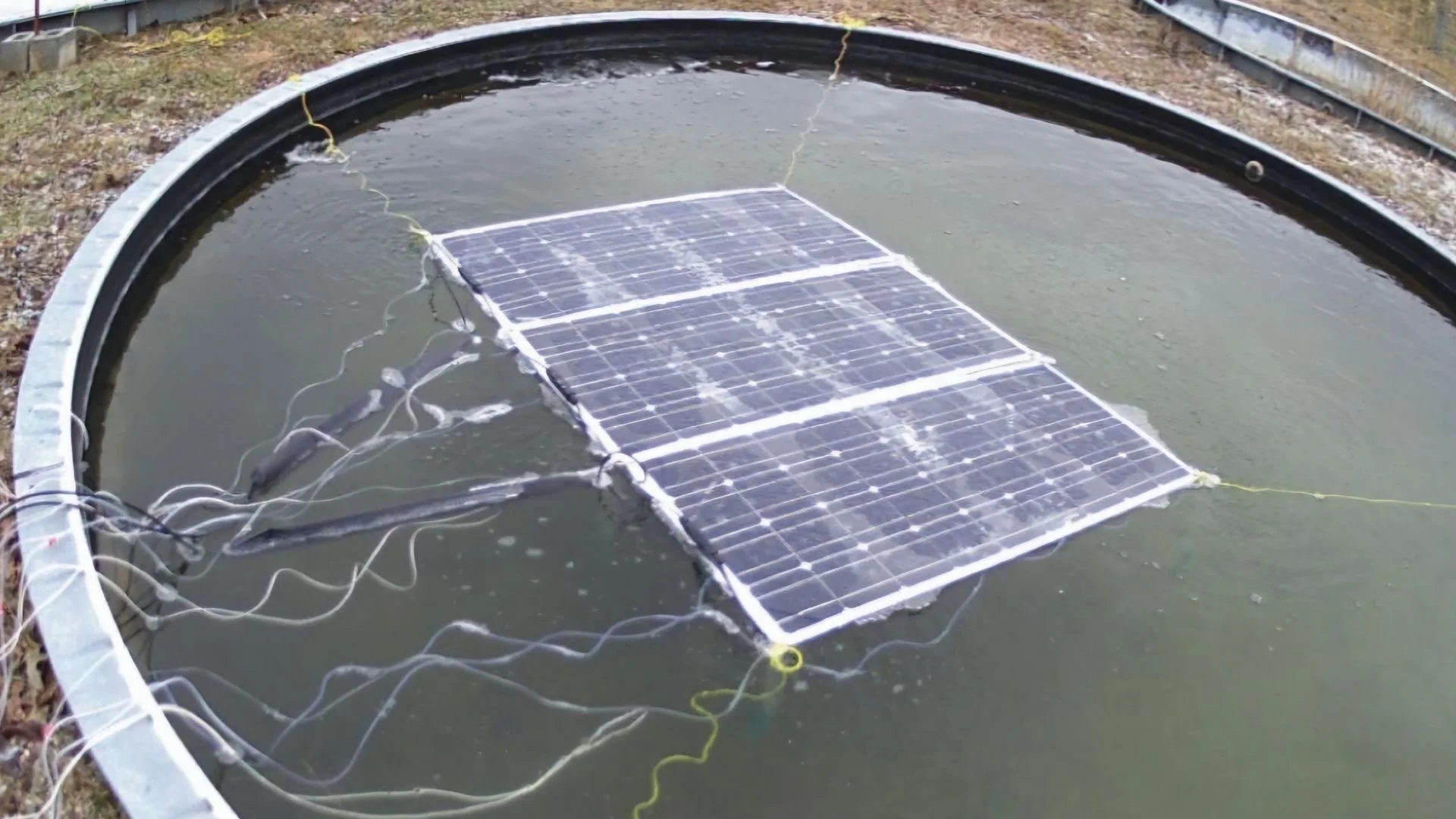
A floating solar power system tested in Canada has successfully operated through harsh winter conditions while remaining free of ice.
Researchers developed a new design that combines foam-backed solar panels with an air-bubbler system to prevent freezing. The year-long study showed that the technology generated reliable, clean electricity, improved performance, and helped reduce water loss from evaporation.
Floating Solar Panels Beat Cold
Floating solar technology is gaining attention as countries search for new ways to expand renewable energy generation. These systems place solar panels on reservoirs, ponds, lakes, and other water bodies, rather than using valuable land. The approach helps avoid conflicts with agriculture, urban development, and nature conservation.
One challenge has slowed the adoption of floating solar projects in colder regions. Experts have long worried that ice forming on water surfaces during winter could damage floating structures. Thick ice can strain support systems and reduce the reliability of solar installations.
Researchers at Western University in Canada set out to address this problem. Their goal was to develop a floating solar design that can withstand freezing temperatures without major performance losses. The project focused on developing a practical solution for regions that experience long, severe winters.
The team built a 7-kilowatt floating photovoltaic system and installed it on a stormwater pond in Ontario. The project served as a real-world test rather than a laboratory experiment. Researchers monitored the system continuously for an entire year.
READ ALSO: BMW and SOLARWATT Turn Neue Klasse EVs Into Smart Home Energy Storage Systems
Air-Bubbler System Keeps Ice Away
Unlike many floating solar projects, the Canadian design does not rely on large plastic floating platforms. Instead, flexible solar panels were attached directly to thick waterproof foam sheets. This created a lower-profile structure that sits closer to the water surface.
The flatter design offers several advantages. Wind has less impact on the panels compared with elevated systems that use tilted mounting structures. Lower exposure to strong winds can improve stability and reduce mechanical stress.
To prevent ice formation, the researchers installed air lines beneath the floating panels. A pump located onshore continuously pushed air through the system. The air escaped from the bottom of the pond as bubbles, rising toward the surface.
This process helps move slightly warmer water from deeper parts of the pond toward the surface. As the bubbles rise, they circulate water beneath the panels. The movement prevents ice from forming around the floating structure.
The system remained ice-free throughout the winter season. Researchers reported that the air-bubbler required very little energy to operate. According to the study, the additional energy consumption ranged from just 0.02% to 14.5% of the system’s annual electricity production.
Clean Energy Production and Water Savings
During the year-long trial, the floating solar installation generated 7.7 megawatt-hours of electricity. The system also performed better than a reference floating solar setup used for comparison. Researchers recorded an increase in energy production of approximately 2.7%.
The findings suggest that floating solar systems can remain productive even during cold weather. This is important because many northern regions have large bodies of water suitable for renewable energy projects. Successful winter operation expands the potential market for floating solar technology.
The panels delivered another important environmental benefit. By covering part of the pond, they reduced the water’s direct exposure to sunlight and wind. This helped lower the rate of evaporation.
READ ALSO: TUM Researcher Sarah Pappert Wins Global STEM Award While Exploring Supermassive Black Holes
Researchers estimated significant water savings if the technology were deployed on a larger scale. Covering half of the pond with floating panels could save around 927 cubic meters of water every year. Such savings could become valuable in regions facing water management challenges.
Floating solar projects are attracting growing interest worldwide. Governments and energy companies see them as a way to increase renewable power generation without consuming additional land. Large-scale installations are already operating in parts of Asia, Europe, and North America.
The Canadian study adds important evidence that floating solar systems can function effectively in icy environments. Previous concerns about winter ice have limited investment and deployment in colder regions. The new results provide a practical example of how those challenges can be managed.
The research was published in the journal Applied Energy. The team described the foam-based floating photovoltaic platform as adaptable and suitable for cold-weather conditions. They also highlighted the unique performance characteristics of flat-mounted solar panels on water.
Researchers now plan to test the technology on larger projects and across different types of water bodies. Future studies will examine how the design performs under a wider range of environmental conditions.