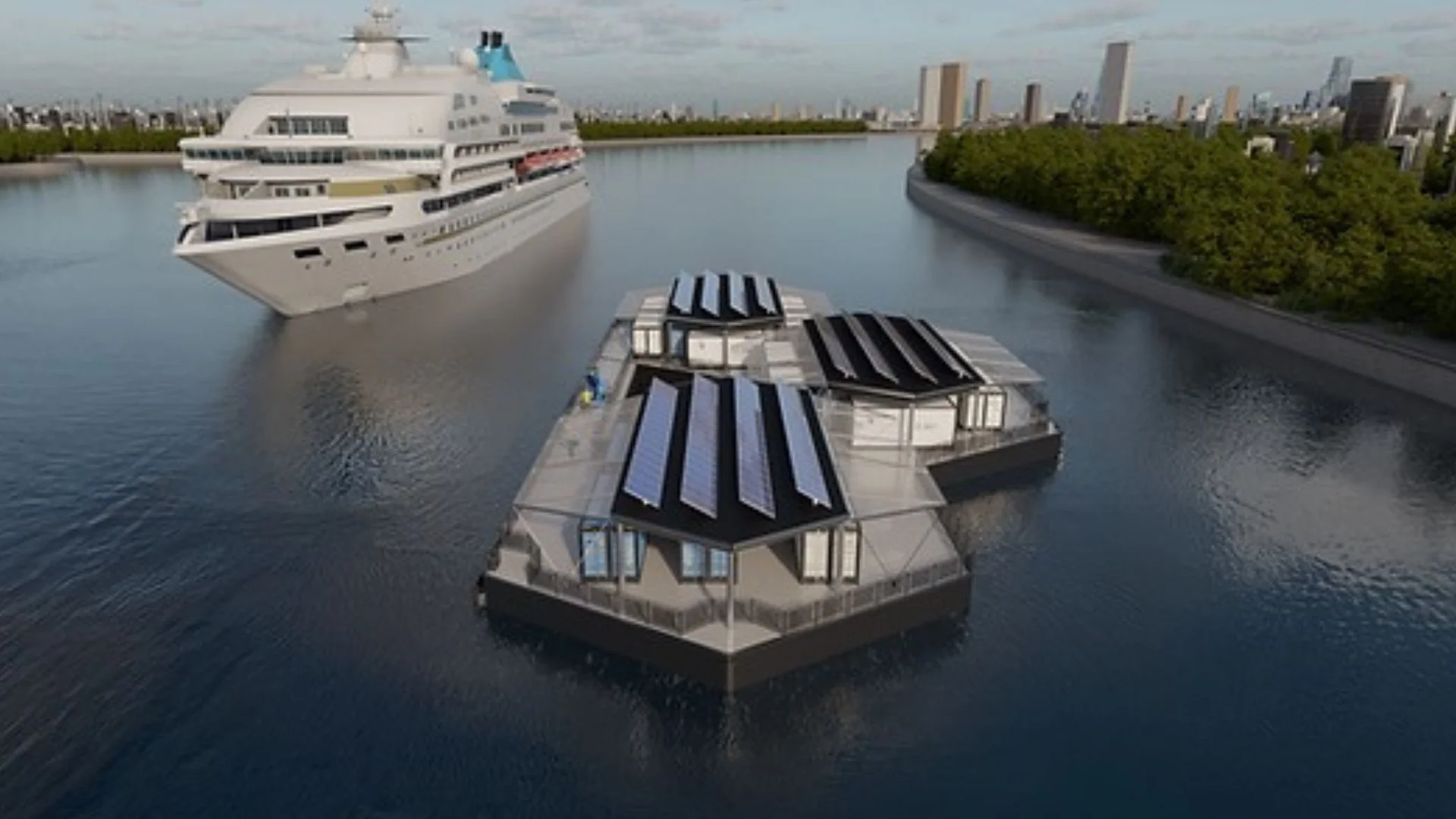
A UK-led consortium has completed engineering trials of a new floating hydrogen-powered platform designed to supply clean electricity to ships while docked.
The system removes the need for major port construction projects and grid upgrades. Developers say it is now ready for commercial deployment.
The platform is called the Hydrogen Power Hub. It was developed under the leadership of Elire Maritime. The project aims to help ports reduce emissions without waiting years for new infrastructure.
Many ports are installing shore power systems to allow ships to switch off their diesel engines while at berth. However, these projects often require extensive construction work. Permitting, grid improvements, and installation can take between three and seven years.
The new floating platform offers a different approach. It operates independently from the local power grid. Ports can deploy it directly alongside ships without rebuilding existing facilities.
The Hydrogen Power Hub consists of three connected hexagonal floating modules. Together, they cover around 1,200 square meters of water surface. The modular design also allows the platform to be moved if operational needs change.
At full capacity, the platform can provide up to 5 megawatts of continuous electricity. That amount of power is sufficient for many medium-sized cruise ships and other large vessels. It can deliver approximately 91 megawatt-hours of energy each week.
READ ALSO: NASA Successfully Acquires GPS Signals on Moon
The system relies on hydrogen fuel cells as its primary power source. Fuel cells generate electricity through a chemical reaction between hydrogen and oxygen. The process produces water as the only direct byproduct.
Several 1.3-megawatt modular fuel cells operate continuously on board the platform. These units slowly charge a large battery storage system. The battery bank has a capacity of 45 megawatt-hours.
When a ship arrives at the dock, the stored electricity can be delivered quickly. This approach works much like a giant rechargeable power bank. It allows vessels to access high levels of power without running onboard diesel generators.
The platform also includes a solar power system. The solar array can generate up to 146 kilowatts of electricity. While relatively small compared with the fuel cells, it helps support operations between hydrogen deliveries.
Hydrogen is supplied to the platform by support vessels. Refueling is expected to take place roughly twice each week. This setup allows the system to operate without depending on fixed fuel infrastructure at the port.
According to project data, the fuel cells consume between 7,500 and 8,000 kilograms of hydrogen each week. That hydrogen is converted into electricity for storage and distribution. The continuous operating model ensures power remains available upon ship arrival.
A key part of the project is a new hydrogen storage technology developed by Rux Energy UK. The company uses nanoporous materials to store hydrogen more efficiently. These materials contain extremely small pores that trap hydrogen molecules.
This storage method allows hydrogen to be held at lower pressures than many traditional systems. Lower-pressure storage can simplify handling and improve safety. It can also reduce some logistical challenges associated with hydrogen transport.
The consortium carried out extensive testing before declaring the design ready. Researchers at the University of Strathclyde conducted wave tank trials. These tests examined structural strength and performance under rough-sea conditions.
Additional reviews focused on electrical and safety systems. Schneider Electric and Ricardo plc independently assessed the platform’s design. Their evaluations confirmed that the system can operate off-grid and safely integrate hydrogen technologies.
The environmental benefits are one of the project’s main selling points. Ships at berth often keep auxiliary diesel engines running to power onboard systems. These engines produce carbon emissions and air pollutants near densely populated port areas.
Project developers estimate that the Hydrogen Power Hub can reduce emissions by about 77 percent compared with conventional diesel-powered operations. The system can also prevent around 47 tonnes of carbon dioxide emissions per ship each week. In addition, it eliminates much of the particulate pollution linked to diesel engines.
The economic picture is more complex. Electricity generated by the floating platform is currently more expensive than power from traditional grid connections or diesel systems. Estimated place costs between £0.25 and £0.50 per kilowatt-hour.
By comparison, electricity from grid power or diesel sources generally costs between £0.15 and £0.25 per kilowatt-hour. Despite the higher price, supporters argue that rapid deployment creates significant value. Ports can begin reducing emissions without waiting years for construction projects to finish.
WATCH ALSO: EHang’s next-gen autonomous eVTOL completes first public flight
The maritime sector faces growing pressure to reduce emissions. Governments and regulators are introducing stricter environmental requirements. Ports are searching for practical ways to meet these targets while maintaining normal operations.
Floating Hubs Reshape Shore Power
Floating energy systems provide flexibility that fixed infrastructure cannot always offer. The platforms can be relocated if shipping routes or port requirements change. This reduces the risk of expensive infrastructure becoming underused in the future.
The project received funding through the UK Research and Innovation Clean Maritime Demonstrator Competition Round 6. The program supports technologies that help reduce emissions across the shipping industry. The Hydrogen Power Hub is one of several efforts to accelerate maritime decarbonization.
Elire Maritime has already started discussions with ports in several regions. Early engagement includes ports in London, Singapore, Hamburg, Brisbane, and Riga. Many of these locations face increasing pressure to cut emissions while avoiding long construction delays.
WATCH ALSO: China commissions world’s largest open-sea offshore solar photovoltaic project
Luke Jenkinson, founder and chief executive of Elire Maritime, said the project has validated a practical and scalable way to deliver clean power directly where it is needed. The company believes the platform can help ports address environmental goals more quickly. The completed trials mark an important step toward commercial deployment.
As ports around the world seek cleaner and more flexible energy solutions, floating hydrogen power hubs are emerging as a new option. Their ability to deliver electricity without major construction projects could reshape how shore power is deployed. If widely adopted, the technology could accelerate the shipping industry’s transition to lower-emission operations.