

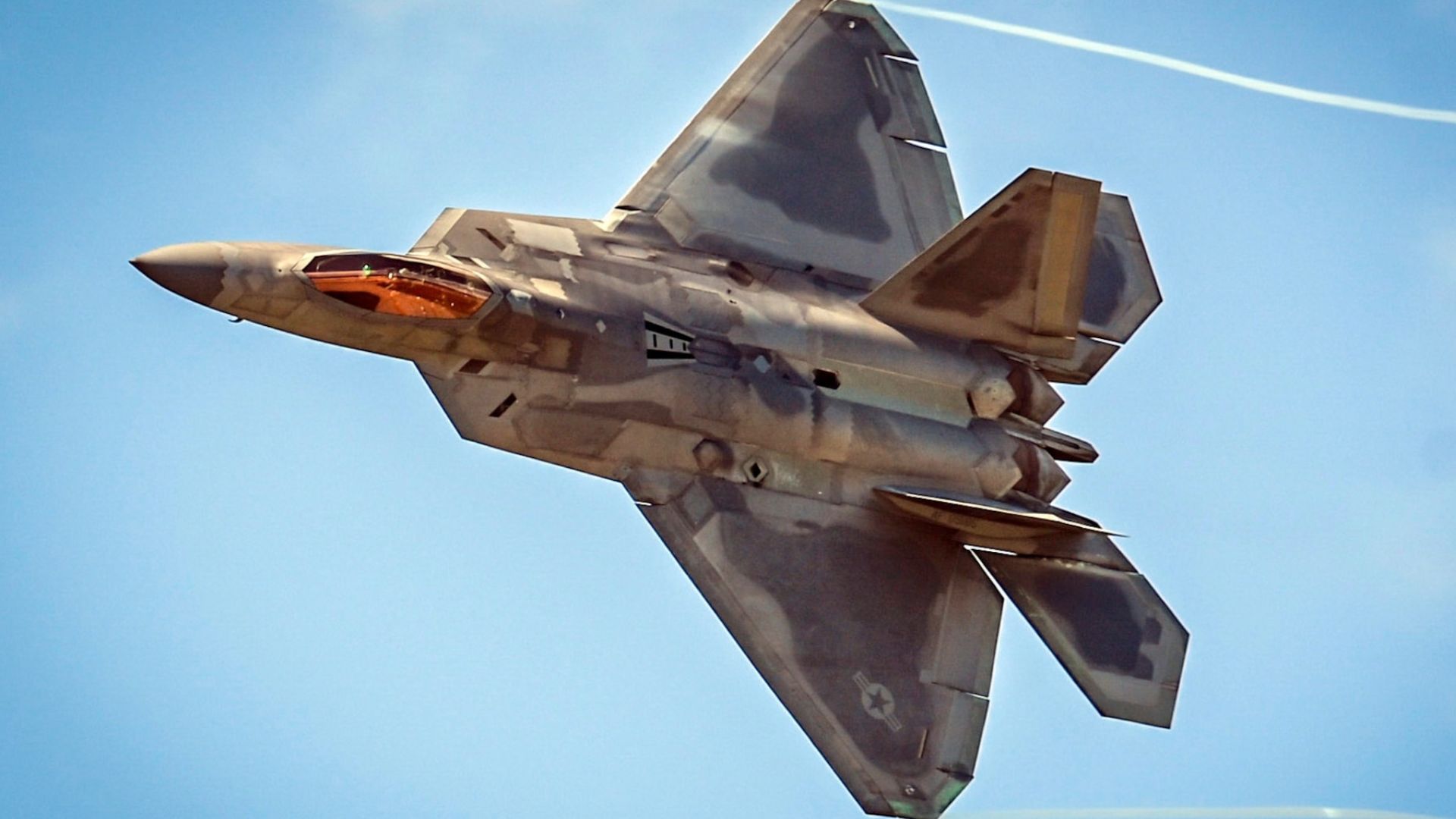
A US Air Force F-22A Raptor has been photographed carrying a pair of unusual low-observable sensor pods during aggressive flight activity near Edwards Air Force Base in California.
The imagery, shared by Mojave Planespotting, adds to a series of recent sightings of the same configuration and points to a more advanced stage of flight testing.
The exact sensors inside the pods have not been publicly identified, but their shape and visible features match efforts to expand the F-22’s passive sensing capabilities.
The latest photographs follow an earlier sighting on September 19. That aircraft carried the callsign FEVER21 and was photographed with two faceted pods under its outer wings. The aircraft also showed light-colored panels on parts of its underside, although their purpose remains unknown.
The timing is important because the Air Force’s F-22 Sensor Enhancements (SeE) program is scheduled to complete its current rapid-fielding phase in September 2026. A July 2026 assessment by the US Government Accountability Office said the program had faced hardware delays that reduced the time available for flight testing.
New Pods Face Harder Testing
The photographs provide a different view of the testing than earlier images.
The F-22 was seen making comparatively aggressive maneuvers while carrying the same type of external pods. The photographs do not reveal the aircraft’s exact speed, altitude, angle of attack or g-load, so they cannot establish the specific test objectives.
More demanding maneuvers expose external equipment to greater aerodynamic forces and vibration. They also provide an opportunity to examine how a sensor performs when the aircraft changes direction or attitude rapidly. For an infrared or electro-optical system, engineers can use such flights to examine issues such as sensor stability, alignment and line-of-sight performance.
This is different from simply checking whether the aircraft can carry a new piece of equipment. A sensor that works during steady flight must also remain useful when the aircraft is turning, accelerating or operating through changing airflow. The latest imagery, therefore, provides evidence of flight evaluation, although it does not by itself prove how close the system is to operational deployment.
READ ALSO: https://modernmechanics24.com/post/trump-says-raf-fairford-suspects-damage/
The pods have an angular design that appears intended to reduce their radar signature compared with conventional external equipment.
At least one earlier photograph appeared to show a transparent opening at the front of a pod, a feature that may be associated with an infrared or electro-optical sensor. The Air Force has not publicly confirmed the function of either pod or stated whether both contain the same equipment.
Passive Sensors Add Another Layer
An infrared search-and-track system (IRST) detects aircraft by their heat and infrared signatures. Unlike a conventional radar, a passive infrared sensor does not need to transmit a signal to search for an aircraft. This gives a fighter another way to detect and track targets while limiting its own electromagnetic emissions.
That distinction matters in heavily contested airspace. Radar remains a central sensor for modern fighters, but its transmissions can reveal the presence and activity of the aircraft using it. Passive sensors provide a different source of information and can be combined with radar, electronic-support systems and data received from other platforms.
The F-22 was designed around a combination of stealth, radar and electronic sensing. Adding another passive sensing channel would give its mission systems more information. It also fits a broader shift toward using multiple sensors and external data sources to build a single picture of the battlespace.
Passive sensing has limitations. Infrared performance can be affected by atmospheric conditions, background temperatures, and the target’s position. A passive sensor can also struggle to determine precise range on its own, which makes sensor fusion important for building an accurate track.
The Air Force has been developing the F-22 Sensor Enhancements program to extend the fighter’s ability to detect and track adversary aircraft. GAO said the earlier F-22 rapid-prototyping effort conducted six sensor-enhancement flight demonstrations in 2024, but the hardware used during those demonstrations operated separately from the aircraft’s other systems.
The next phase has focused on integrating the technology with the F-22. GAO reported in July that the first integrated flight test had moved from March to May 2026 after a subcontractor problem delayed a required hardware component. The delay reduced the time available for testing before the program’s planned September 2026 completion of its Middle Tier of Acquisition phase.
F-22 Program Moves Ahead
The Air Force has also been preparing for production while testing continues. GAO said the program had procured hardware in advance for 30 sensor-enhancement sets, even though flight-test data was still being collected. That approach creates some concurrency because changes identified during testing can affect hardware, cost and schedule.
The program was originally expected to move toward low-rate initial production during the fourth quarter of fiscal 2026. GAO said officials were considering whether the earlier hardware delay would affect that transition. The agency also reported manufacturing, workmanship and supply-chain issues as additional risks for the program.
The financial commitment is also substantial. In August 2024, the US Department of Defense awarded Raytheon a contract worth up to about $1.045 billion for Group B hardware, spare parts and support equipment under the F-22 Sensor Enhancements program. The work was initially scheduled to continue through May 2029.
The current external configuration is also part of a longer series of F-22 development activity seen during 2026.
Earlier imagery showed the aircraft with other low-observable external equipment, including configurations associated with sensor and fuel-carrying concepts. These developments suggest efforts to add capability without major changes to the basic F-22 airframe.
READ ALSO: https://modernmechanics24.com/post/us-navy-robotic-warfighting-center/
External equipment presents a design challenge for a stealth aircraft. Every pod, mounting point and surface junction can affect radar signature and aerodynamics. A low-observable pod is therefore intended to reduce that penalty, but photographs alone cannot establish how much signature reduction the design provides.
The light-colored panels visible on parts of the F-22’s underside raise another question. They may relate to instrumentation, replacement components, or experimental materials, but no public evidence confirms their purpose. They should, therefore, be treated as a separate unresolved feature rather than proof of a particular stealth technology.
The sensor pods should also not be confused with the F-22’s separate infrared defensive work. Lockheed Martin has previously worked on TacIRST technology intended to provide distributed infrared sensing for threat detection and survivability. The publicly available information does not establish that the external pods photographed near Edwards are part of that specific system.
Raptor Bridges Two Eras
The timing of the tests places the F-22 modernization effort alongside the development of the US Air Force’s next-generation F-47 fighter. The Air Force awarded Boeing the Engineering and Manufacturing Development contract for the F-47 in March 2025 as part of the Next Generation Air Dominance family of systems.
The Air Force says experimental aircraft supporting the program have already flown hundreds of hours to mature technologies involving stealth, range and autonomous systems. The F-47 is being developed with a focus on sensor fusion and the ability to incorporate new technologies as requirements change.
No public evidence shows that the F-22 pods photographed at Edwards are F-47 hardware.
It would, therefore, be premature to describe the Raptor flights as direct testing for the F-47. The more certain connection is that the F-22 remains a useful aircraft for testing sensors, software, external equipment and operational concepts before they are considered for wider use.
The F-22 can also provide a platform for examining how passive sensors work with other sources of information. This includes radar tracks, electronic-support data and information received from other aircraft or systems. Such integration matters when aircraft must manage their own emissions while maintaining awareness of surrounding threats.
A separate demonstration showed another aspect of this trend. Lockheed Martin reported that two F-16s equipped with Legion IRST systems exchanged information through a pod-to-pod link, allowing them to share passive sensor data.
That demonstration is not publicly linked to the F-22 pod tests, but it illustrates how passive sensing can move from an individual aircraft capability toward a networked system.
For the F-22, that approach would complement, not replace, its existing sensors. The fighter’s radar would remain important, while passive sensors could provide another source of target information. Data from other platforms could then add further information without requiring every aircraft to use its radar continuously.
The sightings fit into a larger F-22 modernization effort. Different flight configurations show the aircraft being used with equipment that differs from its standard operational appearance. GAO’s acquisition timeline provides further evidence that sensor-enhancement testing is part of an active program rather than an isolated aircraft modification.
The precise purpose of the pods remains the main unanswered question. The available imagery cannot confirm whether they contain identical infrared sensors, different sensor types, or supporting equipment for processing, communications or electronic warfare. It also cannot establish whether the light-colored underside panels are connected to the sensor program.
The latest photographs do show that the configuration has reached flight testing under more demanding conditions. The next stages will determine how the sensors perform across the F-22‘s flight envelope and how effectively their data integrates with the aircraft’s existing systems.











One Response