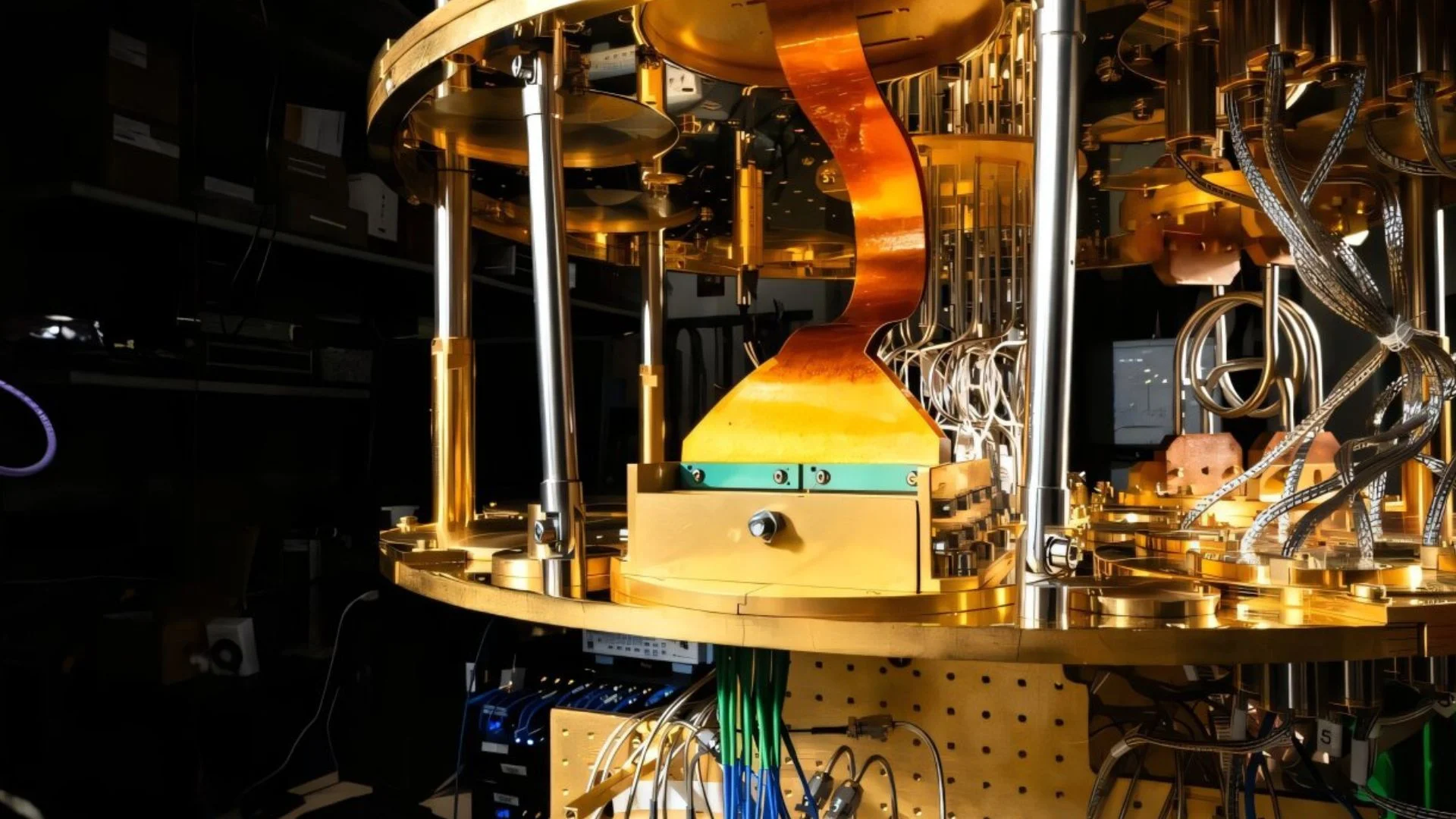
Researchers at MIT Lincoln Laboratory have developed a new type of flexible cryogenic cable designed for use inside dilution refrigerators.
These refrigerators are essential for operating many quantum computers because they create temperatures as low as 5 to 10 millikelvins. Such temperatures are even colder than those found in outer space and help protect delicate quantum bits, known as qubits, from thermal noise and instability.
Quantum computers rely on qubits to process information in ways that traditional computers cannot. However, qubits are extremely sensitive to heat and electrical interference. To function properly, they must operate in highly controlled cryogenic environments.
The new cable design addresses a growing challenge facing the quantum computing industry. As developers increase the number of qubits in their systems, the amount of wiring needed inside dilution refrigerators also rises significantly. Existing wiring solutions are becoming difficult to manage as quantum processors grow larger and more complex.
Why Traditional Quantum Wiring Faces Limits
Most quantum research systems currently use coaxial cables inside dilution refrigerators. These cables are reliable but have several drawbacks when used at scale. They are often bulky, rigid, and can introduce additional heat into ultra-cold environments.
READ ALSO: Georgia Tech’s COBALT Turns Smartphones Into Robotic Arm Controllers for Global AI Training
As quantum systems expand, thousands of cables may be required to connect processors, sensors, and control electronics. Managing large bundles of coaxial cables becomes increasingly difficult. The added heat load can also place greater demands on refrigeration systems, reducing overall efficiency.
To solve these issues, researchers at MIT Lincoln Laboratory explored alternative cable architectures. Their goal was to create a wiring solution that supports high signal density while maintaining low heat transfer and reliable performance at cryogenic temperatures.
The team selected a stripline-based design. In this configuration, conductive layers are placed between flexible polymer layers that help shield signals from electromagnetic interference. This structure reduces signal disruption and supports stable communication across different frequencies.
The resulting cables resemble flexible ribbons rather than traditional round cables. They can carry multiple signals simultaneously while occupying less space. Their design also supports direct-current applications without significantly warming the cryogenic environment.
According to John Cummings, principal investigator for the laboratory’s flexible cable project, another major advantage is manufacturing.
He explained that the cables can be produced using standard printed circuit board manufacturing techniques. This approach lowers production costs and simplifies installation compared with conventional cryogenic coaxial wiring.
From Research Prototype to Commercial Deployment
The technology has attracted the attention of Maybell Quantum, a Colorado-based company that develops hardware for quantum computing research and development. The company has licensed the cable design and is adapting it for use in its dilution refrigerator systems.
Maybell plans to integrate the ribbon-based wiring across all thermal stages of its refrigerators. Initially, the cables will support low-frequency functions, such as thermometry, heating, and sensing. The company also intends to study their suitability for additional applications in future systems.
Lasse Nielsen, strategy and operations lead at Maybell Quantum, said the company plans to incorporate the technology into future generations of its internal refrigerator wiring after qualification testing. He noted that the ribbon format offers strong mechanical durability and reduces the risk of damage during handling.
READ ALSO: NASA’s Pegasus Rover Set to Drive Artemis Astronauts Across the Moon’s South Pole
The flexible construction also improves manufacturing efficiency. Tasks that previously required several days of cable installation can now be completed in only a few hours. This improvement could help reduce production time and simplify maintenance procedures.
Cryogenic Wiring Gets Flexible
The development arrives as the quantum computing industry seeks to move beyond laboratory demonstrations and toward commercial deployment. Building larger quantum computers will require hardware that is easier to manufacture, maintain, and scale.
One of the biggest obstacles is creating infrastructure capable of supporting hundreds or even thousands of quantum chips. Reliable interconnect systems are a key part of that challenge. Without efficient wiring solutions, scaling quantum processors becomes increasingly difficult and expensive.
Maybell Quantum sees the new cables as an important step toward solving that problem. The company believes ribbon-based cryogenic wiring can improve production consistency, simplify upgrades, and support more modular system designs.
Kyle Thompson, founder and chief technology officer of Maybell Quantum, emphasized the importance of scalable interconnect technology. He said future quantum systems will require wiring capable of handling far more signals with greater reliability than current approaches allow.
WATCH ALSO: Swiss company’s new ‘brain’ to help robots conduct real-life tasks autonomously
The new cable technology highlights how advances in supporting hardware are becoming just as important as advances in quantum processors themselves. While much attention focuses on qubits and algorithms, practical engineering solutions will play a key role in bringing quantum computing into mainstream use.
As quantum computers continue to grow in size and capability, innovations in cryogenic infrastructure are expected to become important. Flexible ribbon cables could help create the reliable, scalable hardware foundation needed for the next generation of commercial quantum computing systems.