China’s mysterious Nantianmen Project unveiled hypersonic fighter jets, colossal space carriers, autonomous drone swarms, and tactical robots.
Named as “Southern Celestial Gate,” the project emerged as one of the most intriguing blends of science fiction and military speculation in recent years. It sparked global debate: is it a visionary entertainment franchise, a patriotic technology showcase, or a subtle preview of future warfare?
The Nantianmen Project was launched in 2017 by a subsidiary of the state-owned Aviation Industry Corporation of China (AVIC). It was originally introduced as an aviation-themed intellectual property (IP).
But its unusually high-profile presence at major Chinese air shows, with full-scale mock-ups displayed alongside real military hardware, blurred the line between fiction and strategic signaling.
At face value, the Nantianmen Project is built on a science fiction storyline set in 2043. Humanity faces existential threats from extraterrestrial forces and geological disasters triggered by silicon-based life forms beneath Earth’s crust. After contact with alien technology, the US launches an interstellar expedition program that ultimately collapses.
READ ALSO: https://modernmechanics24.com/post/ai-helps-kidnapped-robots-find/
China, meanwhile, establishes a lunar base and develops an integrated Earth–Moon defense system under “Project Nantianmen.” It was named after the heavily guarded gate to the Celestial Court in Chinese mythology. The novel adaptation, published in 2022, was written by Wu Jun under the pen name Yelanghuan, a popular military sci-fi author.
While the book concludes with a united humanity achieving victory under Chinese leadership, the narrative itself is secondary. The real fascination centers on the speculative weaponry embedded in the storyline, i.e., more than 100 futuristic platforms detailed in artbooks, blueprints, and exhibition models.
From Artbook to Airshow
In April 2025, an official Nantianmen Project artbook by illustrator Wei Tianhe catalogued dozens of advanced platforms with intricate schematics. What elevated the project from fiction to global attention was its physical debut at China’s premier defense exhibitions.
At the 2024 Zhuhai Airshow, a model of the fictional “Baidi” stealth fighter appeared on display near the debut of China’s real fifth-generation Shenyang J-35A aircraft. The positioning fueled speculation, particularly as sightings of China’s sixth-generation prototypes surfaced weeks later.
Similarly, at the 2025 Tianjin helicopter expo, a mock-up of the Zihuo vertical take-off and landing (VTOL) craft was displayed in a setting that closely resembled a real aerospace product launch. The staging left many observers questioning whether the line between imagination and prototype was thinner than advertised.
WATCH ALSO: https://modernmechanics24.com/post/china-sets-maglev-700kmh-record/
State broadcaster China Central Television further intensified the debate in January, describing the project’s designs as reflecting reality. Military analyst Wang Zhiming said that the question about these technologies is not if they can be achieved, but which will come first and when they will be fully realised.
Hong Kong-based defense commentator Song Zhongping said that some elements, including hypersonic weapons and particle-beam systems, are already under development in various forms worldwide. He described the Nantianmen concept as part of a tiered pipeline of frontier exploration, advanced concept research, systematic development, and production. Hardware: Aerospace Carriers, Hypersonic Fighters.
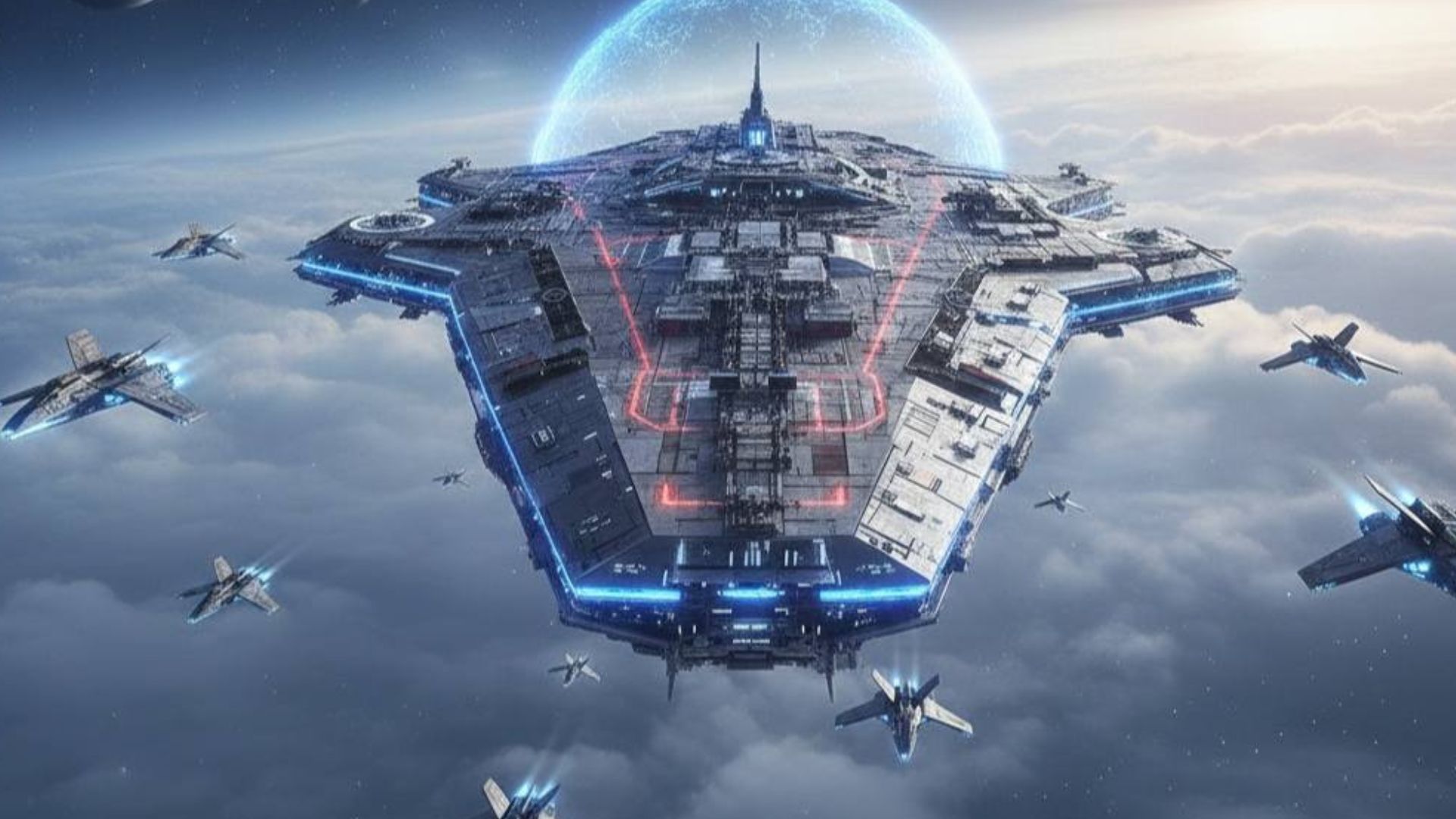
The Nantianmen narrative has three flagship platforms: the Luanniao aerospace carrier, the Xuannu fighter, and the Chengying tactical robot ecosystem.
Luanniao Aerospace Carrier
Named after a mythical bird, the Luanniao is envisioned as a strategic aerospace carrier. It can operate in Earth’s atmosphere and in orbit. It boasts a 682-meter wingspan and is powered by nuclear fusion reactors that power dozens of hybrid engines. The carrier can reportedly deploy 88 Xuannu fighters in a single orbital insertion mission.
Though purely fictional, the concept aligns with real-world discussions about reusable space planes, orbital logistics systems, and high-altitude launch platforms.
Xuannu Hypersonic Fighter
The Xuannu is known as the ‘Mystic Lady.’ It is designed as a hyper-manoeuvrable aircraft capable of exceeding Mach 8 and sustaining extreme G-forces. It exists in both manned and unmanned variants and operates within a Manned-Unmanned Teaming (MUM-T) structure, where a pilot commands autonomous drone companions during missions.
Features include adaptive engines, full-spectrum stealth, modular payload systems, and variable-geometry wings. These traits mirror ongoing research into sixth-generation fighter programs across multiple global powers.
READ ALSO: https://modernmechanics24.com/post/kim-jong-un-unveils-nuclear-rocket/
Chengying Tactical Robot Ecosystem
The Chengying system resembles a giant humanoid mech at first glance, but it functions as a coordinated combat ecosystem. A central manned ‘Shadow Bearer’ command unit directs various unmanned ground robots for reconnaissance, communications, and combat support.
If command links are severed, swarm intelligence algorithms enable autonomous coordinated attacks. The project also features the Langzhu Tarantula, a six-legged transport and construction robot capable of traversing rugged terrain with track-assisted propulsion.
Technology Trends or Propaganda Strategy?
The Nantianmen arsenal incorporates emerging technological themes such as hypersonic flight, directed-energy weapons, metamaterial stealth, AI-driven battlefield decision-making, reusable space-to-Earth systems, and morphing airframes and adaptive propulsion.
Brandon Weichert, a senior editor at The National Interest, compared the concept to the Reagan-era Strategic Defense Initiative. He also warned that while the project may function as a brilliant propaganda push, it could also stimulate real technological spin-offs.
“The US should keep an eye on it,” Weichert said. “Not necessarily because it will enter service soon, but because the frontier technologies involved will move forward at a staggering pace.”
WATCH ALSO: https://modernmechanics24.com/post/ehang-next-gen-evtol-first-public-flight/
Corporate Connection
The Nantianmen IP is owned by Avic Global Culture Technology Co, a subsidiary under AVIC’s cultural branch. Established in 2014, the company initially focused on media production, exhibitions, and cultural exchange. In 2025, it rebranded and expanded operations. It also handles the construction of large-scale Nantianmen-themed parks in Shanghai and Meizhou.
The Meizhou base covers 1,600 square meters. It replicates the interior of a fictional aerospace carrier and features interactive combat missions. The Shanghai facility is set to open in 2027. It will coincide with the 100th anniversary of the People’s Liberation Army. It will span more than 80,000 square meters and include immersive lunar base and deep-space battle set environments.
Strategic Space Rivalry
The project unfolds amid intensifying US–China competition in outer space. General B. Chance Saltzman, head of the US Space Force, repeatedly warned that Beijing is investing across the full spectrum of space weapons. It includes directed-energy, radio-frequency, and kinetic systems.
Although Washington has not formally scrutinized the Nantianmen Project, it fits into a broader narrative of technological ambition and space-domain dominance.
READ ALSO: https://modernmechanics24.com/post/china-overtakes-us-in-hypersonic-arms/
Blueprint or Branding?
For now, there is no physical evidence that Nantianmen is an operational weapons program. It remains an intellectual property franchise with commercial and cultural ambitions.
But its strategic timing, state-linked ownership, and alignment with real aerospace trends are beyond mere fantasy.
No matter whether the Nantianmen Project is a sophisticated branding exercise, a patriotic educational tool, or an early-stage conceptual roadmap, it reflects that the future of warfare lies at the intersection of space, AI, and hypersonic technology.