

China has provided its clearest public indication yet that it is developing an airborne laser system for advanced fighter aircraft.
A display at a defence electronics exhibition in Beijing showed a laser-weapon tracking and aiming system alongside an illustration identified by analysts as the J-36, an aircraft associated with China’s sixth-generation fighter programme.
The system’s advertised specifications suggest work on a high-power airborne directed-energy weapon, although there is no public evidence that it has been installed or flight-tested on a fighter.
The system was displayed by the Aviation Industry Corporation of China (AVIC) Beijing Precision Engineering Institute for Aircraft Industry at the 14th China International Defence Electronics Exhibition.
READ ALSO: https://modernmechanics24.com/post/volkswagen-id-buzz-ev-guinness-record/
The event took place in Beijing from September 15 to 17 and brought attention to technologies designed for military aircraft and electronic systems. Social media images from the exhibition showed a poster describing a “fighter aircraft laser-weapon tracking and aiming system.”
The display listed the system’s weight as less than 380 kilograms, or about 838 pounds. Its transmission power appeared as ‘00kW,’ with part of the figure hidden, while its dynamic tracking accuracy was shown only as ‘μrad (RMS)’ – microradians Root Mean Square. The missing figures prevent an exact assessment of the system’s performance.
The power figure is significant because the visible format suggests a rating of at least 100 kilowatts if the obscured character represents a single digit.
A laser weapon also needs more than a powerful laser source to work effectively from a moving aircraft. It requires a tracking system that can keep the beam accurately focused on a target despite vibration, turbulence and rapid changes in aircraft position.
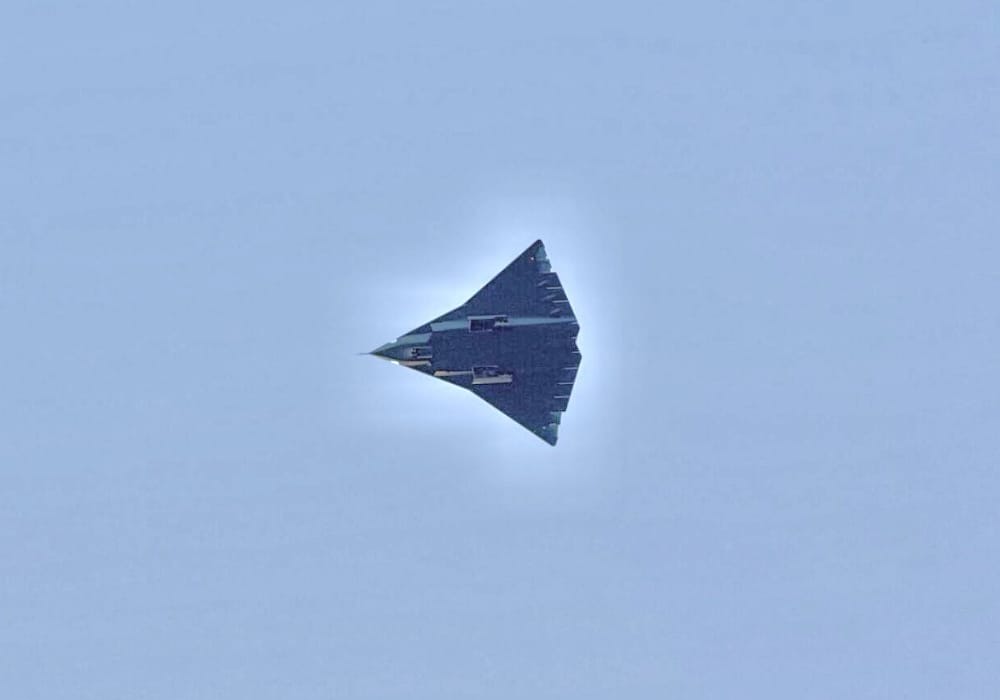
The poster showed the system beside an image of a large, tailless aircraft. Andreas Rupprecht, an author and researcher who tracks Chinese military aviation, identified the aircraft as the J-36, the unofficial designation used for a three-engine aircraft first seen flying near Chengdu in December 2024. The aircraft is widely associated with a sixth-generation fighter project being developed by Chengdu Aircraft Corporation, another company under state-owned AVIC.
Why Tracking Matters
For an airborne laser, aiming is as important as generating the beam itself. The system must identify a target, track its movement and keep the laser pointed at a precise location for long enough to produce the desired effect. Even a small error can cause the beam to move away from a vulnerable part of the target.
Mark Cazalet, editor-in-chief of international defence news organisation Warsight, said the exhibition illustration appeared to show a J-36. He also said the aircraft appears to have enough space, weight capacity and power to accommodate a high-energy laser, noting that larger aircraft generally provide more room for such equipment.
WATCH ALSO: https://modernmechanics24.com/post/deep-humanoid-robot-stair-climbing/
The 380-kilogram figure, however, needs careful interpretation. Cazalet said it may cover the beam director, laser source and cooling equipment, but the exhibition material did not establish exactly which components were included.
It also did not disclose the system’s electrical power requirements, an important factor because high-energy lasers need substantial power and thermal management.
The system’s possible role is another unresolved issue. An airborne laser does not necessarily need to destroy an aircraft or missile by burning through its structure. At longer distances, a laser may instead target optical sensors and interfere with the seeker used by an incoming missile to locate its target.
At shorter ranges, a sufficiently powerful beam can potentially damage physical components. Cazalet said lasers are generally limited by range when used to destroy physical targets, with several kilometres being a typical scale, while optical sensors can be affected at greater distances.
China’s Earlier Airborne Work
China has shown interest in airborne laser technology for several years. In 2020, procurement notices from the People’s Liberation Army sought suppliers for an ‘airborne laser attack pod’ and control software intended for a ‘laser attack platform.’ A military programme linked to China’s state broadcaster CCTV also reported work on a prototype airborne laser and cited research involving energy storage and power supply.
Chinese researchers have also examined the problem of maintaining laser accuracy while an aircraft is moving. In 2021, a study used flight data from a transport aircraft to simulate how an airborne laser system could maintain accurate tracking despite aircraft movement and vibration. Such work addresses one of the main engineering problems involved in converting a ground-based laser into an airborne weapon.
AVIC has separately reported tests involving directed-energy tracking technology. A China Aviation News report published in July said researchers at the Beijing institute developed and field-tested a tracking system within a year.
The report described a test conducted in March 2024. During the trial, the system maintained a lock on a drone while conditions included clouds, birds and increasing distance from the target. Later versions were reportedly tested on several platforms, but the report did not identify those platforms or connect the trials directly with the fighter aircraft laser system shown at the recent exhibition.
READ ALSO: https://modernmechanics24.com/post/gtri-classified-us-space-force/
The Missile Defence Challenge
The potential use of an airborne laser against missiles is closely linked to the changing range of modern air combat weapons.
The US is developing or fielding long-range air-to-air missiles including the AIM-174B and AIM-260, while the AIM-424 has also been associated with future long-range air combat capabilities. A defensive laser could provide another layer of protection if it can detect, track and engage an incoming weapon quickly enough.
Such a system would differ from conventional defensive measures. Fighters normally rely on electronic warfare, decoys, manoeuvring and interceptor weapons to counter incoming missiles. A laser would use directed energy instead, allowing the aircraft to engage a target without launching another missile.
The concept has already faced major technical obstacles in the United States. The US Air Force’s Self-protect High Energy Laser Demonstrator (SHiELD) was designed to examine whether a pod-mounted laser could protect fighters from incoming air-to-air and surface-to-air missiles.
The programme encountered difficulties caused by wind, turbulence and rapid aircraft manoeuvres. Programme manager Jeff Heggemeier described these conditions as among the major technical problems facing the project, and the programme ended in 2024 without a laser pod being mounted on a fighter test aircraft.
That experience provides useful context for interpreting the Chinese display. Showing a tracking and aiming system at an exhibition demonstrates development activity, but it does not establish that a complete operational laser weapon exists or that it can defeat incoming missiles in flight.
The technology may also have applications beyond fighter aircraft. Large bombers, transport aircraft and airborne early-warning platforms have more room for power systems, cooling equipment and beam-control hardware. If China succeeds in reducing the size and weight of the technology, such platforms could become potential candidates for future directed-energy systems.
For now, the Beijing exhibition provides evidence of an active Chinese research effort rather than confirmation of an operational fighter-mounted laser. The obscured specifications, unclear equipment weight and absence of public flight-test evidence leave major questions about range, power, cooling, targeting speed and effectiveness against real missiles.
Further testing and future disclosures will determine whether the system moves from an engineering project shown at an exhibition to a practical defensive weapon for China’s next generation of military aircraft.









One Response