

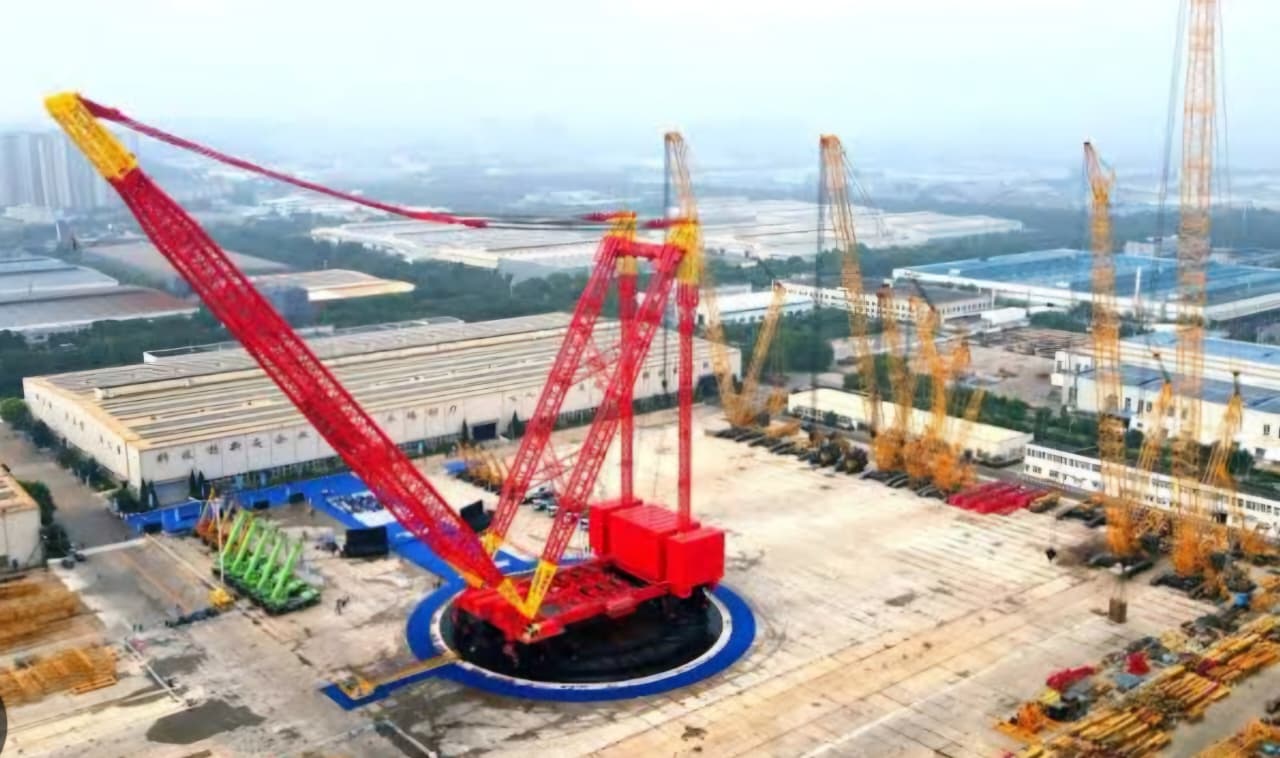
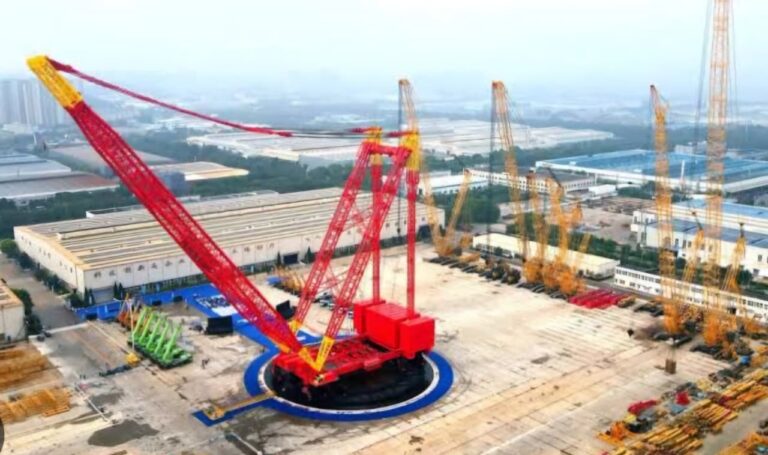
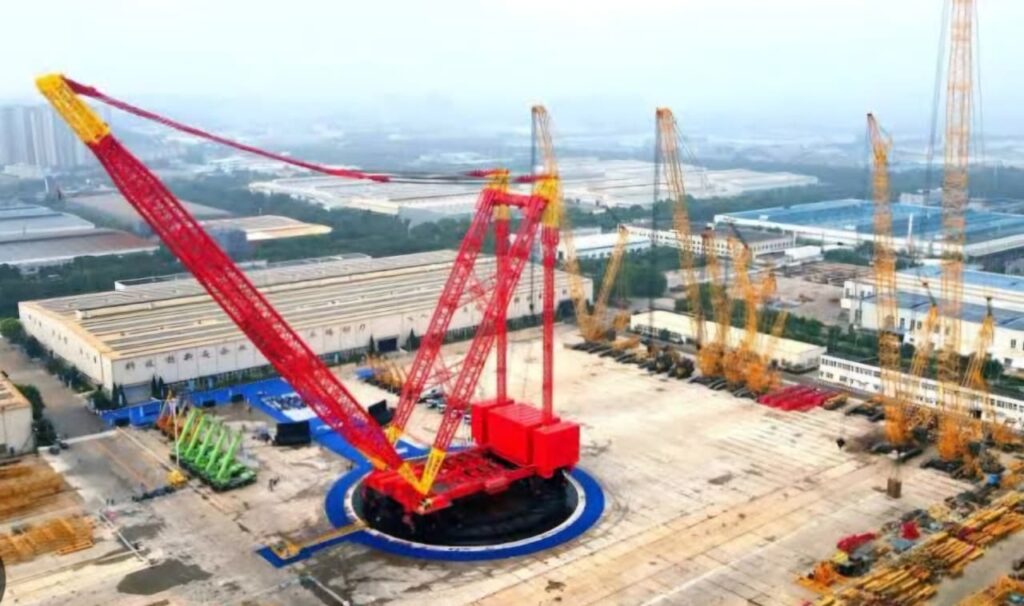
China has completed a giant ring-rail crane designed to support the construction of its next generation of Hualong One nuclear power plants.
China General Nuclear (CGN) says the 250,000-tonne-metre machine will support Hualong One 2.0 projects and is designed to handle heavy lifting for two reactor units from a single position.
The crane combines ultra-long booms, electric drive systems and digital safety tools to reduce construction time and operating costs.
The crane recently rolled off the production line at Sany’s Huzhou Industrial Park in Zhejiang province.
It was jointly developed by Sany Heavy Machinery and China Energy Engineering Guangdong Thermal Power Special Equipment Co Ltd. CGN said the project followed seven years of research into the design, manufacturing and assembly of ultra-large nuclear lifting equipment.
The machine uses two ultra-long boom configurations measuring 137 metres and 66 metres. Its maximum operating height reaches 207 metres, allowing it to work around large nuclear power plant structures. CGN said its lifting capacity at large operating radii is about 50% higher than that of comparable foreign products.
READ ALSO: https://modernmechanics24.com/post/deltaquad-evo-le-drone-8-hour-flight/
The crane is designed for the ‘one machine, two islands’ arrangement used for Hualong One 2.0 construction. In this configuration, one ring-rail crane is positioned between two nuclear islands. From that position, it can lift modules and major equipment for both reactor units without requiring a second crane position.
Electric System Cuts Costs
The crane uses a fully electric drive system instead of conventional oil-powered equipment. It can connect directly to a 10kV industrial power supply, which the developers say eliminates direct emissions during operation and reduces noise at the construction site. The design also aims to simplify energy supply during long construction activities.
Project calculations indicate that using the crane may shorten nuclear plant construction schedules by about 15%. The same estimates put its operating costs at roughly one-quarter of those associated with traditional oil-fired lifting equipment. Site costs are expected to fall by about 20%, while logistics costs may decline by around 30%.
These figures are based on project calculations rather than completed operating results. They show the economic case behind using one large electric crane across two reactor construction areas. The approach also reduces the need to reposition heavy lifting equipment during different stages of construction.
Digital Tools Add Safety
The crane also includes several digital systems designed to support safer lifting operations.
These include intelligent anti-collision technology and a 360-degree surround-view system that gives operators a wider view around the machine. Remote fault diagnosis is included to help identify equipment problems without requiring every issue to be inspected directly on site.
A cable-tangling detection system monitors another potential source of operational risk. Facial recognition and work-behaviour recognition systems are also installed as part of the crane’s digital control and monitoring functions. Together, these systems are intended to improve risk detection and support protective measures during heavy lifting work.
The crane is intended to meet lifting requirements under a single operating condition and from one station. That feature is particularly relevant to the two-reactor layout planned for Hualong One 2.0 projects. It allows the equipment to cover both nuclear islands while maintaining a fixed position on the ring rail.
WATCH ALSO: https://modernmechanics24.com/post/spacex-falcon-9-successfully-lands/
Hualong One 2.0 Moves
The new crane is being introduced as China expands its nuclear construction programme. On July 31, the Chinese State Council approved three pairs of Hualong One reactors at the Jinqimen, Taipingling and Zhuanghe sites, along with two Guohe One CAP1400 reactors at the Laiyang site.
The Jinqimen Phase II units, numbered 3 and 4, in Zhejiang, and the Taipingling Phase III units, numbered 5 and 6, in Guangdong, have been designated as demonstration projects for Hualong One 2.0. CGN said the new crane will be used first at Taipingling Phase III and later at other Hualong One 2.0 projects.
Hualong One 2.0 builds on China’s HPR1000 reactor technology and incorporates lessons from the construction and operation of existing Hualong One plants.
It is described as an advanced pressurised water reactor design that combines third-generation technology with further technical developments. The design has been developed through domestic research and broader cooperation across China’s nuclear industry.
According to the information provided by CGN, 10 Hualong One reactors are already commercially operating in China and overseas. Another 37 units have received approval for construction, giving the technology a growing role in China’s domestic nuclear programme and its international reactor projects.
The introduction of the 250,000-tonne-metre crane links the development of the reactor design with changes in construction equipment. Its deployment at Taipingling Phase III will provide an early test of the one-machine, two-islands construction approach for Hualong One 2.0.


One Response