The first human mission to travel around the Moon in more than fifty years has successfully returned to Earth. The crew of NASA’s Artemis II test flight completed a historic journey, marking a major step toward sending humans back to the lunar surface.
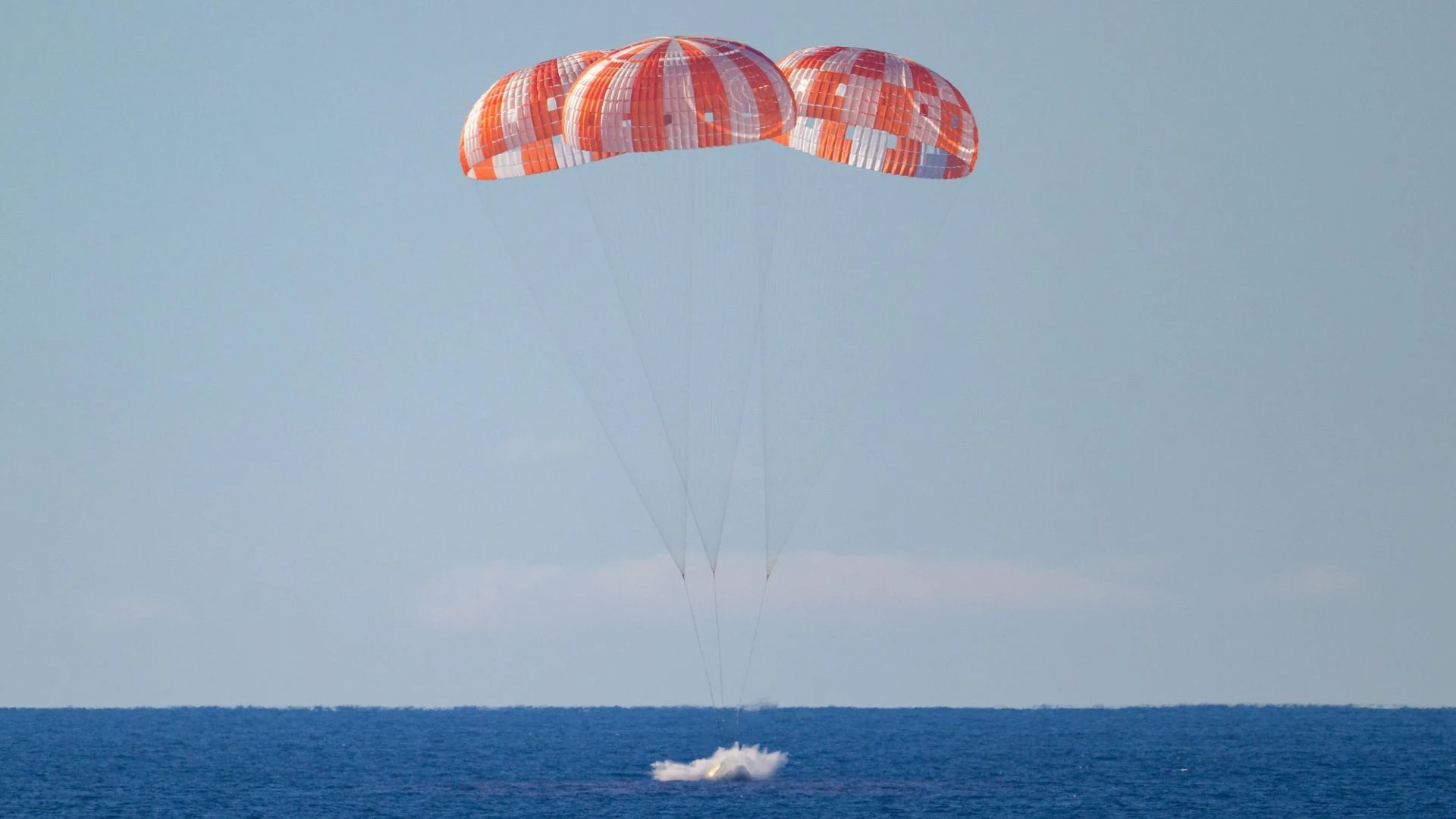
Four astronauts, Reid Wiseman, Victor Glover, Christina Koch, and Jeremy Hansen, returned safely after a mission that lasted nearly ten days. Their spacecraft splashed down in the Pacific Ocean at 5:07 p.m. PDT on Friday, just off the coast of San Diego.
The mission pushed the limits of human space travel. At its farthest point, the crew reached a distance of 252,756 miles from Earth. In total, they traveled an incredible 694,481 miles during the journey. This distance set a new record, going farther than any humans have ever traveled before. The previous record was set by the Apollo 13 astronauts in 1970.
READ ALSO: Cornell Student Develops Ultra-Precise Microchips to Boost Tech Reliability
NASA Administrator Jared Isaacman welcomed the astronauts back with strong praise. He said the crew showed skill, courage, and dedication throughout the mission. He added that Artemis II proved the strength of NASA’s new systems and highlighted the importance of continued support from leadership and international partners.
After landing in the ocean, recovery teams from NASA and the US military quickly reached the spacecraft. They helped the astronauts safely exit the capsule while it floated in open water. A helicopter then transported the crew to the USS John P. Murtha, where doctors carried out initial medical checks. The astronauts are expected to return to Johnson Space Center for further evaluation and recovery.
The mission began on April 1, when the crew launched aboard NASA’s powerful Space Launch System rocket from Kennedy Space Center in Florida. The rocket produced 8.8 million pounds of thrust at liftoff, sending the Orion spacecraft into orbit with precision.
WATCH ALSO: China’s military showcases modern battlefield capabilities in new exercise
Inside the spacecraft, named Integrity by the crew, the astronauts began checking all systems shortly after launch. On the first day, they ensured everything was working properly before heading toward the Moon. During this phase, NASA also deployed four small satellites, known as CubeSats, contributed by international partners.
On the second day, the spacecraft performed a key engine burn, placing it on a trajectory toward the Moon. At its closest point, Orion flew just 4,067 miles above the lunar surface. This close flyby allowed the crew to observe the Moon in great detail and test navigation systems.
NASA Associate Administrator Amit Kshatriya described the mission as a success for both technology and teamwork. He said the systems for entry, descent, and landing worked exactly as planned. He also highlighted the global effort behind the mission, noting that thousands of people from fourteen countries contributed to making it possible.
During the flight, engineers used the opportunity to test every aspect of the Orion spacecraft. Since this was the first time humans traveled aboard Orion, it was important to check how well it could support life in deep space. The astronauts tested life support systems, emergency procedures, and onboard equipment.
The crew also conducted manual piloting exercises. They took control of the spacecraft at different points to test how it responds to human input. These tests will help NASA prepare for future missions, especially when astronauts will need to dock with lunar landers.
READ ALSO: A-10 Warthog Tests New Refueling Probe, Expands Range and Combat Flexibility
Health and safety were another key focus. The astronauts evaluated their spacesuits, known as the Orion Crew Survival System, and performed physical exercises to understand how the human body behaves in deep space conditions.
The mission also included important scientific research. One experiment, called AVATAR, studied how human tissue responds to microgravity and deep-space radiation. This research is essential for preparing astronauts for longer missions, including future journeys to Mars.
The crew collected extensive visual data during the mission. On April 6, during their lunar flyby, they captured more than 7,000 images. These included detailed views of the Moon’s surface, as well as a solar eclipse seen from space.
The images revealed craters, ancient lava flows, and variations in the Moon’s surface. The astronauts also photographed Earth rising and setting beyond the lunar horizon, a rare and striking sight. They even captured images of the Milky Way galaxy from deep space.
One of the most important observations came from studying the Moon’s terminator line, the boundary between day and night. This region has lighting conditions similar to the lunar South Pole, where future missions plan to land. These observations will help scientists choose landing sites for upcoming missions.
The astronauts also reported seeing flashes caused by meteoroid impacts on the Moon’s dark side. They even proposed names for two lunar craters, adding a human touch to the exploration effort.
Beyond science, the mission tested how astronauts live and work in deep space. They practiced daily routines, used emergency equipment, and gathered data that will guide future mission planning.
With Artemis II complete, NASA is now preparing for the next phase, Artemis III. This mission aims to return humans to the lunar surface for the first time since the Apollo era. It will also involve testing new systems, including commercially developed lunar landers.
NASA plans to establish a long-term human presence on the Moon. The agency is working toward building a lunar base that will support scientific research and exploration. These efforts are part of a larger goal to eventually send humans to Mars.
The Artemis program represents a new chapter in space exploration. It focuses not only on reaching the Moon but also on staying there and building sustainable operations. This includes international collaboration, technological innovation, and scientific discovery.
WATCH ALSO: Wing expanding drone delivery to additional Walmart stores in US city
The safe return of the Artemis II crew marks a major milestone in this journey. It shows that humans can once again travel deep into space and return safely. It also demonstrates that the systems designed for future missions are ready to meet the challenges ahead.
As NASA moves forward, the success of Artemis II will guide every step. From training astronauts to designing spacecraft, the lessons learned from this mission will shape the future of human spaceflight.
For now, the focus remains on recovery and analysis. Scientists and engineers will study the data collected during the mission to improve future flights. The astronauts, meanwhile, will undergo medical evaluations and share their experiences.
Their journey has not only set records but also renewed humanity’s connection with the Moon. After more than half a century, humans have once again ventured beyond Earth’s orbit and returned with knowledge, confidence, and a clear path forward.