

Scientists have made a new measurement that could help explain how strontium is formed inside stars. The international team studied a difficult nuclear reaction involving krypton-88, reducing a major uncertainty in models of how stars create heavier elements.
The research was carried out using the Argonne Tandem Linac Accelerator System (ATLAS) and the Summing NaI (SuN) detector from the Facility for Rare Isotope Beams (FRIB). The findings were published in Communications Physics on June 8, 2026.
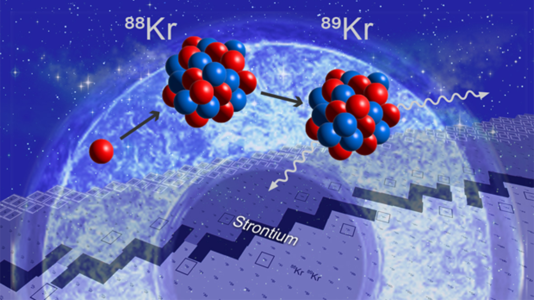
The study focused on how krypton-88 captures neutrons. This reaction is important because it affects how much strontium is produced during a process called the intermediate neutron-capture process, or i-process.
READ ALSO: https://modernmechanics24.com/post/berkeley-lab-develops-images-electrons/
Earlier models had a large uncertainty in this reaction rate. The possible rate varied by at least a factor of eight. The new experiment reduced that uncertainty to about a factor of three.
More importantly, the researchers found that the actual neutron-capture rate of krypton-88 is consistently lower than earlier theoretical predictions.
When the new measurement was added to different i-process models, the models produced more strontium. The results came closer to the amounts of strontium that astronomers observe in very old stars.
The project was led by Caley Harris, a former graduate student at FRIB. The international team included researchers from 12 institutions across the United States, Canada and Europe.
The work brought together nuclear physicists and astrophysicists. Artemis Spyrou, professor of physics at FRIB and Michigan State University, and Falk Herwig, professor of physics and astronomy at the University of Victoria, were among the researchers involved.
The team used the SuN detector at Argonne’s ATLAS facility. According to Guy Savard, ATLAS scientific director and Argonne Distinguished Fellow, the combination of the detector and ATLAS’s high-purity radioactive beams provided new information about important processes that happen inside stars.
Scientists have long used three major processes to explain how elements heavier than iron are created: the r-process, s-process and p-process.
However, observations of very old stars revealed elemental patterns that did not fully fit these processes. Strontium was one of the elements that remained difficult to explain.
The i-process became one possible explanation. It occurs under conditions between those associated with the s-process and r-process. During this process, atomic nuclei capture neutrons and gradually form heavier elements.
But i-process models repeatedly predicted too little strontium. Researchers suspected that missing nuclear data could be responsible.
WATCH ALSO: https://modernmechanics24.com/post/black-hawk-ai-hunter-killer-drone/
Directly measuring the krypton-88 reaction is difficult because the relevant nuclei are short-lived and the reaction is rare.
Instead, researchers produced krypton-89, which contains one more neutron than krypton-88. As the krypton-89 nuclei moved to lower-energy states, they released gamma rays.
The SuN detector measured these gamma rays. Researchers then used the data to reconstruct the reaction and estimate the krypton-88 neutron-capture rate.
The new measurement removes one of the major nuclear uncertainties in i-process models. However, questions about the exact conditions inside stars remain.
Researchers now want to study factors such as neutron density and the timing of nuclear burning. These studies could help bring models even closer to what astronomers observe in ancient stars.
The work also shows how laboratory experiments with rare isotopes can help answer questions about the history and chemical evolution of the universe.









One Response