

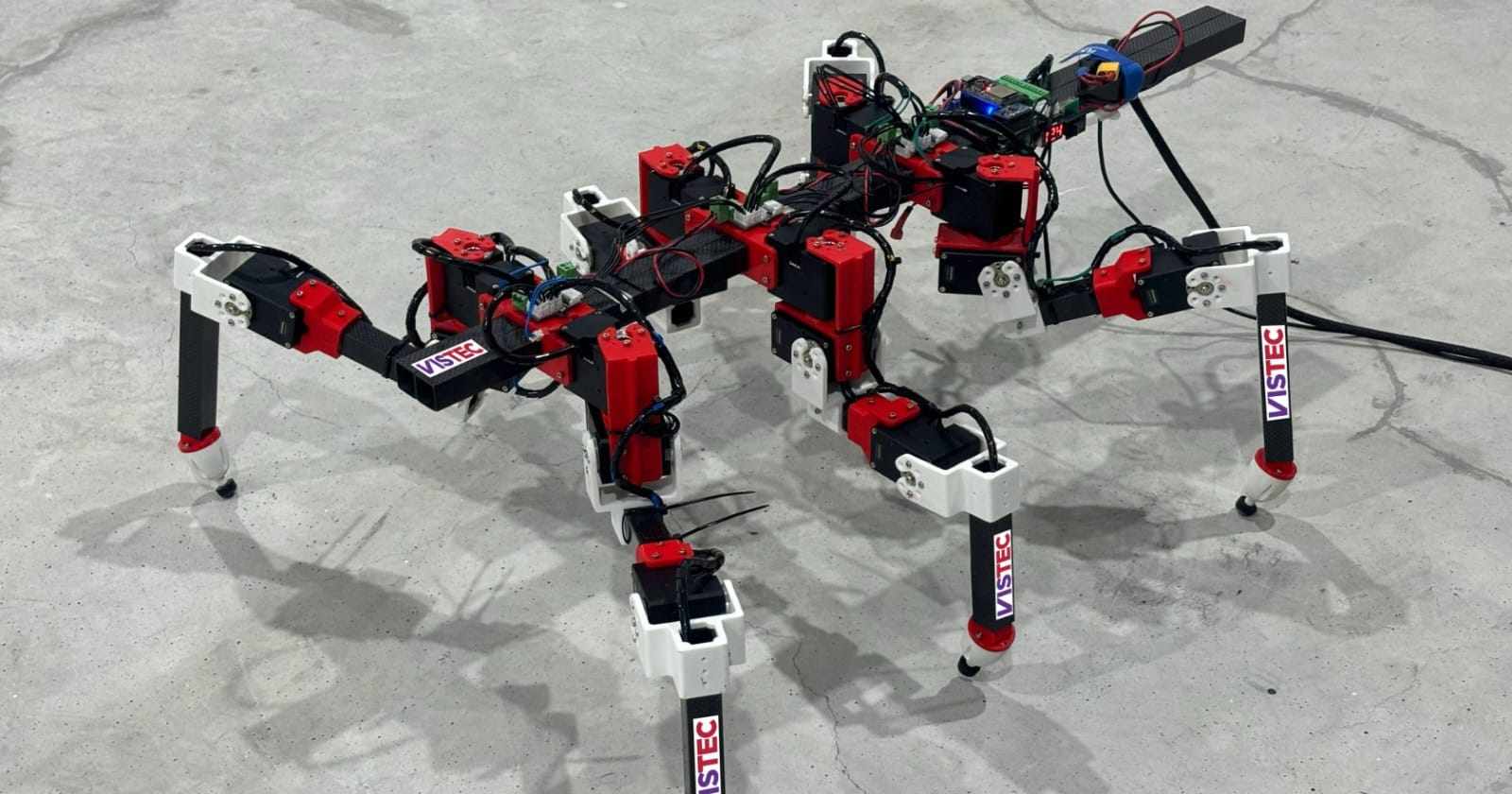
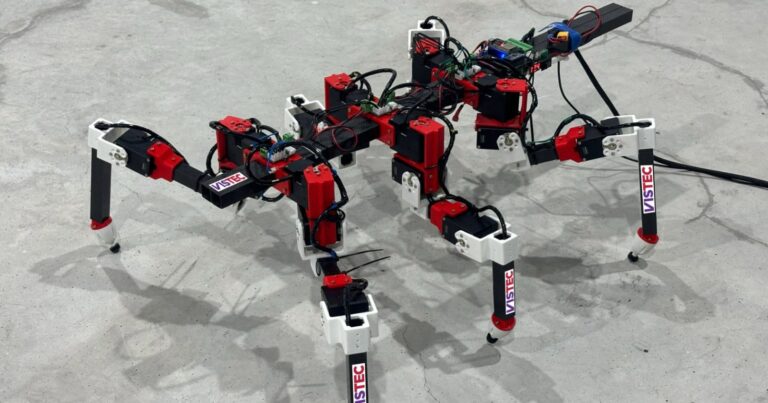
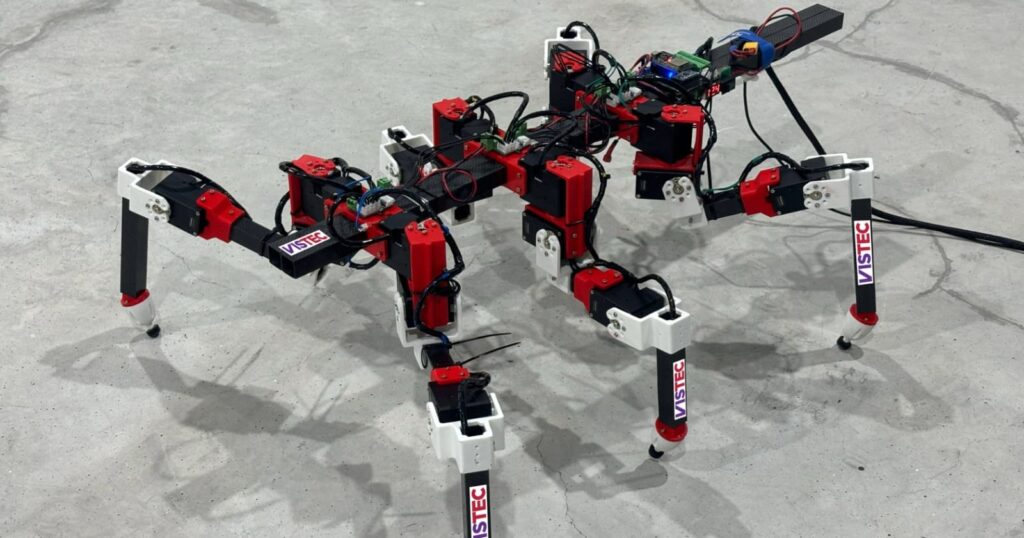
Researchers in Japan and Thailand have trained a six-legged robot to walk by studying how a stick insect coordinates its legs.
The system uses artificial intelligence to learn movement patterns from a small amount of insect walking data. The approach may help future robots move across uneven ground where conventional wheeled machines struggle.
Researchers Rethink Robot Walking
The research was led by Tohoku University in Japan and the Vidyasirimedhi Institute of Science and Technology (VISTEC) in Thailand.
Their findings were published in the journal Bioinspiration & Biomimetics. The team focused on a basic problem in robotics: how to teach a machine to coordinate several legs while responding to changes in the ground.
READ ALSO: https://modernmechanics24.com/post/us-navy-149m-radar-upgrade-uss-pinckney/
Insects have relatively small nervous systems, yet they can control several legs at the same time. They can also adjust their movements when they encounter changes in terrain. Researchers have long studied these abilities for ideas that can be transferred to walking machines.
However, copying insect movement is not straightforward. Earlier robotic systems often relied on manually designed coordination rules, movement parameters or reward systems. Such systems can work for one robot but may need major changes when the robot’s body shape, size or leg arrangement changes.
Robot Learns From Insects
The researchers took a different approach. Instead of giving the robot detailed instructions about how each leg should move, they used a form of artificial intelligence called adversarial inverse reinforcement learning. The method allows a machine to study an example of successful movement and infer what actions are being rewarded.
For the experiment, the researchers recorded a stick insect walking across a flat surface. The robot then used this limited example to identify the movement principles behind the insect’s actions. It was not directly programmed with a sequence of steps to copy.
Dai Owaki, an associate professor at Tohoku University, said the result showed that a small amount of insect movement data was enough to identify a principle that worked on a robot five times larger. The team described this as evidence that the learned movement strategy was not tied closely to the insect’s own body dimensions.
The robot learned the walking behaviour in less than an hour. After training, it was able to use the learned system to move across different types of terrain.
WATCH ALSO: https://modernmechanics24.com/post/nasa-roman-telescope-new-view-universe/
One Learning System, Many Robots
One important part of the research was the flexibility of the reward system. The researchers found that the system could be applied to robots with different body designs without requiring detailed adjustments for each machine.
This matters because walking robots do not all have the same shape. A six-legged machine designed for disaster response may have a different size, weight distribution and leg structure from a research robot used in a laboratory. A learning system that can transfer between these designs may reduce the need to create separate movement rules for every platform.
The researchers also examined the possibility of robots continuing to move after losing a limb. A six-legged robot has several points of contact with the ground, giving it more options for maintaining balance than a conventional wheeled vehicle. With additional memory and further development, the learning system may allow such machines to adjust their movement after physical damage.
Robots For Difficult Environments
The research has potential applications in environments where roads are damaged, blocked or absent. Earthquake zones are one example, particularly where rubble prevents conventional emergency vehicles from reaching people.
Walking robots can step over obstacles and negotiate uneven surfaces. Their ability to adapt their movement is therefore an important part of making them useful outside controlled laboratory environments.
The new learning method addresses that challenge by allowing the robot to acquire coordination from biological movement rather than relying entirely on manually written instructions.
The same principle may also be relevant to exploration in environments such as the Moon or Mars. Future exploration robots will need to operate on surfaces that are difficult to predict and may have limited access to human assistance. A system that allows a machine to adjust its walking behaviour without constant remote control could be useful in such conditions.
READ ALSO: https://modernmechanics24.com/wp-admin/post.php?post=29428&action=edit
The researchers’ approach also points to a wider use of biological examples in robotics. Stick insects are one possible source of movement data, but other animals with efficient and coordinated movement may provide additional models for future machines.
The next stage will involve testing how well the learned behaviour performs across more complex surfaces and under changing conditions. Researchers will also need to determine how the system responds to damaged limbs, different robot designs and longer periods of autonomous operation.










One Response