

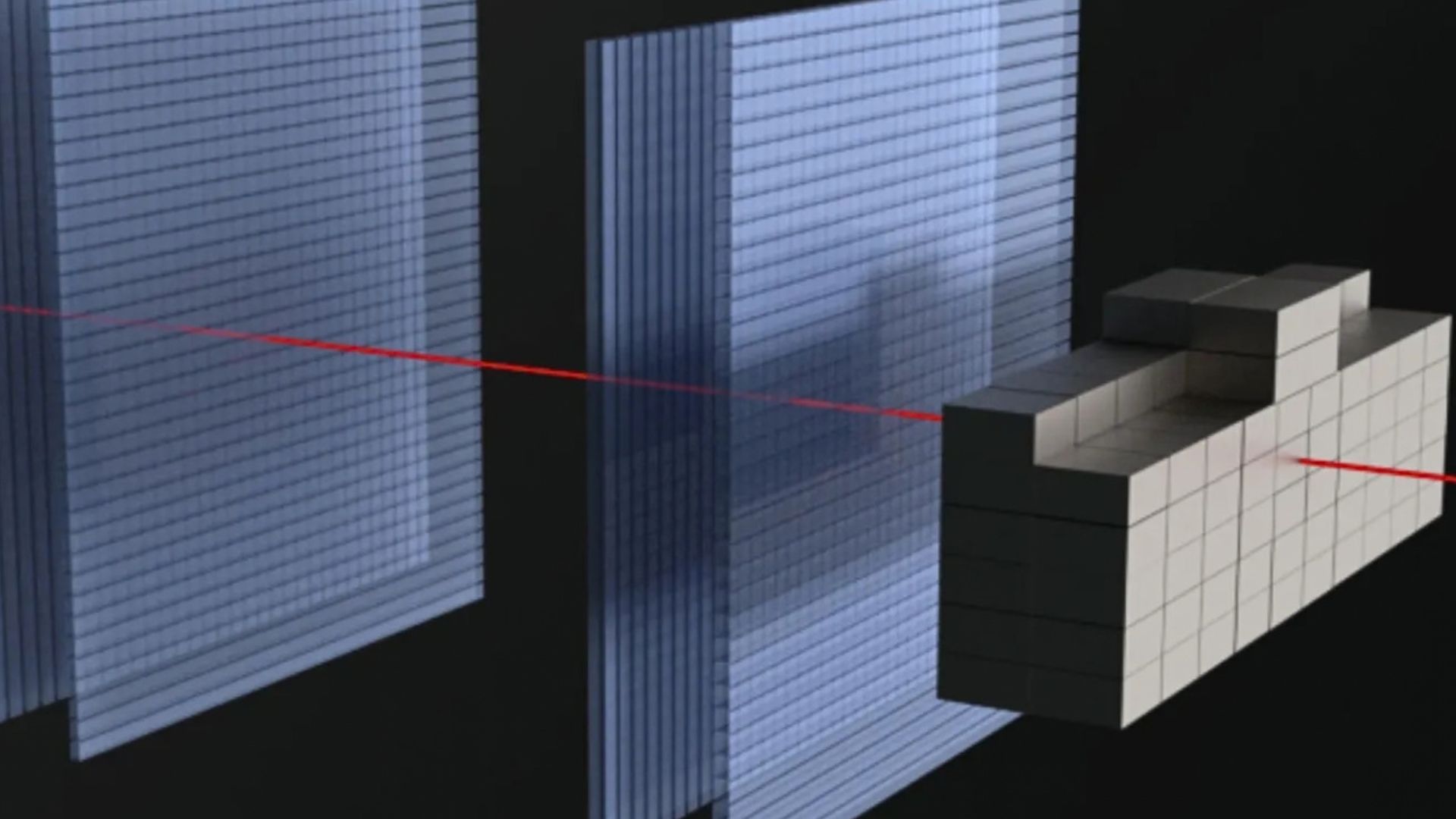
Physicists have used one of the world’s most powerful lasers to generate muons and image an object hidden behind two metres of concrete.
The experiment at Romania’s Extreme Light Infrastructure Nuclear Physics (ELI-NP) produced images using artificially generated muons rather than conventional X-rays. The result marks an important step toward practical muon imaging systems for structures that are difficult to examine with ordinary imaging methods.
The experiment used ELI-NP’s 10-petawatt laser, which can deliver an extremely powerful pulse for a very short period. The laser accelerated electrons to high energies before sending them into a lead target. The resulting interaction produced particles, including muons, allowing researchers to create a controlled source of these penetrating particles.
Muons are heavier relatives of electrons and are naturally produced high in Earth’s atmosphere. Fast-moving protons collide with atoms in the atmosphere and produce particles called pions, which rapidly decay into muons. These muons then travel toward the ground and can pass through large amounts of matter before decaying.
Their greater mass gives muons an important advantage over X-rays for imaging thick materials. X-rays lose energy more rapidly when they pass through dense, thick objects, while high-energy muons can travel through substantial layers of rock, concrete, and other materials. Scientists have therefore used naturally occurring muons to study structures located deep underground.
Muons Turned Into Imaging Tools
Researchers have used cosmic-ray muons for decades in a technique known as muography. The method has helped scientists investigate the internal structure of pyramids and search for geological features and mineral deposits beneath the surface. Natural muons, however, arrive from the sky at limited angles and at a relatively low rate of about one particle per square centimetre per second.
That limitation makes some forms of muon imaging difficult to perform. Artificially producing muons offers a way to create a source at a selected location and direct the particles toward a specific target. Previous experiments showed that high-power lasers can accelerate electrons enough to generate muons over practical distances.
Researchers in China, the US and the UK demonstrated this laser-based approach in an earlier experiment.
Another international team involving Lawrence Livermore National Laboratory and Colorado State University used a similar method to produce a particle beam that imaged lead weights inside a truck. The exact number of muons in that beam was not established, leaving questions about whether it represented the first artificial laser-based muon image.
READ ALSO: https://modernmechanics24.com/post/us-navy-uss-ted-stevens-destroyer/
Six Feet Of Concrete Tested
The ELI-NP experiment used a filtering system to remove as many unwanted particles as possible. The researchers built the filter from polyethylene sheets wrapped around blocks of paraffin, creating a setup designed to leave a relatively pure muon beam. The filtered particles then travelled toward a two-meter-thick concrete wall.
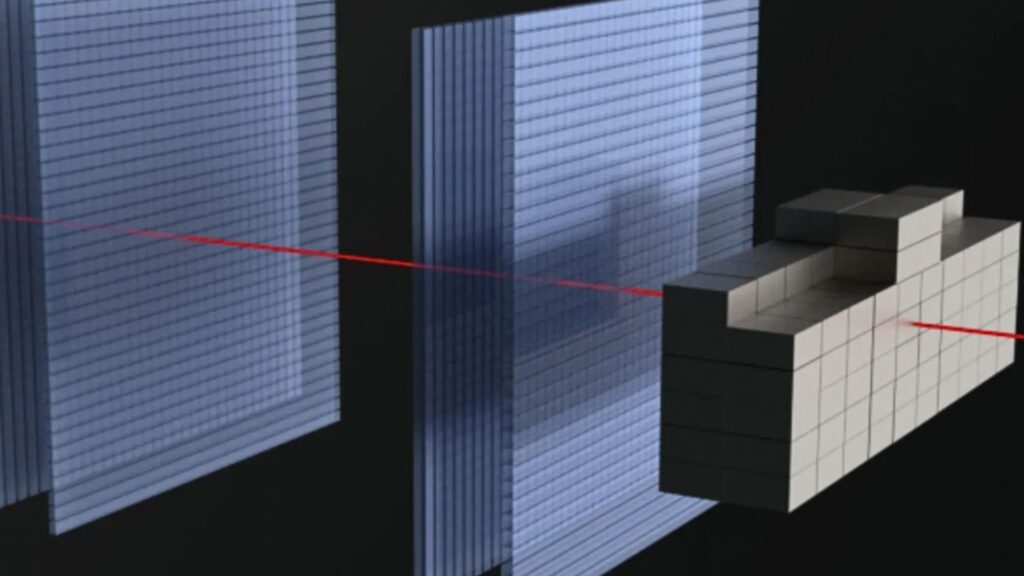
A detector array was positioned inside a van on the opposite side of the wall. The researchers placed a group of lead blocks in the muons’ path and recorded the changes in the particle distribution after the beam passed through the concrete. Those measurements produced a shadow-like image of the lead objects.
The resulting images were grainy and had limited detail, but they showed the method works through a substantial thickness of concrete. The research team described the experiment as the first official muograph produced artificially using a laser-generated muon source. The findings were presented in a paper available through the arXiv preprint repository.
Future Uses For Muon Imaging
Artificial muon sources may address several limitations of cosmic-ray muography. A controlled source can be placed near a target and used to obtain images from directions that naturally arriving particles cannot cover. This makes the approach relevant to applications where the location, angle and timing of the imaging system matter.
Potential uses include inspecting thick concrete structures, examining the interiors of large industrial objects and studying geological formations.
The technique is also relevant to archaeology, where researchers seek information about structures hidden behind or beneath dense materials. Other possible applications include examining the interiors of large metal structures and assessing areas that are difficult to reach directly.
The current system remains large and the images are relatively low in quality. Researchers would need to improve the particle source, detectors and overall system design before the technology becomes practical for routine field use. The long-term goal is a more compact and transportable muon imaging system that can examine thick materials without requiring access to the interior.
The ELI-NP experiment shows that a high-power laser can provide a controlled source of penetrating muons for imaging. Further development may turn the laboratory demonstration into a portable technology for inspecting concrete, rock, metal structures and other dense materials.











One Response