

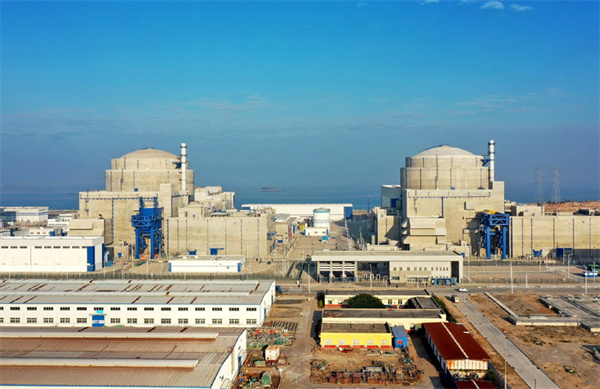
China has unveiled Hualong One 2.0, an upgraded version of its domestically developed nuclear power technology, with changes aimed at improving safety, construction efficiency and plant operations.
The Generation III-plus pressurized water reactor design builds on experience gained from the construction and operation of earlier Hualong One units. Its developers say the updated technology is now ready for international markets as China expands its nuclear power industry.
Hualong One Enters New Phase
The upgraded reactor technology was presented on Tuesday by a joint working group responsible for integrated innovation on Hualong One 2.0.
The group said the new design uses Chinese standards and supports full domestic production of key equipment. Its safety performance indicators are also described as being among the leading group of large pressurized water reactors worldwide.
READ ALSO: https://modernmechanics24.com/post/starship-orbital-launch-september-22/
Hualong One 2.0 is based on the existing Hualong One design, which has been developed and used through large-scale construction and commercial operation.
Engineers incorporated experience from earlier projects and combined several technical improvements into the updated model. The aim is to improve the reactor across safety, construction, cost, operation and maintenance, and environmental protection.
Wu Yuxiang, deputy chief designer of subsequent Hualong One reactor models under China National Nuclear Corporation, said the upgraded design uses a reactor core with 177 fuel assemblies. Each assembly contains 264 fuel rods, which hold the nuclear fuel used to generate heat. Control rod assemblies regulate the reactor’s nuclear reaction by adjusting the number of neutrons available to sustain the process.
In a pressurized water reactor, heat from the nuclear fuel is transferred to water under high pressure. The heated water produces steam through a separate system, which drives turbines to generate electricity. This arrangement keeps the radioactive reactor coolant separate from the steam used in the power generation process.
Passive Systems Strengthen Safety
Safety is a central part of the Hualong One 2.0 upgrade. The design combines improvements to active safety systems with expanded passive safety features that use natural physical forces rather than relying entirely on powered equipment.
According to its developers, the reactor can operate without operator intervention for 72 hours after an accident and maintain an autonomous accident response for seven days.
Niu Wenhua, chief expert on advanced Hualong One models at China General Nuclear Power Corporation, said the Fukushima nuclear accident had made safety the leading concern in nuclear power development worldwide.
He explained that the most important task after a reactor shuts down is to continue removing heat from the core. Even after the chain reaction stops, the fuel remains hot and requires continued cooling.
Hualong One 2.0 uses gravity to move water from elevated storage tanks into the cooling system. Natural circulation and nitrogen expansion provide additional forces to move the water through the relevant systems. This arrangement reduces dependence on pumps and alternating-current power supplies during key safety operations.
WATCH ALSO: https://modernmechanics24.com/post/electronic-warfare-future-air-combat/
The passive safety system is designed to continue performing essential functions during certain emergency conditions. Its operation relies on stored water, gravity and other natural processes. This approach reduces the number of powered components needed for some emergency cooling tasks, although the complete safety performance of any nuclear plant depends on its full design and operating procedures.
The updated reactor also addresses risks linked to extreme weather and changing environmental conditions. Its safety calculations use a reference seawater temperature of 45 degrees Celsius, providing a margin for high-temperature conditions. The cooling system does not depend entirely on seawater, as external high-temperature water tanks provide an additional source of protection when outside conditions become severe.
Simpler Design Cuts Construction
Alongside its safety improvements, Hualong One 2.0 introduces changes intended to simplify plant construction and maintenance.
The upgraded design reduces the length of pipelines by about 31 percent and cuts the number of process valves by approximately 25 percent. These changes reduce the amount of equipment and connection work required across the plant.
The volume of buildings on the nuclear island is expected to fall by about 21 percent. Nuclear island installation work is also projected to decrease by approximately 33 percent. The nuclear island contains the reactor and several systems directly linked to nuclear operations, making it one of the most technically demanding parts of a nuclear power station.
The design also increases the proportion of automated operations. Automation can help operators monitor equipment and manage routine processes with greater consistency. It also reduces the amount of manual work required for certain activities, although trained staff remain necessary for supervision, maintenance and emergency response.
Niu described the project as a systematic improvement of an established design rather than an entirely new reactor concept.
He said the upgrade focuses on improving quality and efficiency across five areas, including safety, construction schedules, costs, operation and maintenance, and environmental protection. The changes are intended to improve the performance of future projects while retaining the foundation of the existing Hualong One technology.
READ ALSO: https://modernmechanics24.com/post/blackbeard-hypersonic-missile-us-navy/
Global Expansion Of Nuclear Tech
Hualong One has already moved beyond the development stage and into commercial operation. According to information released by the project, 11 Hualong One units in China and overseas had entered commercial service as of Monday. Another 36 units had either received approval or were under construction.
The number of operating, approved and developing units reflects the scale of China’s nuclear power programme. It also provides the technology’s developers with experience from repeated construction and operation. Hualong One 2.0 builds on that experience as China seeks to offer an updated reactor design to international customers.
The technology is classified as a Generation III nuclear power system, while the upgraded version is described by its developers as Generation III-plus. These classifications generally refer to improvements in safety, efficiency and design compared with earlier reactor generations. They do not remove the need for strict regulation, careful construction and long-term monitoring.
The international market for nuclear power includes countries seeking reliable electricity generation and lower-carbon energy sources. Nuclear reactors produce electricity without direct carbon dioxide emissions during operation, although their construction, fuel production and wider supply chains also involve environmental costs. Hualong One 2.0 is being presented as an option for countries assessing new nuclear power projects.
China’s nuclear industry is also using domestic standards and equipment production as part of its wider development strategy. The Hualong One 2.0 design is intended to support domestic manufacturing of key components, which can reduce dependence on overseas suppliers for major equipment. Its developers say the updated technology is now available for the global market.
The next stage will involve applying the revised design to future projects and assessing how its changes perform in practice. Construction results, operating data and regulatory reviews will help determine how effectively the upgraded technology delivers its stated improvements.
Hualong One 2.0, therefore, marks the next phase in China’s effort to refine its nuclear reactor technology and expand its role in the international nuclear power industry.


One Response