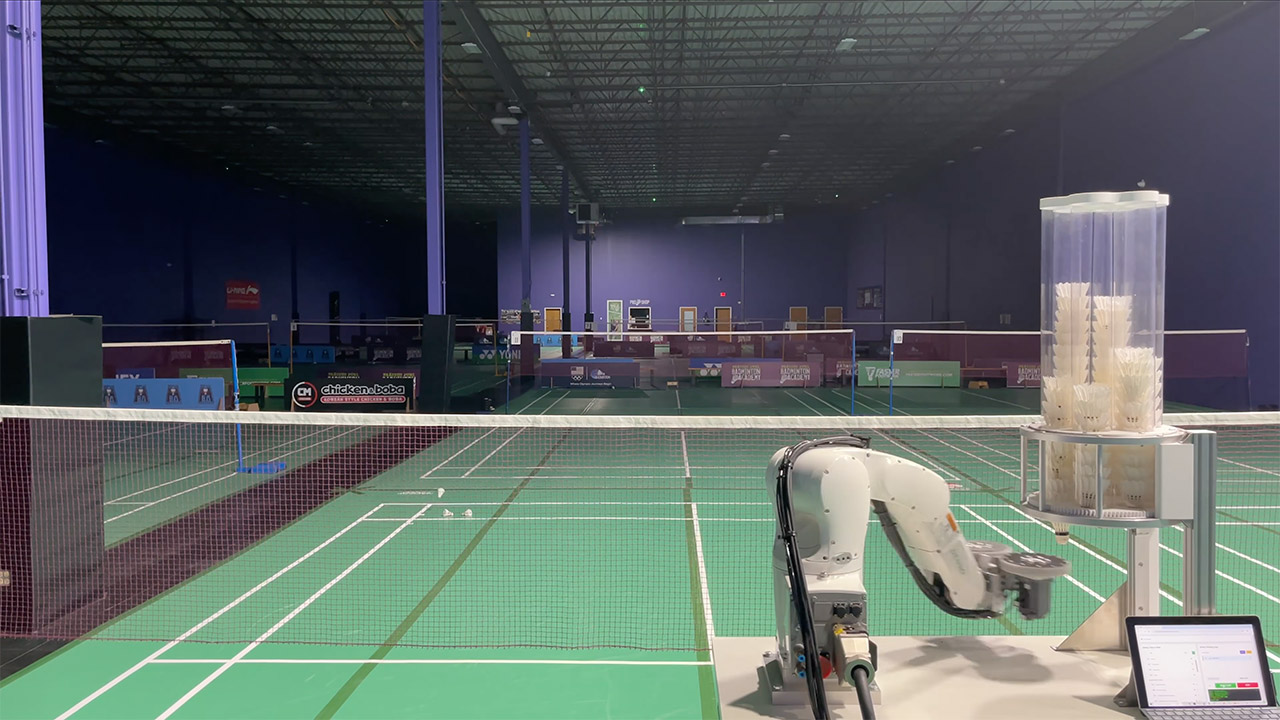
A used industrial robot has been converted into an automated badminton training machine capable of storing and firing up to 120 shuttlecocks.
The system was built by badminton player Travis Mitchell, who spent about six months adapting a Denso VS-050 six-axis robotic arm for use on a court.
It combines industrial motors, pneumatic actuators, sensors, custom-fabricated parts and programmable controls to deliver repeatable shots without a human feeder.
From Factory To Court
Mitchell had been looking for a practical way to practise badminton with his family after his children began learning the sport.
His wife previously competed in women’s singles for Team USA and now operates a 15-court badminton facility. Mitchell had also tried to build a shuttlecock launcher about a decade ago using a CR-10 3D printer and a low-cost CNC router, but the project was eventually abandoned.
READ ALSO: https://modernmechanics24.com/post/small-aircraft-pollution-oregon-homes/
He returned to the idea after buying a used Denso VS-050 industrial robot on eBay. Instead of developing a conventional fixed launcher, he used the robot’s six-axis movement to position the shuttlecock feeder.
A digital model of the Denso arm published by the manufacturer was imported into Fusion, allowing the custom parts to be designed around the robot’s existing geometry. The launcher was then mounted on an aluminium frame attached to the robot’s wrist.
Two 400-watt AC servo motors drive the launch wheels. Two pneumatic cylinders control the shuttlecock, with one holding it in position and the other pushing it into the rotating wheels.
Sensors Manage Feeding
The machine carries its own supply of shuttlecocks through a motorised six-tube carousel. Each tube holds about 20 shuttlecocks, giving the system a capacity of roughly 120 shots before it needs to be reloaded.
A time-of-flight sensor checks whether a shuttlecock is correctly positioned in the active tube. When the tube is empty, the carousel moves to another position, allowing the next loaded tube to enter the firing sequence.
The control system was modified during development. An initial Raspberry Pi Pico was replaced by an Arduino Mega after the smaller board proved to have insufficient input and output connections for the system.
Communication with the Denso arm also required experimentation. USB, RS-232 and Ethernet connections did not provide a suitable solution, so the final system uses Bluetooth together with a bank of input-output connections.
The software can store up to 127 programmed positions. These include movements for positioning, gripping, aiming and firing, allowing the robot to repeat different training sequences.
WATCH ALSO: https://modernmechanics24.com/post/us-firm-sea-launcher-underwater-drones/
High-Speed Launch Challenge
The launch wheels presented one of the main engineering challenges. They need to remain balanced while rotating at up to 6,000 revolutions per minute and must generate enough friction to grip the shuttlecock’s nylon skirt.
Several materials were tested during development. EVA foam cut with a CO2 laser failed to provide the required surface, while gum rubber stretched excessively at high speed.
Printed hubs coated with Flex Seal also proved unsuitable. Full silicone sheets were subsequently tested but stretched during rapid rotation.
The final design uses a 3D-printed plastic hub with a narrow silicone strip forming the contact surface. The arrangement reduced the amount of flexible material rotating at high speed while maintaining the grip required to launch the shuttlecock.
The pneumatic pusher also required modification after early tests. It sometimes failed to fully position a shuttlecock, resulting in inconsistent launches.
The component was redesigned and printed again, improving the feeding mechanism. Testing began in the workshop before the complete machine was taken onto a badminton court.
Mobile Platform Supports Robot
The robotic system operates on 240 volts and is mounted on a mobile cart. A motorised standing-desk mechanism allows the platform to be lowered for loading and raised during operation to provide clearance above the net.
The cart includes plywood shelves for the air compressor and cables. Its wheels were also modified from M8 to M12 hardware to support the completed system.
READ ALSO: https://modernmechanics24.com/post/china-cliffside-store-hang-120m-high/
Moving the machine into a gym presented another practical hurdle because the entire cart had to pass through a doorway before court testing could begin. Once inside, the robot was tested under actual playing conditions.
The finished machine can select programmed positions and fire shuttlecocks according to predefined sequences. That gives players a consistent source of shots for practising strokes without requiring another person to stand on the opposite side of the court.
Unlike a simple fixed shuttle launcher, the six-axis robot can change the position and orientation of the firing mechanism. This allows different shot locations and training patterns to be programmed into the system.
Commercial badminton feeding machines are already available, but Mitchell’s project demonstrates how an older industrial robot can be adapted for sports training. It also combines technologies used in manufacturing, including computer-aided design, servo control, pneumatic systems, sensors, additive manufacturing and digital fabrication.
The project highlights a wider use for second-hand industrial robots as programmable platforms. With used robotic arms and fabrication equipment accessible, similar systems can be adapted for specialised tasks beyond their original factory applications.
For badminton players, the immediate application is automated and repeatable practice. For robotics development, the machine demonstrates how an industrial manipulator can be paired with custom hardware and software to perform a task far removed from its original manufacturing role.