

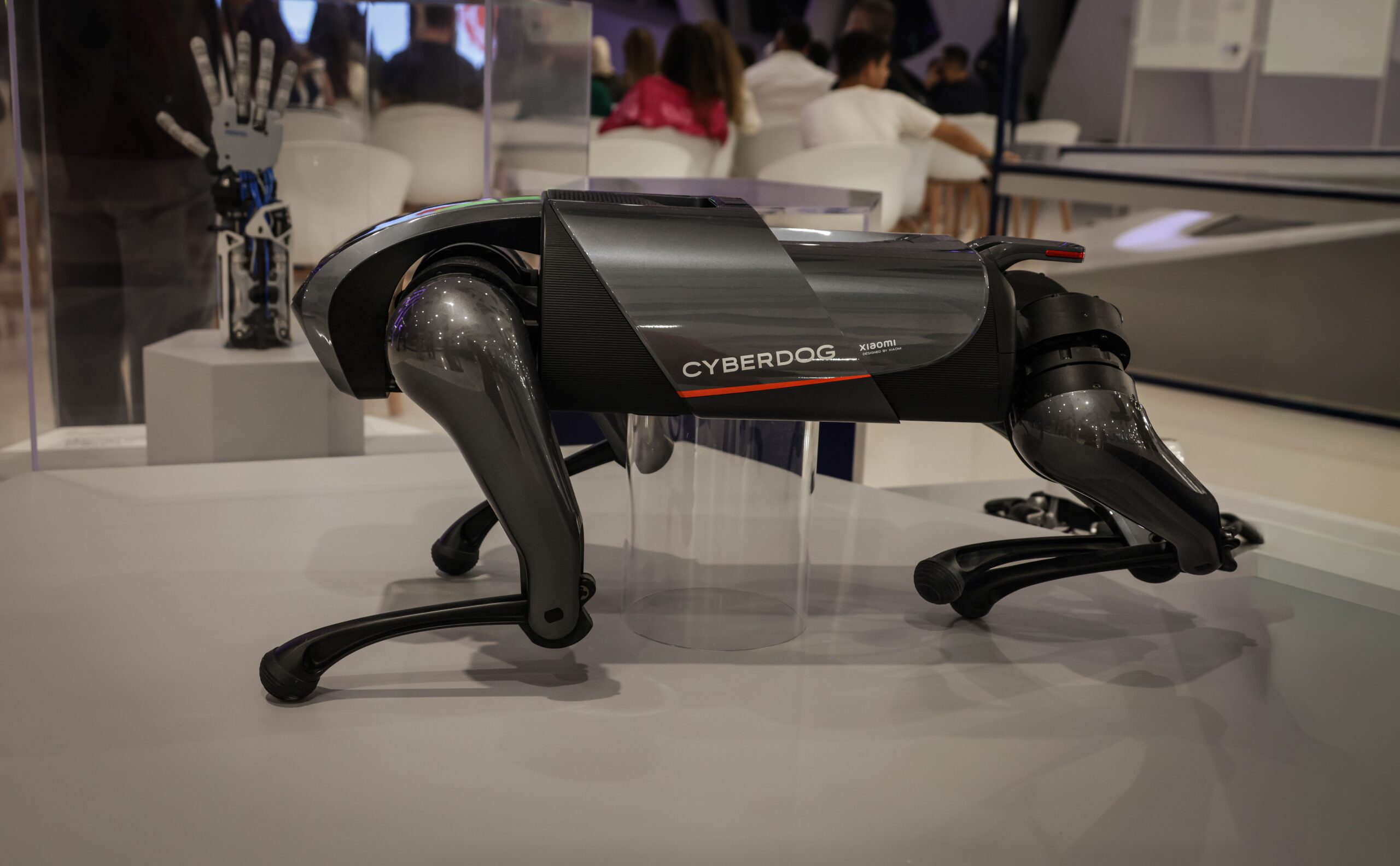
Researchers at the University of Hong Kong (HKU) and the Oxford Robotics Institute have developed a learning system that helps four-legged robots move through narrow spaces at high speed. Tested on the 22-kg Aliengo robot, the system allows it to detect a small gate, decide how to approach it, jump through it, and continue running.
The research, published in Advanced Robotics Research, takes inspiration from dogs and other agile animals. Instead of programming every movement by hand, the researchers trained the robot to learn movements from animal motion data.
The team from HKU’s Adaptive Robotic Controls Lab worked with researchers at the University of Oxford to build the new system. Professor Peng Lu, senior author of the study, said the work was inspired by the way dogs can sprint toward a narrow opening, jump through it and land while continuing to run.
The system has two main parts. A low-level controller learns how the robot should move, while a second network checks whether its movements resemble those of a real animal.
READ ALSO: https://modernmechanics24.com/post/china-tanker-refuels-egypt-rafale-drill/
Researchers used motion-capture data from a real dog to teach the robot different movements. These included walking, running, steering, jumping and landing.
The robot does not learn each movement as a completely separate skill. Instead, the skills can blend together based on the speed and movement the robot needs. This lets it move from running to jumping and then back to running more naturally.
The high-level controller uses an onboard RGB-D camera to detect the gate. It then decides how fast the robot should move forward and which direction it should turn.
During testing, the Aliengo robot accelerated toward the gate and folded its legs while in the air. Importantly, the researchers had not directly programmed the robot to tuck its legs or specify exactly when it should jump. The robot learned the sequence through training.
The robot was able to handle gates placed at different positions and heights. It could change its approach, use a longer run-up for higher openings and adjust its direction when the gate was placed to one side.
The system could also react when the gate was moved while the robot was already running toward it. This shows that the robot was not simply repeating one memorized jump.
The system still depends on an external motion-capture setup for part of its training process. The researchers want future versions to rely only on onboard sensors so the robot can operate in cluttered environments and deal with obstacles that are partly hidden.
The team also plans to expand the number of movements the system can learn. The researchers are exploring whether the same approach could eventually be applied to other robots, including humanoid machines.
Fast and agile movement could be useful for robots working in difficult environments. In collapsed buildings, industrial sites and other cluttered areas, a robot that can quickly jump over or through obstacles could reach places that are difficult to navigate slowly.
WATCH ALSO: https://modernmechanics24.com/post/china-trains-hq17-type-625-air-defense/
The work also shows how robots can learn physical skills by copying animal movement rather than relying entirely on manually programmed actions. This could help researchers build more adaptable legged robots for real-world environments.









One Response