

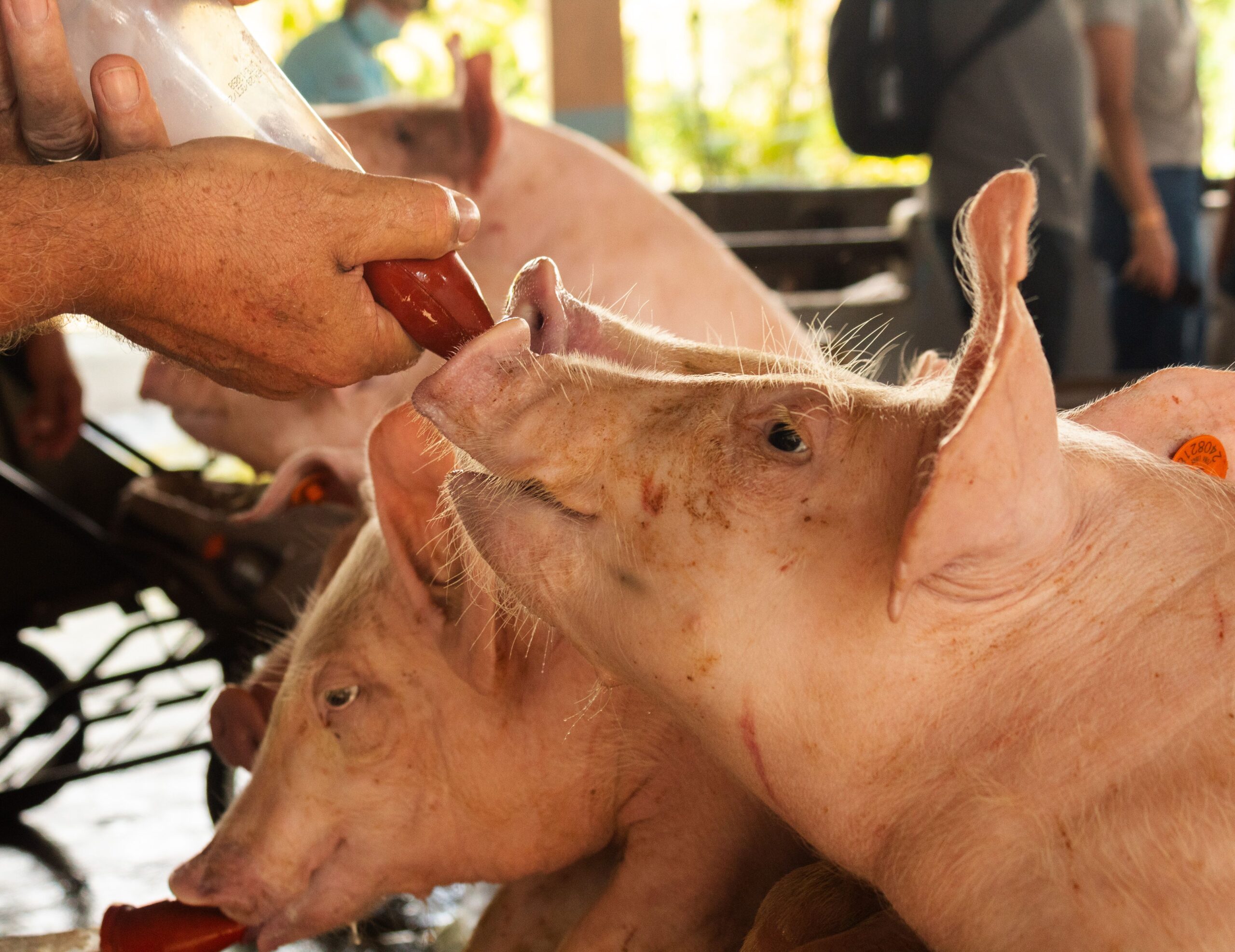
A Chinese research team has built an AI robot that can vaccinate pigs without using a traditional needle. The system combines computer vision and a six-axis robotic arm, reaching 93.3% accuracy in tests.
The robot was developed by Li Bin, a research fellow at the Beijing Academy of Agriculture and Forestry Sciences, and his team. The work aims to reduce the heavy manual effort needed to vaccinate pigs on large farms.
The system targets the base of a pig’s tail, where the vaccine can be delivered into the nearby muscle. The South China Morning Post reported that the robot is designed to address common problems with manual vaccination, such as missed injections, broken needles and incorrect injection positions.
READ ALSO: https://modernmechanics24.com/post/dune-ai-transforming-neutrino-research/
The Beijing Academy of Agriculture and Forestry Sciences team built the system with support from China’s National Key Research and Development Programme for New Generation Artificial Intelligence. Their study was published in June in the peer-reviewed journal Transactions of the Chinese Society of Agricultural Engineering, according to the South China Morning Post.
The robot uses a depth camera to find the pig’s tail base and work out the correct injection position. A laser sensor first maps the stall, while the robotic arm moves into place and delivers the needle-free vaccine.
In farm tests in Qinhuangdao, Hebei province, the robot was tested on 12 Landrace pigs. It made 180 injection attempts, with 168 successful injections. Each attempt took about 7.9 seconds, while the average positioning error was around 1 centimetre.
The system still has limits. Sudden pig movements caused some failures, while lying down or moving close to stall walls also made injection harder. Researchers also found that defecation could lift a pig’s tail and change the target position.
WATCH ALSO: https://modernmechanics24.com/post/xpeng-second-gen-iron-humanoid-robot/
The project matters because China has a huge pig farming industry and needs ways to handle routine work on large farms. If the robot becomes more reliable in changing farm conditions, it could help make pig vaccination more automated and reduce the need for workers to perform repeated injections.
Main breakthrough: The AI robot combines navigation, visual tracking and robotic injection in one system, showing how automation could take over a routine task in large-scale pig farming.










One Response