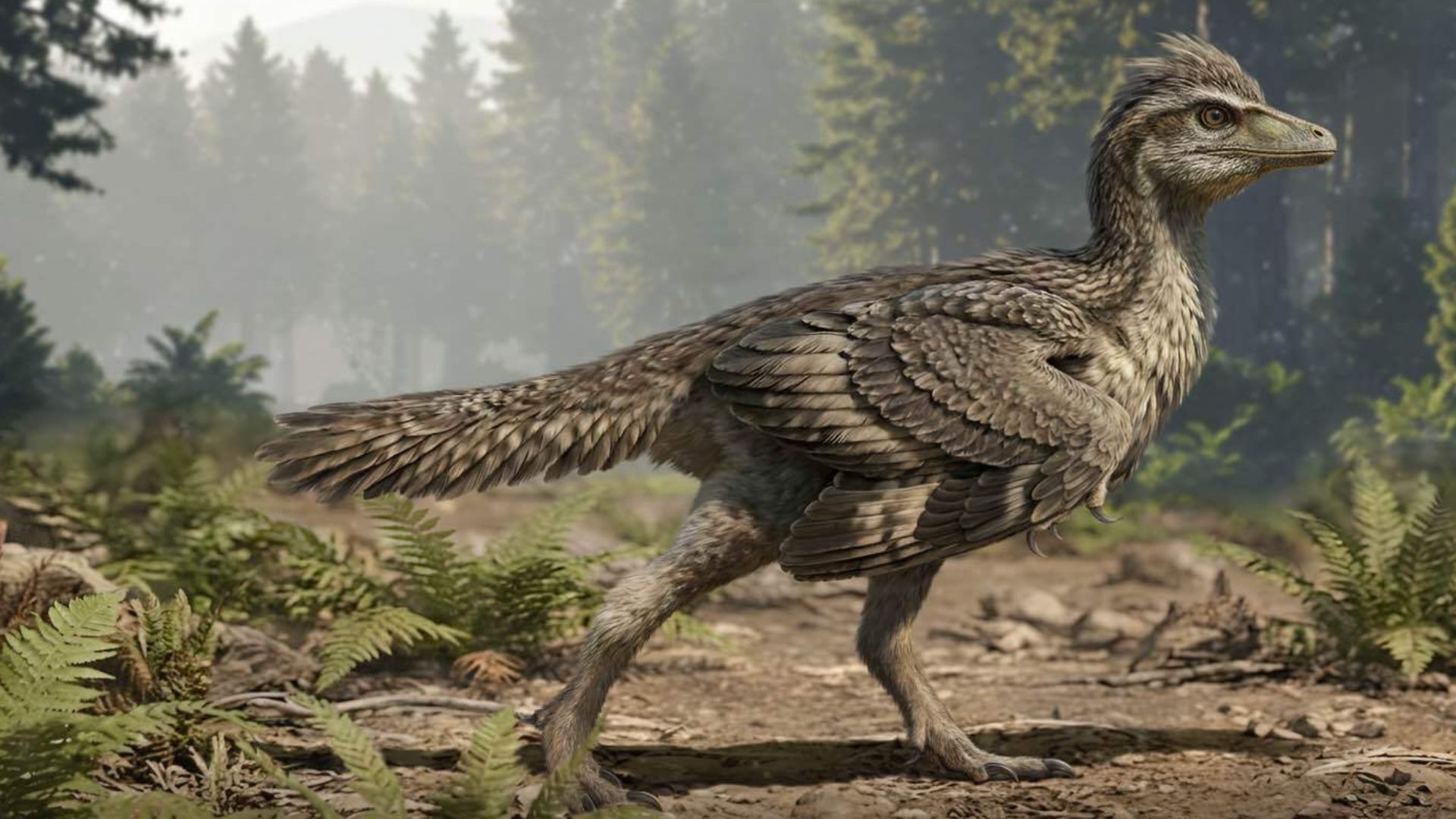
Chinese scientists have identified the world’s smallest known long-tailed Jurassic bird, offering new insights into the evolution of modern bird tails.
The fossil reveals an important stage in the evolution of modern birds’ short tails over millions of years. The discovery also challenges a long-standing idea about the sequence of changes that shaped early bird evolution.
Long-tailed Bird Evolution
The newly discovered species has been named Zhengheornis buyu. Researchers from the Institute of Vertebrate Paleontology and Paleoanthropology, Chinese Academy of Sciences, led the study, with support from the Fujian Institute of Geological Sciences. Their findings were published in the scientific journal Science Advances.
The fossil provides some of the strongest evidence yet that bird tails became shorter before the final tail bones fused into a single structure. This changes a long-accepted view held by many scientists for decades. It fills an important gap in understanding how birds evolved from their dinosaur ancestors.
Modern birds have short tails composed of only a few vertebrae. At the end of the tail sits a fused bone called the pygostyle, which helps support tail feathers used for balance and flight. Scientists have long believed that shortened tails and the pygostyle evolved together during bird evolution.
The newly discovered bird tells a different story. It had only 15 tail vertebrae, far fewer than the more than 23 found in other early long-tailed birds. However, these bones remained separate and had not fused into a pygostyle.
Researchers compared the fossil with other known ancient birds. They found that Zhengheornis buyu had the shortest tail relative to its body among all known long-tailed avialans. This shows that tail shortening happened before the fused tail structure evolved.
Why a Shorter Tail Helped Early Birds Fly Better
Birds evolved from small feathered dinosaurs over millions of years. During this process, many body features gradually changed to improve flight. One of the biggest changes was reducing the tail’s size and weight.
READ ALSO: BMW Deploys Figure 03 Humanoid Robot to Power AI-Driven Factory Logistics at Spartanburg
A shorter tail reduced body weight and shifted the bird’s center of mass closer to the wings. This made balancing during flight easier. It also helped improve stability while flying.
Having fewer tail joints also made the tail stiffer. A stiffer tail gave birds better control during flight and allowed tail feathers to move more efficiently. These changes gave birds greater agility than earlier species such as Archaeopteryx, one of the earliest known birds.
The discovery supports the idea that evolution often happens in several stages rather than all at once. Instead of developing every modern feature together, early birds first shortened their tails before evolving the fused tail bone seen today. This step-by-step pattern offers a clearer picture of how flight adaptations developed.
Tiny Jurassic Bird Discovered
Researchers also found that Zhengheornis buyu was extremely small. It measured about 20 centimeters in length and weighed between 74 and 163 grams. That makes it the smallest long-tailed avialan identified so far.
Its femur measured only about 63 percent of the length of the femur in M. zhaoianus, which had previously been considered one of the smallest known dinosaurs. The bird was also around 10 percent smaller than the recently described Chicago specimen of Archaeopteryx. These comparisons highlight just how tiny this Jurassic bird was.
READ ALSO: Israel Tests Iron Dome With Iron Beam Laser, Unveiling a Smarter Air Defense Strategy
Its small body suggests that some early bird relatives reduced their size much earlier than scientists had expected. Smaller bodies would have made movement through forests easier and supported more efficient flight. This also helped birds explore different habitats and food sources.
The research identified Zhengheornis buyu as the fourth known species in its evolutionary lineage. Unlike some other birds from the same period, it did not show clear signs of living mainly on the ground or in trees. Instead, it appears to have followed its own ecological strategy.
Scientists also observed remarkable differences among birds living during the Late Jurassic period. They varied in body size, anatomy, and lifestyle despite sharing the same environment. This diversity shows that bird evolution had already expanded into several different forms much earlier than previously understood.
The discovery provides valuable evidence for one of the most important chapters in the history of life on Earth. It helps scientists better understand how dinosaurs gradually evolved into the birds seen today. As more Jurassic fossils are uncovered, researchers expect to reveal even more missing pieces of the story behind the origin and evolution of modern birds.