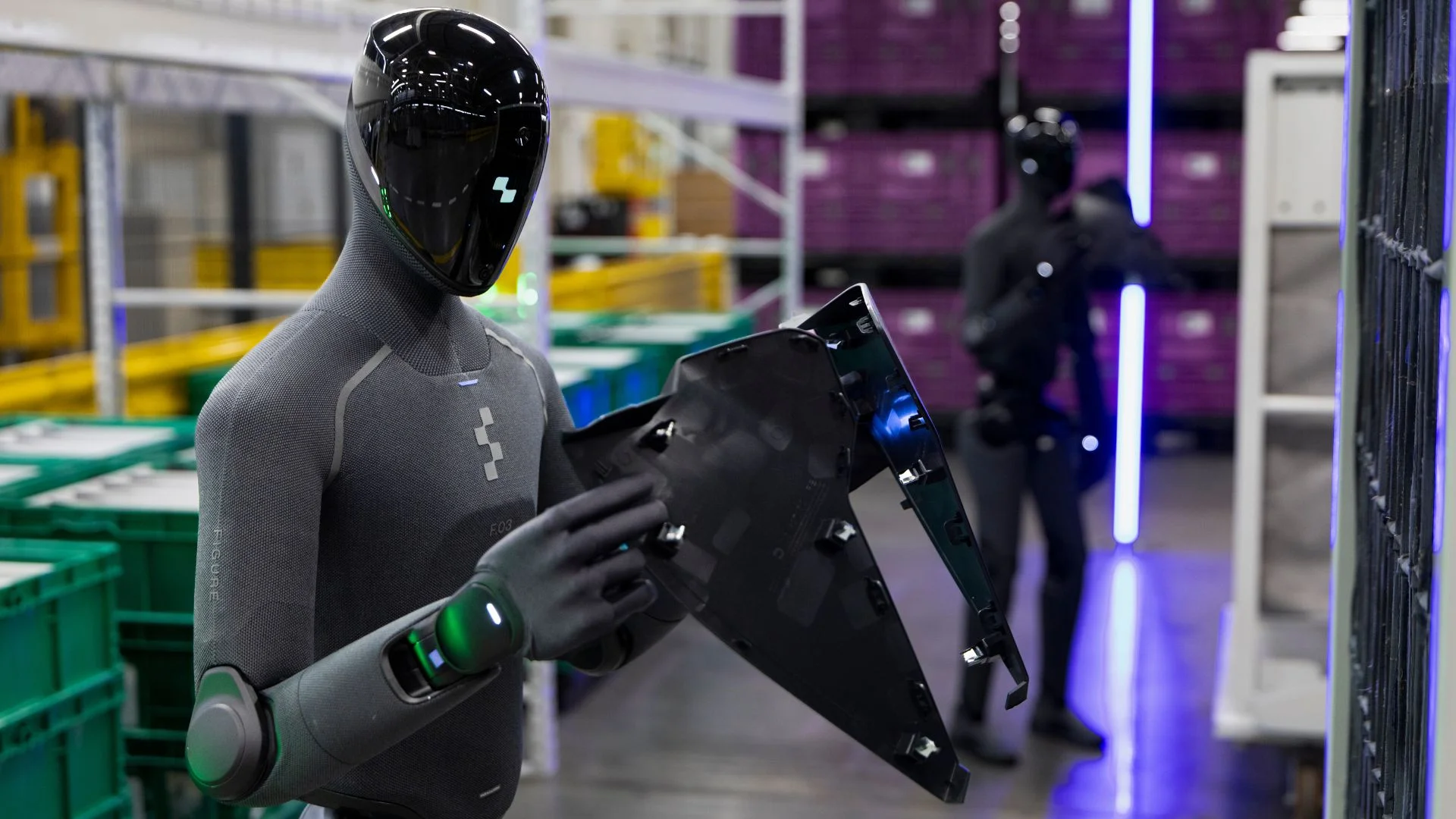
BMW is increasing its investment in artificial intelligence across its global manufacturing network. The company is now using a more advanced humanoid robot, Figure 03, at its largest production facility in the US.
The project reflects BMW’s long-term plan to combine AI software with robots that can safely work alongside people.
The new robot follows the successful deployment of Figure 02 at BMW’s Spartanburg plant. Figure AI developed both robots as part of its partnership with the German automaker. The latest model introduces new hardware and software designed for more demanding factory tasks.
BMW describes this approach as Physical AI. Unlike traditional AI, which works only with digital information, Physical AI enables intelligent software to control machines that interact with the real world. This enables robots to perform practical jobs inside busy production environments.
Plant Spartanburg has become the testing ground for BMW’s humanoid robot program. The facility was the first BMW factory to integrate humanoid robots into everyday production work. The experience gained there is now shaping future automation projects across the company.
Ulrich Wieland, Vice President of Production Control and Logistics at BMW Manufacturing, said Plant Spartanburg has led the company’s efforts in humanoid robotics.
He said the successful Figure 02 pilot created confidence for the next step with Figure 03. He added that the new robot will now take on sequencing tasks in factory logistics.
Figure AI Founder and CEO Brett Adcock said the earlier deployment proved that humanoid robots can operate reliably in real factories. He said they are no longer limited to research laboratories. He added that Figure 03 will now face more complex challenges inside the assembly and logistics areas.
READ ALSO: AI Reveals Water Molecules Switch Between Two Liquid States, Solving a Century-Old Mystery
BMW first introduced Figure 02 into production during 2025. Over about 10 months, the robot supported the manufacturing of more than 30,000 BMW X3 vehicles. It worked inside the body shop where precision and speed are essential.
The robot handled sheet-metal parts before the welding process began. This work requires accurate positioning and repeated movements throughout the day. Such tasks are physically demanding for workers over long periods.
BMW said the trial showed that humanoid robots can perform repetitive industrial jobs safely and consistently. The project also demonstrated that robots can operate under real factory conditions without disrupting production. These lessons formed the foundation for the deployment of Figure 03.
Figure 03 includes several upgrades over the previous model. It uses softer external materials to improve safety when operating near workers. The robot also supports wireless charging, reducing downtime during operations.
The new robot features speech-to-speech communication. Workers can interact with it using natural spoken language rather than relying solely on programmed commands. This makes communication easier during factory work.
Figure 03 also comes with improved robotic hands. Tactile sensors allow the robot to detect pressure while handling objects. Palm-mounted cameras provide additional visual information, improving accuracy when picking and placing parts.
Figure 03 Transforms Logistics
The first assignment for Figure 03 focuses on sequencing operations inside the logistics department. In automotive manufacturing, thousands of different parts must reach the assembly line in the correct order. Even small delays can affect production efficiency.
Components usually arrive at the factory in large containers without a specific arrangement. Figure 03 will pick individual parts from these containers. It will then organize them into a sequencing trolley based on production requirements.
Once the trolley is complete, workers move it to a collection point. From there, automated tugger trains or Smart Transport Robots deliver the parts to the assembly line. Employees receive every component exactly when it is needed during vehicle assembly.
This process is known as just-in-sequence. It ensures that the correct parts arrive at the right workstation at the correct time. The system reduces unnecessary handling, saves storage space, and helps maintain a steady production flow.
BMW believes this type of work offers strong opportunities for future automation. Similar logistics tasks exist throughout vehicle manufacturing plants. Success with Figure 03 could support wider deployment across additional production facilities.
READ ALSO: Scientists Build a Flying Robot That Stays Airborne Using Wind Instead of Propellers
The company says humanoid robots are not replacing existing factory automation. Instead, they add flexibility where traditional industrial robots are less suitable. Their human-like shape allows them to work in spaces already designed for people.
BMW expects humanoid robots to handle repetitive, physically demanding, or safety-sensitive jobs. This reduces physical strain on employees. Human workers can then focus on tasks requiring judgment, problem-solving, and technical skills.
Digital Factory Strategy Supports Future Production
The Figure 03 project is part of BMW’s wider digital manufacturing strategy, BMW iFACTORY. The company combines automation, artificial intelligence, and digital planning tools to improve factory performance. These technologies support production before, during, and after assembly.
Hall 52 at Plant Spartanburg has undergone major expansion and modernization. The facility currently assembles different versions of the BMW X3. In the future, it will also build the fully electrified BMW iX5.
Before production begins, BMW uses virtual 3D simulations to test manufacturing processes. Engineers study workflows inside a digital version of the factory. This allows them to identify problems before equipment is installed.
BMW also operates the BMW Virtual Factory platform. The system simulates employee movements while performing manual work. Engineers use these simulations to improve ergonomics and make daily tasks more comfortable for workers.
Artificial intelligence also plays an important role in quality control. BMW uses a system called AIQX, which stands for Artificial Intelligence Quality Next. The technology performs both visual and acoustic inspections during production.
WATCH ALSO: World’s first motorbike backflip between two moving trucks successfully completed
Camera systems and sensors continuously monitor vehicles as they move along the assembly line. The AI analyzes the collected information in real time. Workers receive immediate feedback through smart devices whenever the system identifies a potential issue.
BMW has already established AIQX as a standard quality inspection system within its manufacturing operations. The company is also evaluating ways to make the technology available to suppliers. This would help maintain consistent quality across the wider production network.
The latest deployment of Figure 03 highlights BMW‘s steady move toward smarter manufacturing. By combining humanoid robotics, artificial intelligence, and digital factory planning, the company aims to create more flexible and efficient production systems.