A team of researchers has developed a new method to produce nanodiamonds using specially designed graphene molecules.
The study was led by scientists at the Max Planck Institute for Polymer Research. Their findings were published in the journal Nature.
Nanodiamonds are diamond particles that measure only a few nanometres across. Despite their tiny size, they possess many of the useful properties of larger diamonds. These properties make them valuable for advanced scientific and technological applications.
Traditional nanodiamond production often starts with larger diamonds. Scientists typically crush or mill these materials into smaller particles. This process can make it difficult to precisely control the final size and characteristics of the nanodiamonds.
The new approach follows a different path. Instead of breaking diamonds apart, researchers build them from carefully designed carbon-based molecules. This gives scientists much greater control over the final product.
New Graphene Method Improves Precision
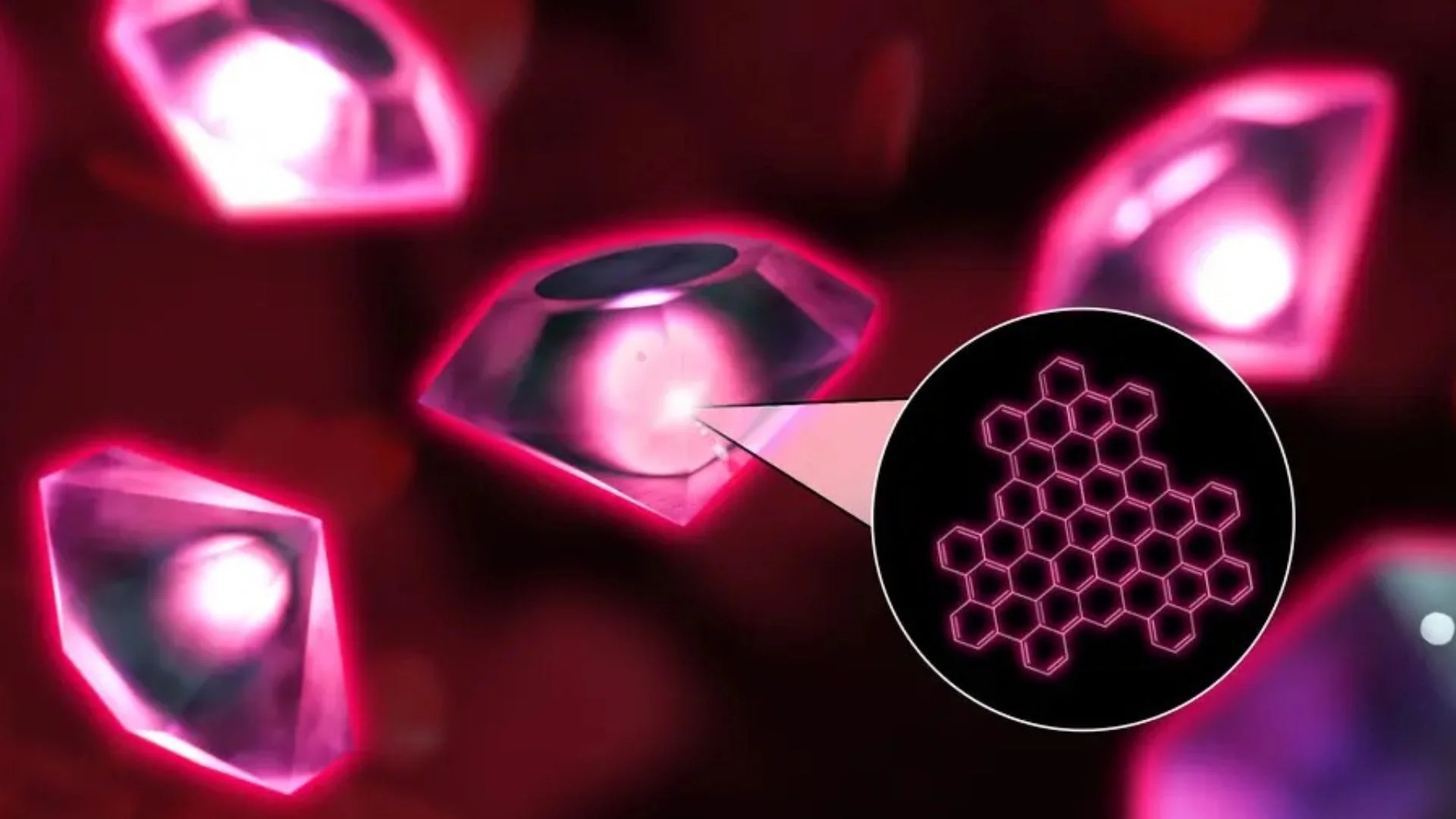
The research team used molecularly defined nanographene as the starting material. Nanographene consists of extremely small fragments of graphene, a material made of a single layer of carbon atoms. These flat carbon structures served as the foundation for the creation of nanodiamonds.
READ ALSO: MSU research: How race, socioeconomic status contribute to math education inequalities
Researchers exposed the nanographene molecules to very high pressure and high temperatures. Under these conditions, the flat carbon structures transformed directly into diamond-like crystalline materials. The result was the formation of highly uniform nanodiamonds.
One of the biggest advantages of the method is molecular-level precision. Scientists can define the structure, size, and chemical composition of the starting materials before the synthesis process begins. This control helps determine the properties of the finished nanodiamonds.
Using the technique, the team produced nanodiamonds measuring about three to four nanometres in size. The particles were highly uniform compared with those produced through conventional methods. Uniformity is important because it improves performance and consistency in scientific applications.
The process also simplifies the creation of specialized nanodiamonds. Researchers can introduce specific elements into the diamond structure during synthesis. This removes several manufacturing steps that are often required in conventional production methods.
Quantum Technology and Medical Research Gain New Tool
The team successfully incorporated silicon- and germanium-based color centers directly into the diamond lattice. Color centers are tiny defects inside a diamond structure that can emit light. These features are essential for many quantum technology applications.
Normally, creating such color centers requires additional treatments after diamond production. These steps can include ion implantation, irradiation, or other complex processing methods. The new approach integrates these features during the initial synthesis stage.
This capability enables researchers to produce fluorescent nanodiamonds in a single step. The optical properties can be tailored to match specific scientific or technological needs. Such customization is important for developing next-generation quantum devices.
READ ALSO: Heat-Free Technology Revolutionizes Fruit Dehydration
Nanodiamonds are attracting growing interest in quantum computing and quantum communication. They can function as stable single-photon sources, which are key components in secure quantum networks. They can also serve as highly sensitive sensors capable of detecting extremely small magnetic fields.
Beyond quantum technologies, nanodiamonds are gaining attention in biomedical research. Scientists are exploring their use as optical markers to track biological processes within cells. Their durability and stability make them attractive for long-term imaging applications.
Nanodiamonds Redefine Carbon Science
The research also demonstrates the growing importance of advanced carbon materials. Graphene and diamond have long been viewed as two of the most remarkable forms of carbon. This new synthesis strategy creates a direct connection between the two materials in a highly controlled way.
WATCH ALSO: World’s first motorbike backflip between two moving trucks successfully completed
The project brought together expertise from several leading institutions. Participants included DESY, Goethe University Frankfurt, Johannes Gutenberg University Mainz, the Leibniz Institute for New Materials, multiple Max Planck Institutes, the University of Cambridge, Saarland University, the University of Göttingen, and Ulm University.
The new manufacturing platform provides a scalable route to produce tailor-made nanodiamonds for future technologies. As researchers continue refining the process, these precisely engineered particles are expected to support advances in quantum sensing, photonic devices, and biomedical imaging in the years ahead.