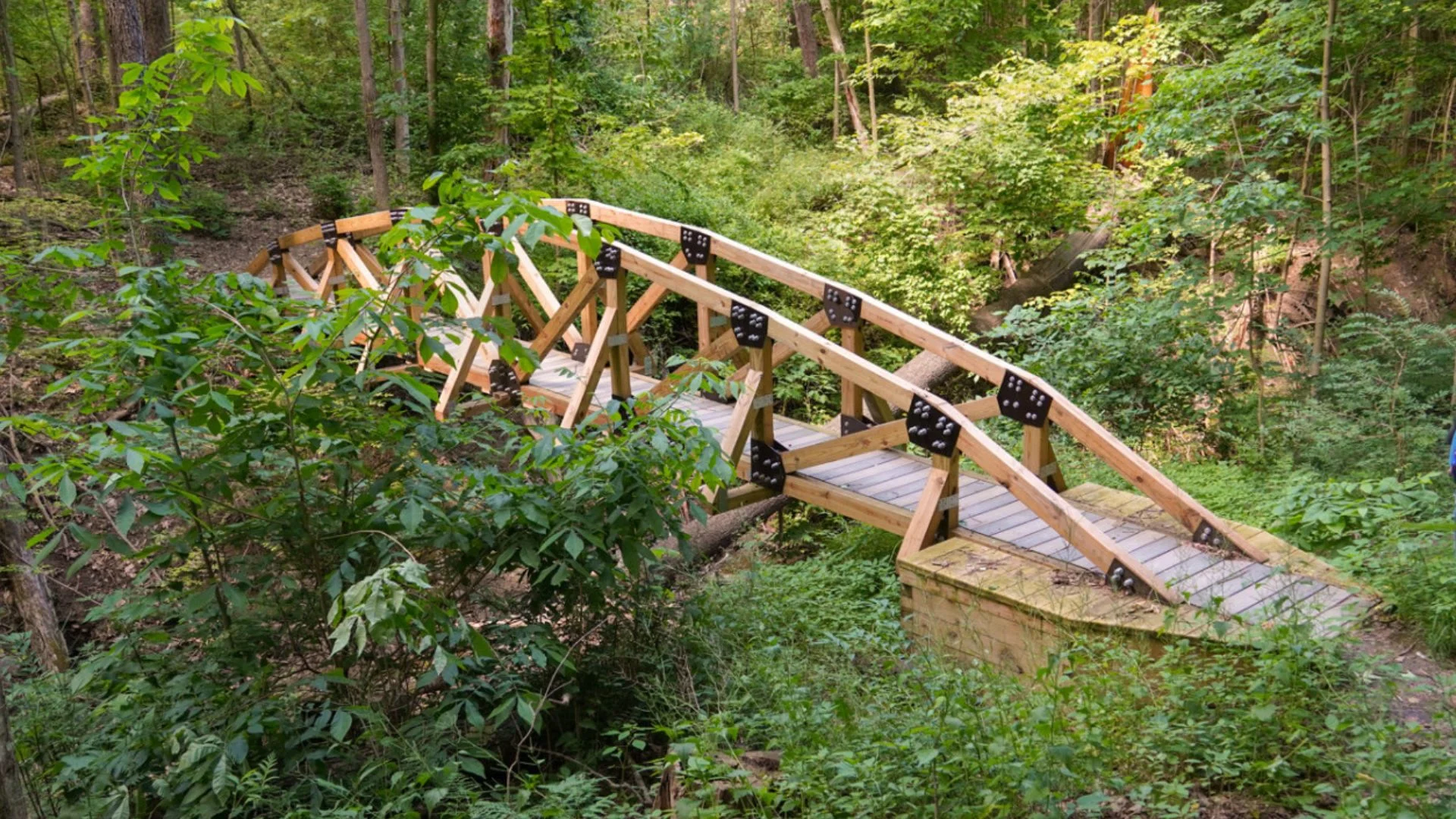
A unique engineering course at Cornell University is giving students the chance to move beyond classrooms and create infrastructure that serves local communities.
Through the program, students design, plan, permit, and build real bridges that improve access to parks and trails. The initiative has already completed multiple bridges across New York while providing valuable hands-on experience in engineering and project management.
What began as a simple conversation during a walk has grown into a program that is changing both communities and engineering education. Cornell adjunct professor Charlie Trautmann launched the effort after noticing that a popular footbridge in the Cornell Botanic Gardens had fallen into poor condition.
The idea emerged when Trautmann and his wife, Nancy, crossed the Flat Rock footbridge near Fall Creek. The bridge was deteriorating, and Nancy asked whether something could be done to repair it.
That question led Trautmann to explore ways of restoring the structure. He soon partnered with Todd Bittner, director of natural areas for Cornell Botanic Gardens, to find a solution.
The bridge played an important role in the area. It provided visitors with access to miles of trails located along the opposite side of Fall Creek.
Funding, however, presented a challenge. There was no dedicated budget available for the project, making student participation a practical and valuable option.
After more than two years of securing permits and six weeks of construction work, Trautmann and members of the Cornell Student Chapter of the American Society of Civil Engineers (ASCE) completed the 180-foot bridge in spring 2023. The project became the foundation for future community-focused engineering efforts.
The success of the Flat Rock bridge encouraged additional collaborations. In 2024, Bittner approached Trautmann again about another bridge project.
The new assignment involved building a 45-foot truss bridge in the Monkey Run Natural Area along the Cayuga Trail in the Town of Dryden. A truss bridge uses interconnected structural elements arranged in triangles, helping distribute weight efficiently and improve strength.
While working on that project, Trautmann realized students were contributing significant time and effort. He began developing a formal academic course that would allow students to earn credit while learning practical engineering skills.
That idea became reality in spring 2025 with the launch of Engineering in the Community, officially known as CEE 3090. The course was designed to provide students with direct experience in designing and constructing infrastructure projects.
The program teaches much more than technical engineering concepts. Students also learn communication, teamwork, planning, permitting, and public engagement skills.
Trautmann emphasized that engineers often serve communities beyond traditional design work. Local governments, nonprofit organizations, and community groups frequently seek technical guidance from engineering professionals.
The course reflects that reality. Students learn how technical knowledge and people-focused skills must work together to solve public challenges.
Cornell Builds Community Bridges
The value of that approach became clear in late 2024. The Dryden Rail Trail Task Force approached Trautmann and his students while planning an extension of the local rail trail toward Route 366.
The project faced a major obstacle. A section of the trail had washed away, leaving a gap roughly 16 feet deep and 45 feet wide.
Crossing the damaged area safely required a bridge. Students enrolled in Engineering in the Community took responsibility for designing the solution.
Eleven students worked on the project. During class sessions, they focused on planning and management, while weekends were dedicated to construction-related tasks.
The students handled nearly every stage of the project. They prepared site plans, completed engineering designs, and produced detailed structural drawings.
READ ALSO: Astronomy Meets AI: New Supernova Class Comes to Light
Permitting became one of the most important learning experiences. Students worked with the New York State Department of Environmental Conservation to obtain environmental approvals and determine whether endangered species were present near the construction site.
They also coordinated with New York State Electric and Gas, which owned the land where the bridge would be built. Permission from the utility company was necessary before construction could proceed.
Beyond engineering work, students managed project logistics. They collected cost estimates from steel suppliers and coordinated with the Dryden Department of Public Works regarding earth-moving activities.
The students also provided regular updates to the Dryden Rail Trail Task Force. This gave them direct experience communicating with community stakeholders and project partners.
For many participants, the project offered lessons that extended beyond textbooks. Designing a bridge from the ground up required repeated revisions and careful problem-solving.
Student Ulises Balbuena Figueroa, who helped design the steel structure, said each design revision provided new learning opportunities. The process helped students better understand how individual design choices affect an entire structure.
Because permitting and approvals took considerable time, construction could not be completed within a single semester. Many students involved in the original design graduated before the project was finished.
To ensure continuity, the graduating students prepared extensive documentation. Their notes, drawings, and plans allowed future students to continue the work without having to start over.
A new group of students resumed work on the Dryden Rail Trail bridge during the spring 2025 semester. They rebuilt formwork, prepared reinforcing steel, and prefabricated safety guardrails while awaiting final permits.
At the same time, they accepted another community challenge. Students designed and built a bridge for the new Water Tower Park in Interlaken, New York, located about 18 miles north of Ithaca.
The bridge serves as a key feature of the village’s first public park. It provides access to a natural area that community leaders hope to further develop.
According to local organizers, the structure creates opportunities for visitors to explore more of the park. It also helps connect recreational spaces that were previously difficult to access.
WATCH ALSO: American company’s next-generation ejection seat offers a 92% survivability rate
Following completion of the Water Tower Park bridge, attention returned to the Dryden Rail Trail project. The Dryden Department of Public Works and local volunteers joined efforts to finalize construction.
The bridge was completed on June 14. Its completion restored access across the damaged section of trail and supported plans for future trail expansion.
Students involved in the projects say the experience offered a different perspective on engineering. Unlike assignments completed on paper or computer screens, these projects resulted in permanent structures used by real people.
The work also highlighted the importance of collaboration. Successful completion required coordination among students, government agencies, utilities, suppliers, community organizations, and volunteers.
For Cornell’s ASCE student chapter, the projects demonstrated how engineering can directly improve daily life. The bridges now serve residents, visitors, hikers, and outdoor enthusiasts throughout the region.
The initiative also reflects a broader trend in engineering education. Universities seek opportunities to combine classroom instruction with practical experience and community engagement.
By involving students in every phase of a project, from planning to permitting and construction, Cornell’s program provides a comprehensive understanding of how infrastructure is developed. Students gain technical knowledge while learning how projects operate in real-world settings.
The bridges themselves represent more than transportation structures. They connect parks, trails, and natural spaces while creating valuable educational opportunities for future engineers.
As additional communities seek infrastructure improvements, the Engineering in the Community program offers a model that combines public service with practical learning. Its success suggests that student-led engineering projects can continue delivering lasting benefits while preparing the next generation of engineers for the challenges ahead.