A team of researchers from European XFEL, the University of Potsdam, and several partner institutions has uncovered a surprising effect inside layered metals.
Their study shows that ultrashort laser pulses can induce extremely rapid vibrations in specially engineered metal structures. The research was published in the journal Nature Communications.
The scientists built an artificial metal lattice using alternating layers of platinum and copper. Each layer measured only a few nanometers thick, making the structure thousands of times thinner than a human hair. These stacked layers acted as a highly controlled system for studying how light interacts with metals.
When the structure was exposed to a laser pulse, the metal layers immediately began to vibrate. The oscillations occurred at around 1 terahertz, which is roughly 1 trillion cycles per second. At this speed, platinum layers repeatedly expanded while compressing the neighboring copper layers.
Researchers expected the motion to result from heat generated by the laser. Normally, laser energy first excites electrons, which then transfer heat to atoms in the material. This heating causes the lattice structure to expand and move.
Laser Pulses, Unexpected Results
However, the team observed something different. The vibrations started too quickly to be explained by conventional heating processes. The results pointed to another force acting inside the metal.
READ ALSO: BAE Systems Unveils Digital Fire Control System to Modernize Artillery Operations
According to the researchers, the motion was primarily driven by electron pressure. After absorbing the laser energy, highly energized electrons created pressure within the platinum layers. This pressure pushed directly on the atomic structure before significant heating could occur.
Jan-Etienne Pudell of European XFEL said the findings were unexpected. He explained that the oscillations originated mainly from the pressure exerted by hot electrons rather than from a heated crystal lattice. This revealed a much faster pathway for converting light into mechanical motion.
Electron Pressure Replaces Heat
The discovery challenges traditional views of how metals respond to laser light. In many materials, heat is considered the dominant mechanism behind expansion and structural changes. This study shows that electrons themselves can play a direct mechanical role.
Researchers describe electron pressure as the force exerted by energized electrons pushing against surfaces and interfaces within the material. In the platinum layers, electrons are reflected from the boundaries, creating a strong internal pressure. This force acted almost instantly upon the arrival of the laser pulse.
Matias Bargheer from the University of Potsdam explained that the experiment showed electrons exerting pressure in less than a trillionth of a second. Instead of waiting for heat to spread through the lattice, the electrons effectively pushed from within. This process generated the rapid terahertz oscillations detected in the experiment.
The findings are important because they connect several fields of research. They help explain how hot electrons, heat transfer, atomic motion, and chemical reactions interact on extremely short timescales. Understanding these relationships is essential for developing future nanoscale technologies.
READ ALSO: US Air Force Orders FQ-42 and FQ-44 Drones as CCA Program Enters Production Phase
Scientists also found that the effect can be adjusted. By changing the materials used or altering layer thicknesses, researchers can influence how the vibrations behave. This opens the door to designing materials with customized ultrafast responses.
European XFEL Captures Atomic-Scale Changes
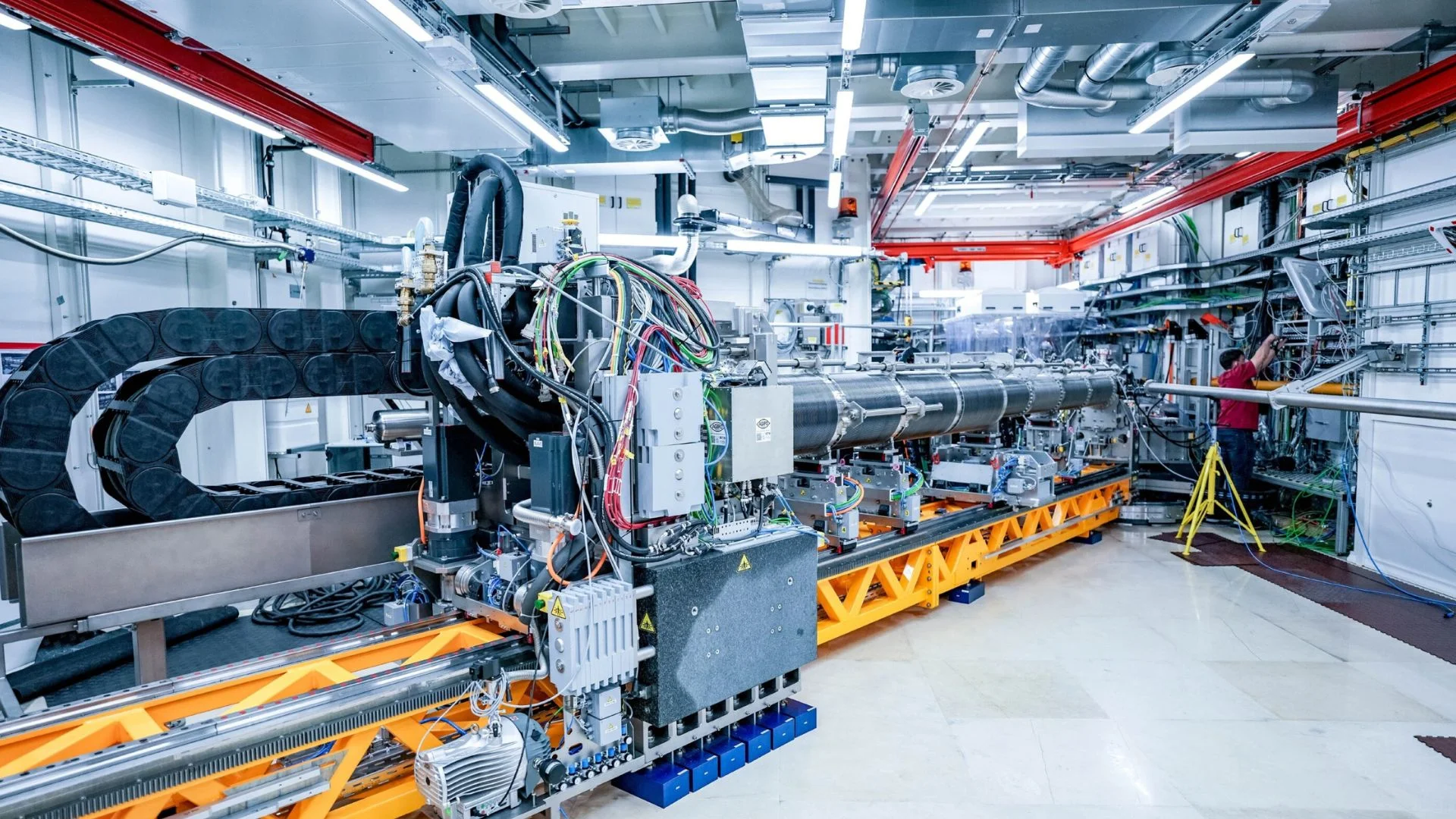
To observe the phenomenon, the team used the Materials Imaging and Dynamics (MID) instrument at European XFEL. The facility generates extremely short, powerful X-ray pulses that capture atomic-scale changes in real time. This allows researchers to study processes that occur within trillionths of a second.
The platinum-copper lattice was first excited with femtosecond laser pulses. A femtosecond equals one quadrillionth of a second. The researchers then probed the structure using equally brief high-energy X-ray pulses.
These X-ray measurements revealed how different layers moved after laser excitation. The technique provided depth-sensitive information, revealing motion throughout the structure. It also helped identify the physical mechanism responsible for the vibrations.
The study has particular significance for nanometer-scale chemistry. Electron pressure at metal surfaces can transfer energy to molecules attached to those surfaces. This process could influence future research in plasmonic chemistry, where light drives chemical reactions.
WATCH ALSO: Chinese company unveils new robot that has human-like appearance
The findings also improve understanding of energy transport in advanced materials. Faster control of atomic motion could support the development of ultrafast electronic devices, sensors, and light-driven technologies. Researchers believe the work provides a new framework for studying how light energy transforms into motion at the nanoscale.