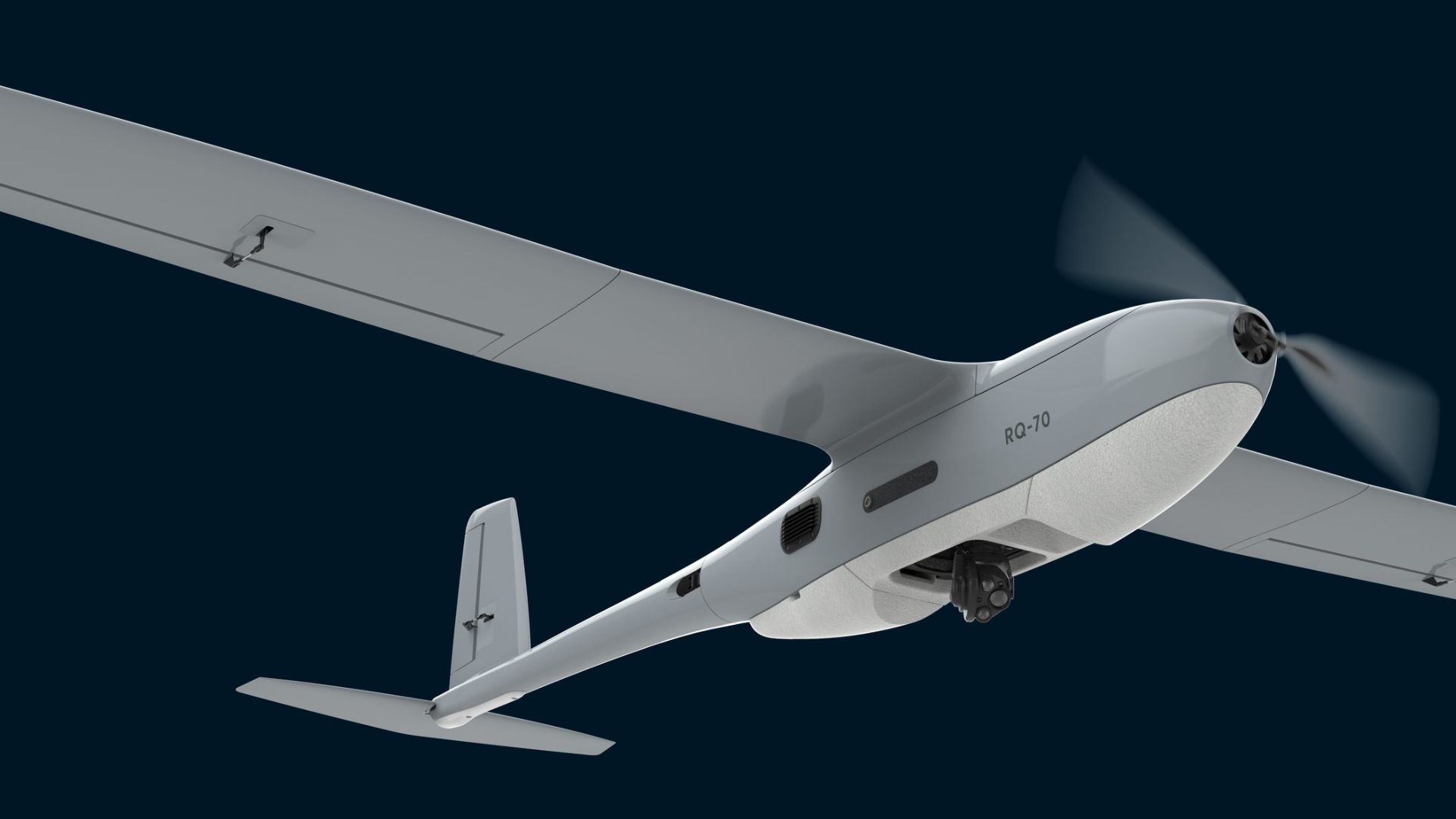
AIRO Group Holdings has officially revealed its new RQ-70 intelligence, surveillance, and reconnaissance drone during Eurosatory 2026 in Paris.
The new aircraft is designed to support long-range military surveillance missions beyond the immediate frontline. The launch expands AIRO’s growing portfolio of defense drone systems.
The RQ-70 was developed by AIRO and its wholly owned subsidiary Sky-Watch A/S. The platform is intended to provide military operators with longer mission endurance and extended operational reach. AIRO says the drone responds directly to customer demand for greater surveillance capability.
The company plans to begin full-scale production of the RQ-70 in January 2027. Manufacturing will use the same industrial infrastructure that currently supports production of the RQ-35 Heidrun drone. AIRO is already discussing future deployment opportunities with existing and potential defense customers.
RQ-70 Boosts ISR Reach
The RQ-70 is designed to perform intelligence, surveillance, and reconnaissance missions over long distances. ISR drones help military forces gather information, monitor activity, and support decision-making in real time. These systems have become important in modern military operations.
READ ALSO: Fusion Energy Milestone: Helion Becomes First US Developer With Full Regulatory Approval
One of the platform’s key features is its operational range of more than 100 kilometers (62 miles). This allows operators to collect intelligence far beyond frontline positions. The capability gives commanders access to information from deeper areas of the battlefield.
The drone can remain airborne for up to eight hours on a single mission. Longer endurance enables persistent surveillance over important locations and targets. It also reduces the need for frequent aircraft rotations during extended operations.
The RQ-70 is designed to operate in environments where GPS signals are unavailable or disrupted. Such conditions have become common in modern conflicts due to electronic warfare and signal interference. Maintaining operational effectiveness in these situations is a major requirement for military drone systems.
AI Features and Flexible Configurations
The platform incorporates onboard artificial intelligence technologies. AI can assist with data processing, mission management, and operational efficiency during flights. The addition also supports AIRO’s broader strategy of integrating advanced AI capabilities into future systems.
The drone offers multiple configuration options for different mission needs. Customers can choose from standard, long-range, and vertical takeoff and landing (VTOL) variants. This flexibility allows military operators to adapt the platform to various operational environments.
A modular payload architecture enables the aircraft to carry different sensors and mission equipment. The software system is also designed for customization. Together, these features allow users to tailor the drone to specific operational requirements.
Like the RQ-35 Heidrun, the RQ-70 can be launched by hand and recovered using a deep-stall landing method. Deep-stall landing allows the aircraft to descend steeply and land in confined areas. This reduces logistical requirements and simplifies field operations.
READ ALSO: Rheinmetall Unveils Skyspotter Drone Detection System to Protect Airports and Infrastructure
The system is designed for single-person operation. Missions can be conducted with fully autonomous flight and recovery functions. This helps reduce manpower requirements while maintaining operational effectiveness.
Building on Success of RQ-35
The RQ-70 builds on the operational experience gained from the RQ-35 Heidrun platform. The RQ-35 has been deployed by NATO member nations and allied military forces. Its field performance provided a foundation for developing a larger and longer-range surveillance system.
According to AIRO Chief Executive Officer Joe Burns, customers requested a platform with greater range and endurance while maintaining the reliability associated with the RQ-35. He said the two systems together provide military forces with a broader set of ISR options. The combination also strengthens AIRO’s position in multiple mission categories.
The company believes the RQ-70 will help expand its customer base across allied defense organizations. Demand for long-range surveillance drones continues to increase as militaries seek better battlefield awareness. Nations are also investing heavily in autonomous systems that can operate efficiently in contested environments.
The drone is designed to connect with modern digital battlefield networks. Fast information sharing has become a critical requirement for military operations. Integrating surveillance platforms into connected command systems helps deliver intelligence to decision-makers more quickly.
WATCH ALSO: China’s UBTech has started world’s first mass delivery of humanoid robots
AIRO Executive Chairman Dr. Chirinjeev Kathuria said modern conflicts depend on the speed at which intelligence is collected and delivered. The RQ-70 was developed to support that need through persistent long-range surveillance. Its design focuses on providing reliable intelligence within connected military environments.
The public unveiling at Eurosatory 2026 offers defense customers and industry partners their first close look at the aircraft. Visitors can evaluate its design, scale, and operational concept firsthand. The event also provides AIRO with an opportunity to showcase its expanding defense technology capabilities.
As AIRO moves toward production in 2027, the RQ-70 is expected to play an important role in the company’s long-term growth strategy. The platform strengthens its position in the competitive ISR drone market. Growing demand for long-range autonomous surveillance systems is expected to keep such capabilities at the center of future defense planning.