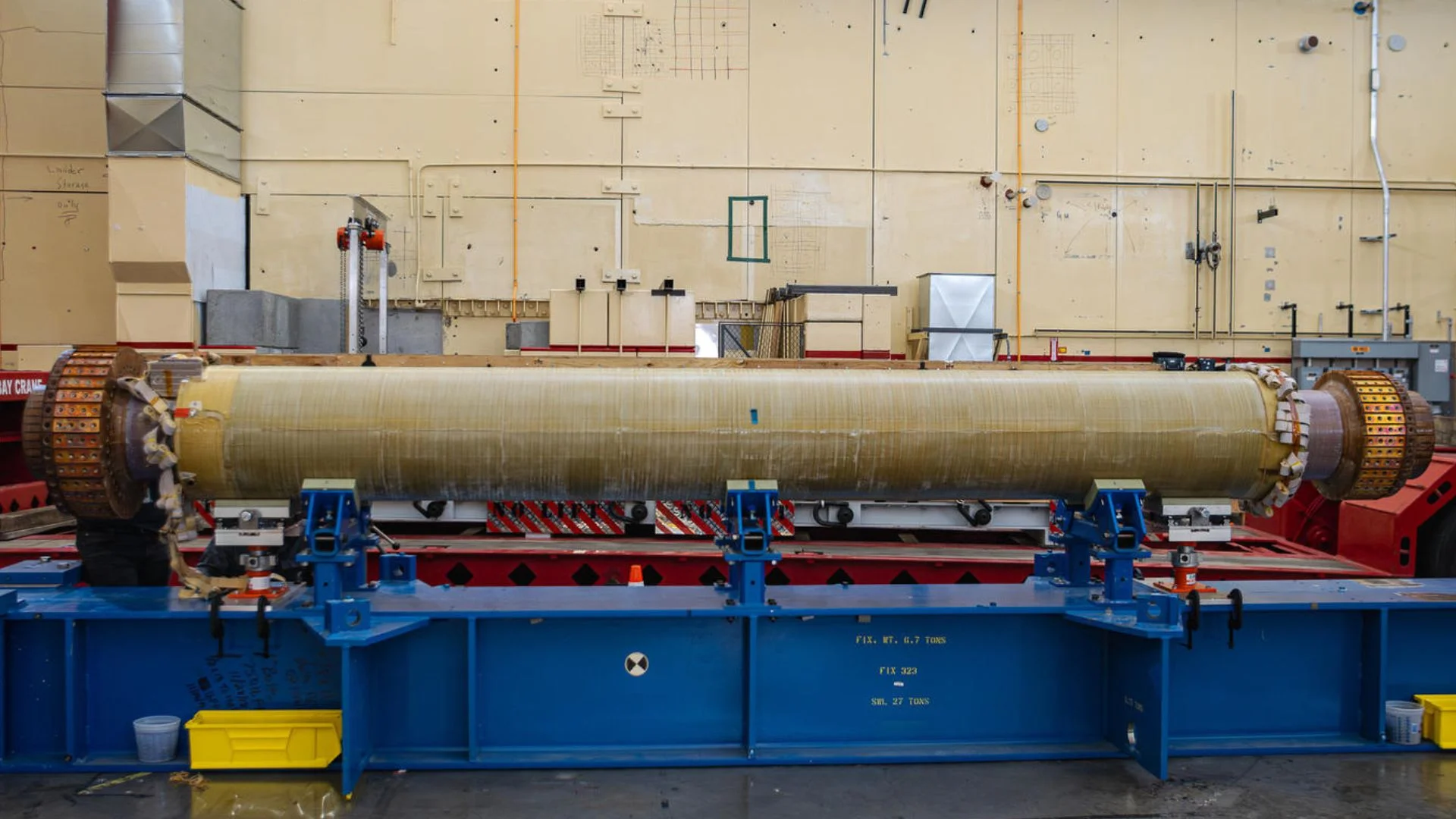
A major milestone has been reached in the US’s effort to advance fusion energy research. Princeton Plasma Physics Laboratory (PPPL) in New Jersey has received the central magnet bundle for its National Spherical Torus Experiment-Upgrade (NSTX-U), bringing the powerful fusion research system a step closer to operation.
The magnet bundle arrived at PPPL on June 3 after a long international journey. It was manufactured by Elytt Energy in Bilbao, Spain, transported across the Atlantic Ocean, and flown into Newark Liberty International Airport. From there, it completed its final trip by truck to the laboratory’s campus in Princeton.
The delivery represents a major step in the reassembly of NSTX-U. Laboratory officials described the arrival as one of the most significant moments in the project’s recent history because the machine cannot operate without this central component.
NSTX-U is designed to explore the potential of fusion energy, a process that powers the Sun and stars. Fusion occurs when light atomic nuclei combine under extremely high temperatures and pressures, releasing large amounts of energy. Scientists around the world are working to harness this process as a future source of low-carbon electricity.
Unlike conventional power plants that burn fuel, fusion systems aim to produce energy using hydrogen-based fuels while generating minimal long-lived radioactive waste. Researchers view fusion as a possible long-term solution for meeting growing global energy demands.
READ ALSO: The “Spacecraft Speedometer” is a novel and cutting-edge method for monitoring satellite movement.
The NSTX-U project focuses on a specific type of fusion device, the spherical tokamak. Traditional tokamaks have a doughnut-shaped design, while spherical tokamaks are more compact and resemble a cored apple. This shape allows them to operate efficiently while using a smaller structure.
Scientists want to determine whether spherical tokamaks can serve as practical foundations for future commercial fusion power plants. If successful, these systems could potentially reduce construction costs and improve performance compared to larger conventional designs.
NSTX-U Fusion Magnet Arrives
The newly delivered magnet bundle is one of the machine’s most important components. It weighs approximately 23,000 pounds and stretches nearly 20 feet, making it roughly comparable in size to a school bus.
The bundle combines two major magnetic systems into a single assembly. One system creates the toroidal magnetic field that surrounds and stabilizes the superheated plasma inside the reactor. The second system generates magnetic fields that help drive electrical current through the plasma, providing additional heating and confinement.
Plasma is often described as the fourth state of matter. It forms when gases become so hot that electrons separate from atoms, creating a charged mixture that responds strongly to magnetic fields.
Because plasma temperatures in fusion experiments reach millions of degrees, no solid material can contain it directly. Instead, powerful magnets keep the plasma suspended away from the reactor walls.
Building the magnet bundle required a complex manufacturing process. Engineers first assembled the toroidal field magnet using 36 copper conductors, each measuring about 19 feet long.
Technicians wrapped these conductors with fiberglass insulation and resin, then permanently bonded them together using a process called vacuum-pressure impregnation. This technique removes trapped air and strengthens the entire structure.
READ ALSO: Burning plastic for cooking and heating an emerging crisis, study finds
The ohmic-heating magnet was then constructed by winding copper coils around the toroidal magnet. Engineers applied additional insulation and resin, then used the same bonding process to create a unified assembly capable of withstanding extreme operating conditions.
Once installed, the bundle will generate two separate magnetic field systems inside NSTX-U. One field circles around the machine’s main chamber and helps keep the plasma stable.
The second magnetic field runs in a different direction and changes over time. As it changes, it induces an electrical current within the plasma, similar to how electromagnetic induction works in many electrical devices.
That electrical current serves two purposes. It heats the plasma and creates additional magnetic fields that help maintain confinement during experiments.
NSTX-U is expected to contribute directly to the US Department of Energy’s Fusion Science and Technology Roadmap. This national strategy outlines scientific and engineering goals needed to support a competitive domestic fusion energy sector.
Researchers also plan to use data generated by NSTX-U to support the development of artificial intelligence. Large volumes of experimental data can help train AI systems that monitor plasma behavior, improve machine performance, and assist operators in managing complex fusion experiments.
The machine functions as a national user facility. This means scientists from universities, research institutions, and laboratories across the country can submit proposals and use NSTX-U for approved research projects.
Following its arrival, the magnet bundle was transported to PPPL’s D-Site complex, where NSTX-U is located. Engineers used a powerful overhead crane capable of lifting 15 tons to remove the component from the transport vehicle.
The bundle was then placed on specialized equipment known as a tilt fixture. Over the coming months, engineers will carefully rotate the structure into a vertical position before moving it closer to the fusion device.
The installation process requires extensive planning and precision. Teams must protect the magnet from damage while ensuring every connection aligns correctly with the rest of the machine.
WATCH ALSO: China’s new massive battle tank takes part in live-fire test
Before installation, workers will place a protective metal casing around the magnet bundle. The casing includes carbon-based heat-resistant tiles that shield sensitive equipment from intense thermal conditions within the reactor.
These tiles perform a similar protective function to the thermal shielding once used on NASA’s Space Shuttle. They help prevent heat from damaging critical internal components during plasma operations.
After the casing is installed, cranes will lower the magnet into the center of NSTX-U through an opening at the top of the machine. Engineers will then secure it and connect it to supporting systems.
The next stage involves attaching 72 specialized electrical connectors known as flexbuses. These components will deliver power and connect the bundle to the rest of the machine’s magnetic systems.
Technicians will also complete cooling system connections and install the remaining internal protective tiles. Additional work includes setting up a bakeout system to heat internal surfaces and remove impurities before plasma experiments begin.
WATCH ALSO: Humanoid robot folds towel autonomously after observing human
The final phase before scientific operations is commissioning. During this process, engineers test all systems together to verify that the machine functions safely and as designed.
PPPL expects NSTX-U experiments to begin in 2027. Once operational, the facility will become one of the world’s leading platforms for studying compact fusion systems and exploring pathways toward future fusion power plants.
The arrival of the magnet bundle closes one of the final major chapters in NSTX-U’s reconstruction. As installation work continues, researchers are preparing for a new generation of experiments that will help shape the future of fusion energy, advanced plasma science, and next-generation clean power technologies.