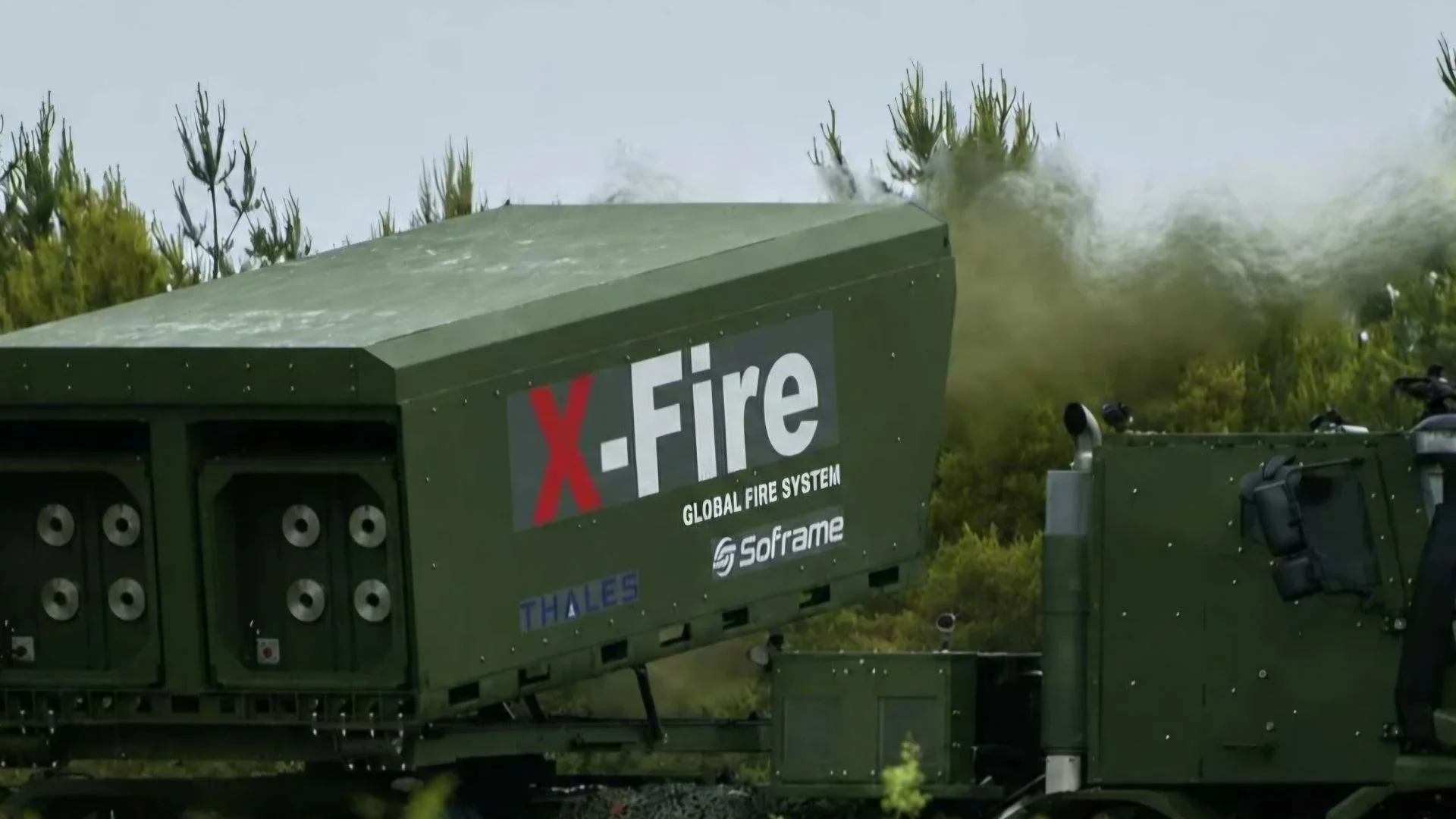
France has completed the first live firing tests of the X-Fire long-range rocket artillery system developed by Thales.
The tests are part of the country’s broader effort to rebuild an independent deep-strike capability for modern warfare. The project also supports Europe’s wider goal of reducing reliance on foreign defense systems.
Thales revealed the firing campaign on May 26, 2026. The company conducted the tests with support from ArianeGroup and several French defense partners. The trials focused on validating rocket launches, fire-control systems, launcher stability, and rapid mobility during combat operations.
The X-Fire launcher is mounted on a highly mobile 6×6 tactical truck chassis. The system is designed for shoot-and-scoot operations, where crews launch rockets and quickly move before enemy forces can respond. This tactic has become increasingly important on modern battlefields because of counter-battery radars and loitering drones.
France wants the new system to replace its aging Lance-Roquettes Unitaire rocket artillery platform. The country also aims to build a sovereign strike capability capable of hitting targets more than 150 kilometers away. Future versions are expected to support even longer-range precision strikes.
X-Fire Modular Architecture
The X-Fire system uses a modular launcher architecture. This means it can potentially fire different types of guided rockets and future long-range missiles. Thales also designed the launcher with digital fire-control systems that support interoperability with NATO command networks.
READ ALSO: CT Scan Reveals First Known Jaw Surgery in 2,500-Year-Old Pazyryk Culture
French defense officials see long-range precision fires as a key requirement for future conflicts. The war in Ukraine showed how rocket artillery can disrupt supply routes, destroy command centers, and weaken logistics far behind the front line. Precision strikes at operational depth have become central to modern land warfare.
The X-Fire project is one of two separate long-range rocket artillery programs now underway in France. Thales and Soframe are leading the X-Fire effort, while the French company Turgis & Gaillard is developing another system called Foudre. Both projects support France’s strategic goal of rebuilding national deep-strike capabilities.
The distinction between the two programs is important because they are independent systems. They use different industrial teams and technological approaches. France appears determined to encourage competition and innovation within its domestic defense sector.
Thales X-Fire Versus HIMARS
The X-Fire launcher is often compared with the US-made HIMARS system. HIMARS, developed by Lockheed Martin, has become one of the most recognized rocket artillery platforms in the world. The system gained global attention after its extensive use during the war in Ukraine.
HIMARS uses a 6×6 wheeled chassis and carries one pod with six guided rockets or one tactical missile. It can strike targets more than 70 kilometers away with Guided Multiple Launch Rocket System rockets. The launcher can also fire ATACMS tactical ballistic missiles at ranges up to 300 kilometers.
The US is also integrating the Precision Strike Missile into HIMARS. This next-generation missile is expected to push strike ranges beyond 500 kilometers. That extended reach is shaping future military planning among NATO countries.
France’s X-Fire launcher shares several operational similarities with HIMARS. Both systems focus on mobility, rapid deployment, and precision strikes against high-value targets. However, the French system is being designed with a different strategic objective.
READ ALSO: China Unveils First 20K Rapeseed Gene Chip to Cut Crop Breeding Time to 3 Years
Thales wants X-Fire to support a European-controlled munition ecosystem. France aims to avoid dependence on a single foreign supplier for rockets, software, or export approvals. This approach gives Paris greater control over production, upgrades, and operational use.
The system’s modular design also opens the door for future European missile integration. Thales has not released full details about the planned rocket family or payload configurations. However, defense analysts expect the launcher to support guided rockets and possibly cruise missile-class weapons in the future.
Operational flexibility is becoming increasingly important for modern artillery systems. Armies now require launchers that can quickly adapt to different missions and evolving threats. Modular systems also reduce long-term costs by allowing upgrades without replacing the entire platform.
Another major factor behind the project is Europe’s growing defense autonomy strategy. Several European countries are increasing military spending after Russia’s invasion of Ukraine. Governments are also reassessing their dependence on US defense systems and global supply chains.
The European Union has pushed for stronger continental defense manufacturing in recent years. Programs linked to long-range strike systems are receiving increased attention across NATO member states. European leaders believe local production improves security during prolonged conflicts.
The HIMARS system remains highly respected because of its combat record. Ukrainian forces used the launcher to strike Russian ammunition depots, bridges, and command posts far behind the front line. Those attacks forced Russia to move logistics hubs farther away, reducing operational efficiency.
France now wants to build a similar operational capability using domestic technology. A sovereign system gives French forces unrestricted access to munitions and maintenance support. It also removes the uncertainty surrounding foreign political approval for missile exports.
The export market is another important consideration for the X-Fire program. Some countries prefer alternatives to US-controlled defense systems because of export restrictions tied to American Foreign Military Sales rules. France sees an opportunity to compete in the growing global market for long-range artillery systems.
The X-Fire launcher could eventually compete with South Korea’s K239 Chunmoo and Israel’s PULS systems. Both platforms have attracted strong international interest in recent years. Demand for long-range rocket artillery has increased sharply since the start of the Ukraine conflict.
WATCH ALSO: American company’s next-generation ejection seat offers a 92% survivability rate
NATO Timing
The timing of the French tests is strategically significant for Europe. NATO countries are rebuilding stockpiles of precision-guided munitions after years of limited production capacity. Defense planners now see long-range strike systems as essential for deterrence and battlefield survivability.
The X-Fire launcher remains in the demonstration phase for now. Additional testing and development work will be required before the system enters operational service. France has not announced a final deployment timeline yet.
Still, the successful live firing campaign represents an important milestone for the French defense industry. It shows that France is moving closer to restoring a fully sovereign long-range artillery capability. The project also highlights Europe’s broader effort to strengthen military independence in an increasingly unstable security environment.
WATCH ALSO: World’s first motorbike backflip between two moving trucks successfully completed
If the program continues to advance, X-Fire could become one of Europe’s first fully indigenous long-range precision rocket artillery systems designed specifically for the post-Ukraine era of warfare.
Mobility, survivability, rapid targeting, and precision strikes are now shaping the future of land combat. France appears determined to secure a leading role in that evolving battlefield landscape.