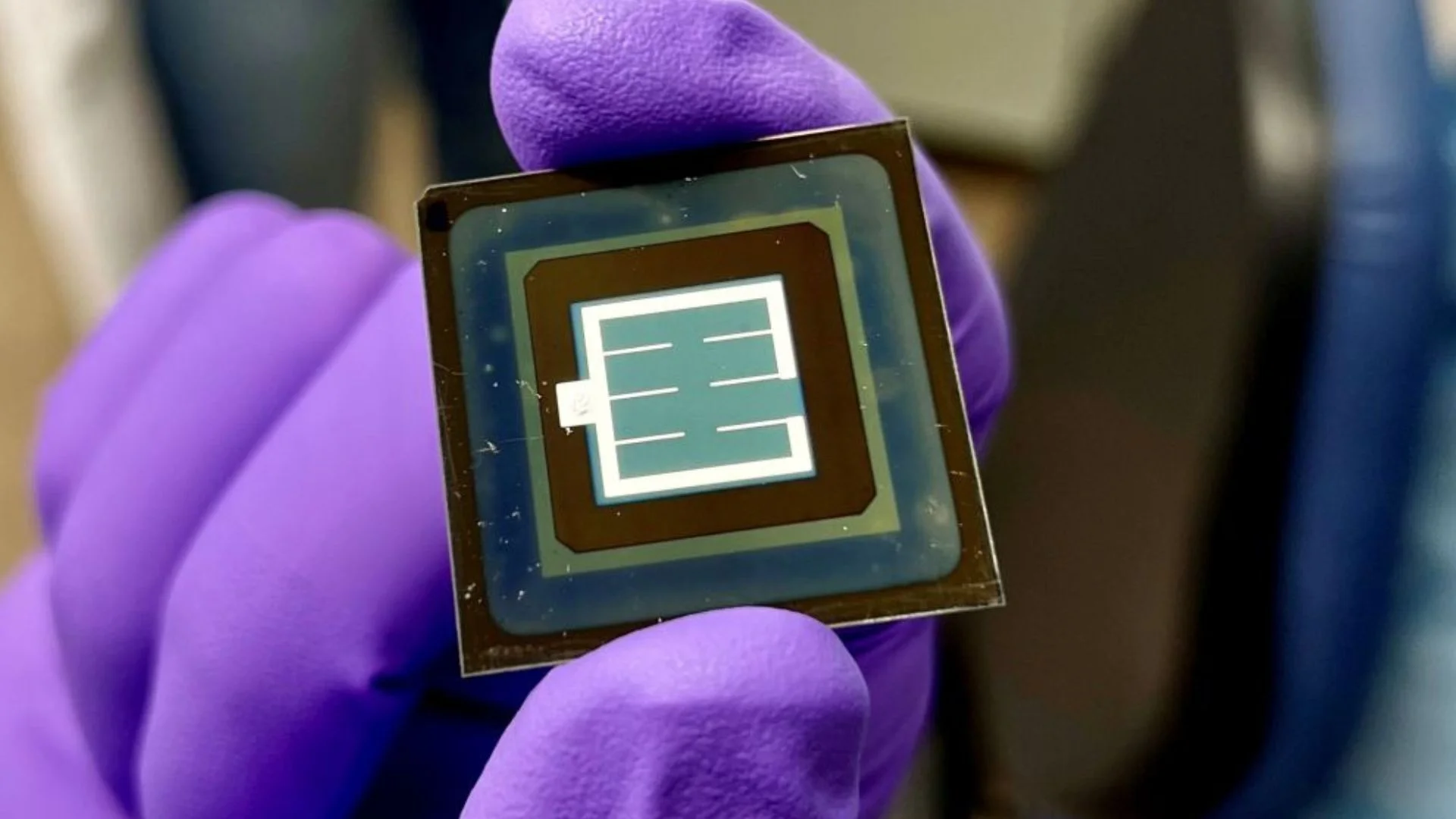
Scientists in Europe have developed a faster, more scalable method for manufacturing high-efficiency perovskite-silicon tandem solar cells.
The research was carried out by teams from the Karlsruhe Institute of Technology and the University of Valencia. Researchers used a solvent-free vacuum process to deposit uniform perovskite layers onto textured silicon surfaces in just a few minutes.
The method is based on close-space sublimation, a fast coating technique designed for industrial-scale production. The tandem solar cells produced with this process achieved efficiencies of up to 24.3 percent during testing.
The findings were published in the journal Nature Energy.
Perovskite-silicon tandem solar cells use two semiconductor layers instead of one. The top perovskite layer captures high-energy sunlight, while the silicon layer underneath absorbs lower-energy light. This design enables the solar cell to convert more sunlight into electricity than a standard silicon-only panel.
One major challenge in producing these cells is applying the thin perovskite coating evenly and quickly. Industrial manufacturers need a process that works at high speed across large surfaces without damaging the materials. Many current methods still rely on slow coating systems or liquid solvents.
READ ALSO: MQ-25A Stingray Certified for Low-Rate Initial Production as Boeing Contract Nears
The research team used a vacuum-based method called close-space sublimation(CSS). In this process, source materials are heated until they evaporate and travel only a short distance to the silicon surface. The materials then react directly on the solar cell to form the perovskite layer.
Researchers said the process works much faster than many traditional vacuum coating methods. The full conversion to a working perovskite layer took about 10 minutes during testing. The process also reduced material waste because the precursor sources can be reused multiple times.
Professor Ulrich Paetzold from KIT said industrial manufacturing requires more than just high efficiency. He explained that manufacturers also need processes that are stable, fast, and scalable for large production lines.
The researchers demonstrated that the CSS process can meet those industrial demands while still producing efficient solar cells.
Perovskite Layer Achieves Controlled Band Gap
The scientists also worked to improve the material properties within the perovskite layer. A key target was adjusting the band gap, which controls how much sunlight the material absorbs. In tandem solar cells, the upper layer requires a wider band gap to efficiently absorb sunlight and transfer it to the silicon layer below.
The team initially used a bromine-containing inorganic precursor layer to increase the band gap. However, the bromine concentration changed during the conversion process, reducing control over the final material. This created difficulties in maintaining the desired solar performance.
To solve this issue, the researchers introduced a mixed organic source containing methylammonium iodide and methylammonium bromide.
By adjusting the ratio between the two compounds, they controlled the bromine content more accurately. This allowed the team to achieve a band gap of 1.64 electronvolts, which is suitable for tandem solar cell applications.
Dr. Alexander Diercks from KIT’s Light Technology Institute helped develop the method during research work at the University of Valencia.
The collaboration took place under the Horizon Europe Nexus project. Researchers said international cooperation played an important role in refining the manufacturing process.
WATCH ALSO: Blue dogs spotted in Chernobyl nuclear disaster site spark concern
The study also tested whether the process worked on different silicon surface textures. Modern silicon solar cells often use textured surfaces because they trap more sunlight and improve absorption. Smooth surfaces alone are not enough for many commercial solar technologies.
The CSS process successfully coated smooth, nano-structured, and micro-structured silicon surfaces without changing the manufacturing settings.
Laboratory imaging and X-ray analysis confirmed that the perovskite layers formed evenly across all surfaces. This consistency is important for mass production because industrial wafers rarely have perfectly flat surfaces.
The finished tandem solar cells delivered strong efficiency results during testing. The smooth silicon cells achieved 23.5 percent efficiency, while nano-structured cells reached 23.7 percent. Micro-structured silicon cells delivered the highest efficiency at 24.3 percent.
These numbers are important because higher efficiency means solar panels can generate more electricity from the same amount of sunlight. Improved efficiency also reduces the land area and installation space needed for solar projects. This helps lower overall system costs over time.
The research also highlights growing global interest in perovskite solar technology. Silicon solar panels dominate the market today, but their efficiency improvements have slowed in recent years.
Tandem designs using perovskite materials are now considered among the strongest options for improving solar performance.
Another advantage of the new process is the absence of liquid solvents during coating. Solvent-free manufacturing can simplify production lines and reduce environmental concerns linked to chemical waste. Vacuum-based systems are also easier to integrate into existing industrial equipment used for electronics and semiconductor manufacturing.
Professor Henk Bolink from the University of Valencia said the process is highly relevant for practical deployment.
He noted that a manufacturing method limited to perfectly smooth surfaces would have little industrial value. The ability to coat textured silicon cells uniformly moves the technology closer to commercial use.
The research represents an important step toward large-scale production of next-generation solar panels. Faster manufacturing and stable coating methods remain essential for bringing tandem solar cells into mainstream energy markets. However, scalable perovskite-silicon technology is expected to play a larger role in future solar power systems.