Engineers at the University of Pennsylvania have turned a simple knot into a tiny soft robot that stores energy and releases it in a sudden burst to jump, fly, and even plant seeds.
The work, published in Science, shows how a small change in thinking can turn an ordinary knot into a powerful system.
The research team, led by materials scientist Shu Yang and postdoctoral researcher Yaoye Hong, focused on a key idea: what happens when a knot is designed to come undone rather than stay tight?
When triggered, these tiny robots can leap nearly two meters into the air. That is hundreds of times their own size.
At the center of the system is a thin fiber, no thicker than a millimeter. It is made from two materials with very different properties. A strong core of Kevlar provides stiffness. Around it sits a soft shell made of liquid-crystal elastomer, a flexible material that responds to heat.
READ ALSO: From Weeks to Hours: AI’s Silent Takeover of US Nuclear Licensing
These materials allow the fiber to twist and store energy. When tied into a knot, that energy builds up like a spring held in place by a latch.
Yang explains it simply: “People see a knot as something passive. We designed it so the knot itself acts like an active system.”
The process begins when the fiber is twisted and tied. This stores elastic energy inside the structure. The knot acts as a lock, holding that energy in place. When the temperature rises to about 60-90 °C, the outer layer contracts. This loosens the knot just enough to trigger a rapid release. In a fraction of a second, the stored energy turns into motion.
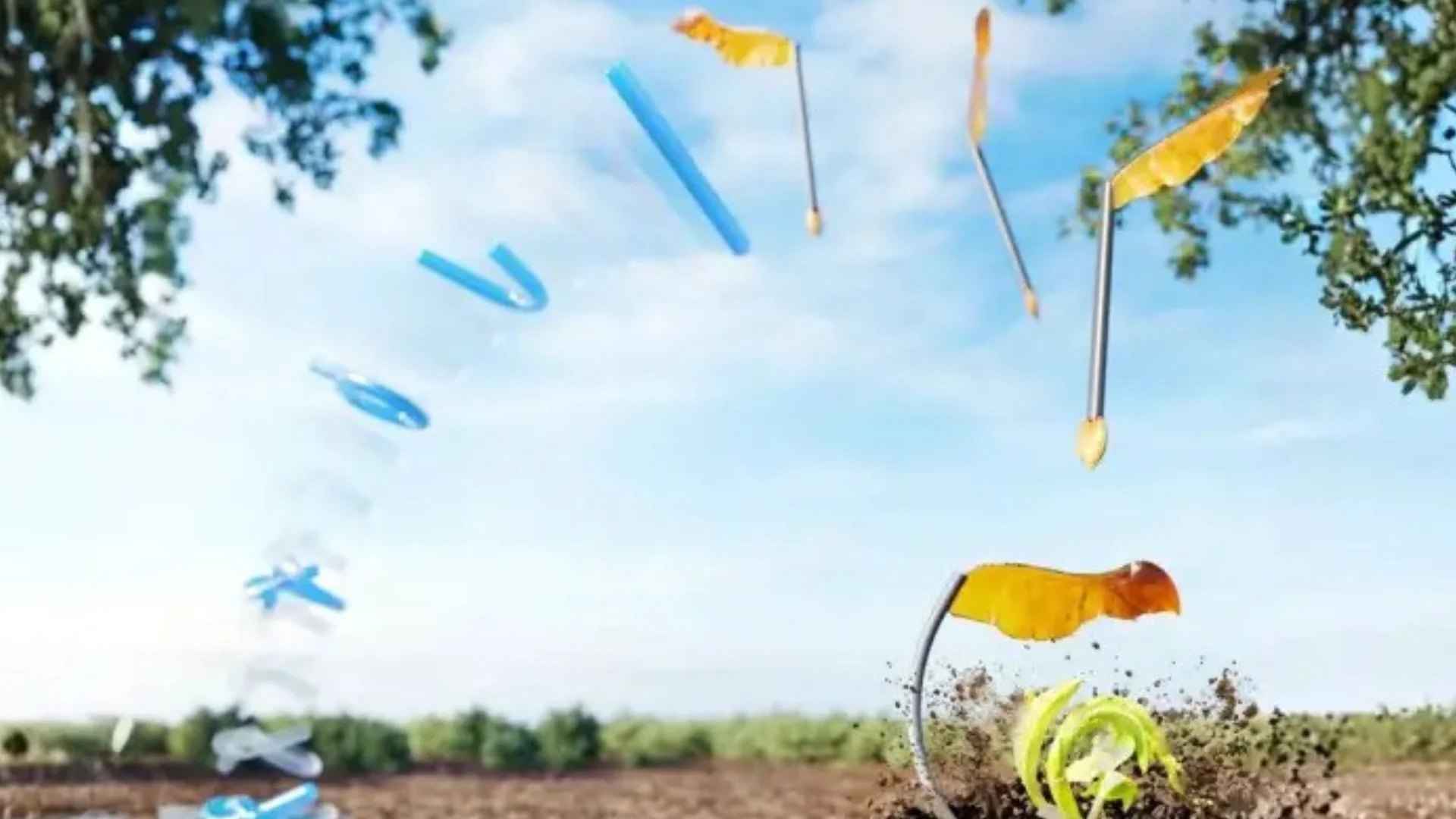
The small fiber snaps open and launches itself into the air. Some versions flip. Others spin like a propeller. A few glide through the air and return close to where they started.
Hong says the team quickly realized how much control they had. “We can change how the robot moves by changing the knot,” he explains.
This control comes from what scientists call knot topology. It describes how a knot is arranged in three dimensions. A simple overhand knot makes the robot flip. A figure-eight knot causes spinning. More complex knots can release energy in stages, creating multiple movements during a single jump.
WATCH ALSO: Humanoid robot plays table tennis like human beings
The idea first emerged when Hong studied how twisted fibers behave under stress. Adding knots introduced a new level of control. It allowed the team to store more energy and decide how to release it.
“Knotting the fiber lets us store more energy,” Hong says. “By changing the knot, we control the motion.”
The researchers also looked to nature for inspiration. To guide the robots in the air, they added a thin wing-like structure. This design is inspired by the way maple seeds fall. These seeds spin as they descend, helping them travel farther from the tree.
In the robot, the wing helps control direction and stability. Some designs move forward and land far away. Others curve back, almost like a boomerang. But the most interesting feature comes after landing. The robot’s jump creates enough force to drive part of the structure into the soil. This allows it to plant seeds.
The team tested this by attaching seeds such as pine and arugula to the fibers. After jumping and landing, the seeds successfully entered the soil and began to grow. This opens up new possibilities for agriculture and reforestation.
Earlier designs from the group relied on moisture to activate seed carriers. Those systems used materials that reacted to rain. But they had limitations. Heavy rain could wash seeds away. Dry conditions could stop the system from working at all.
Yang points out the issue clearly. “We don’t always have rain, but we do have the sun,” she says.
READ ALSO: MQ-4C Triton Vanishes Mid-Flight After 50,000 Ft Drop, US Navy Confirms Crash
The new system uses heat instead of water. Sunlight can provide the temperature needed to trigger the motion, especially in warm regions. This makes the system more reliable in real-world conditions.
It is also much more powerful. The jumping motion creates about 30 times more pressure than earlier designs. This helps push seeds firmly into the ground, improving the chances of growth. The project did not start with farming in mind. It began as a simple exploration of how materials behave.
Yang says curiosity drives much of their work. “We start with interesting ideas and see how far we can take them,” she explains.
One important step came when the team added the Kevlar core. This strengthened the fiber and enabled it to store more energy. As a result, the jumping height doubled. The performance now matches that of small insects like springtails, which are known for their powerful jumps.
The combination of materials is key. Kevlar provides strength and resists bending. The outer layer responds to heat and drives motion.
Hong highlights this balance. “These materials work together to create movements we could not achieve before,” he says.
WATCH ALSO: Apple launches iPhone 17 lineup with contoured edges, and thinner borders
The current version of the robot is still a model system. The researchers plan to improve it further. Future designs may use more eco-friendly materials. The team is also working to lower the activation temperature and improve how the robots interact with soil.
The long-term goal is to build small machines that can operate independently, without electronics or batteries.
Yang sees this as part of a larger vision. “This is one piece of a bigger system,” she says. “We are thinking about how to deliver seeds and adapt to different environments.”
Nature continues to guide their work. From the jumping ability of insects to the flight of seeds, each idea adds to the design. What started as a simple knot has become something far more powerful. Under the right conditions, even a small tangle can turn into a machine that moves, flies, and helps grow new life.