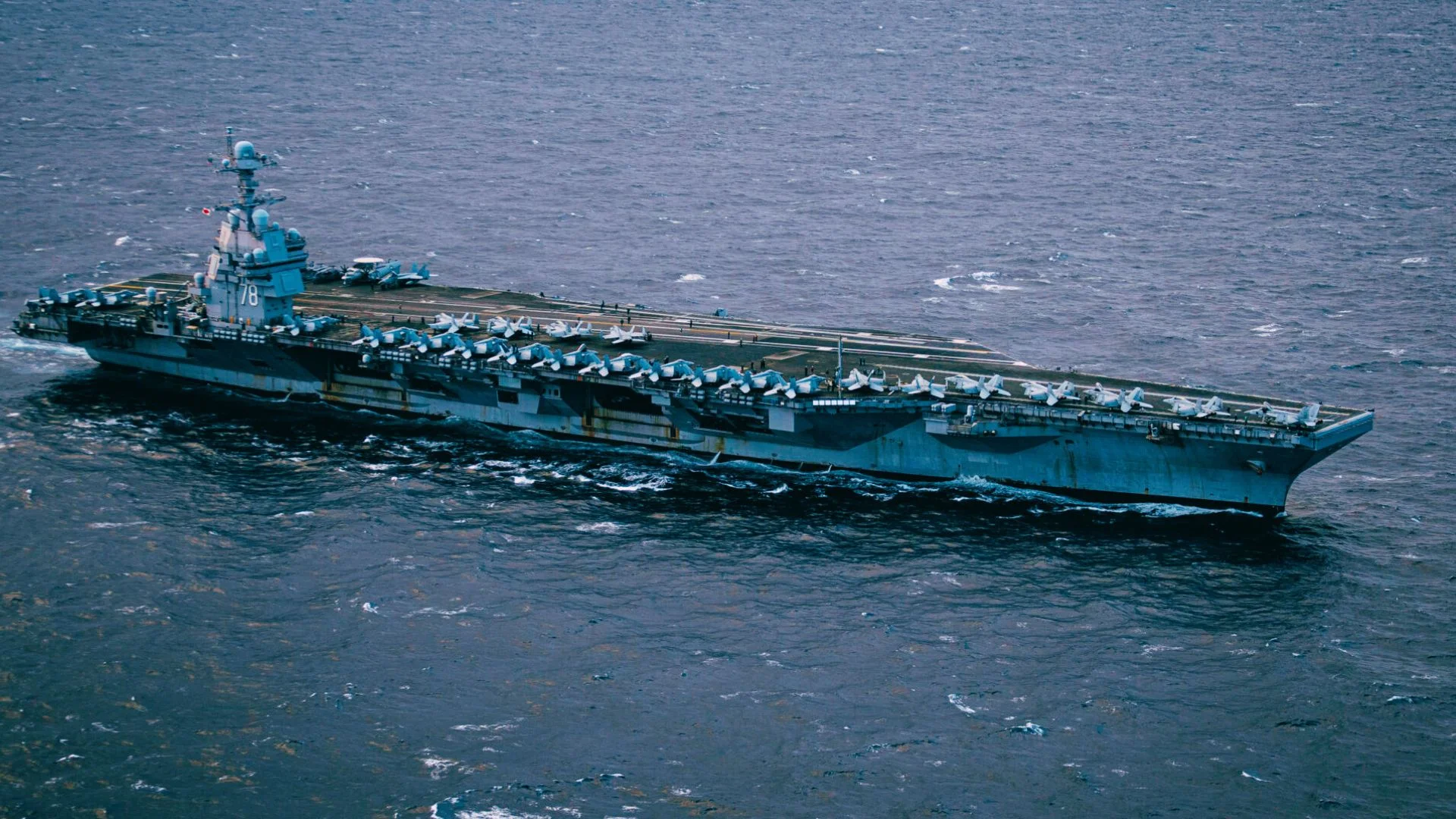
The world’s largest warship, USS Gerald R. Ford (CVN-78), has set a new record for the longest modern deployment by a US carrier since the Vietnam War era.
The milestone highlights not just endurance, but also the growing role of advanced naval power in today’s global security landscape.
The carrier left its home base at Naval Station Norfolk in Virginia on June 24, 2025. Since then, it has remained at sea for 295 days. This long stretch has taken the ship across several important regions, including the Arctic Circle, the Mediterranean Sea, the Caribbean, and the Red Sea. Each of these areas plays an important role in global trade and military strategy.
READ ALSO: Pentagon Shaken as Starlink Failure Halts US Navy Drones Mid-Test, Exposing Risks
This 295-day deployment breaks the previous record held by USS Abraham Lincoln (CVN-72). That ship spent 294 days at sea in 2020, when its mission was extended during the COVID-19 pandemic. The new record shows how operational demands on the US Navy continue to grow in a more complex global environment.
Ford Carrier Deployment
On board the USS Gerald R. Ford are nearly 4,500 sailors. Soon after departure, the carrier moved to the North Sea. There, it carried out joint exercises with NATO partners, including Norway, Germany, and France. These operations were aimed at improving coordination and strengthening alliances.
But the USS Gerald R. Ford is not just another aircraft carrier. It represents a major step forward in naval technology. As the lead ship of the Ford-class, it introduces several advanced systems that set it apart from older carriers.
WATCH ALSO: India’s DRDO successfully completes user evaluation trials of Akash-NG Missile System
The ship weighs over 100,000 tons and is powered by two next-generation A1B nuclear reactors. These reactors produce far more electricity than earlier models. This extra power allows the ship to support modern systems and future technologies, including advanced weapons.
One of its most important features is the Electromagnetic Aircraft Launch System(EMALS). Unlike older carriers that use steam catapults, this system uses electromagnetic force to launch aircraft. It makes launches smoother and reduces stress on planes. It also allows a wider range of aircraft to take off safely.
The Advanced Arresting Gear (AAG) system works alongside EMALS. It helps recover aircraft more efficiently upon landing on the carrier. Together, these systems improve the speed and safety of flight operations.
Because of these upgrades, the USS Gerald R. Ford can carry out more flight missions in a day than older carriers. The Navy says it can generate up to 33 percent more sorties during sustained operations. This gives it a major advantage during both peacetime patrols and combat situations.
READ ALSO: Rocket Lab’s Gauss: Electric Propulsion Satellite Thruster to Meet Constellation Demand
The ship’s air wing is equally powerful. It includes F-35C Lightning II stealth fighters, F/A-18 Super Hornets, EA-18G Growlers for electronic warfare, and E-2D Advanced Hawkeyes for surveillance. These aircraft allow the carrier to handle a wide range of missions, from air defense to precision strikes.
Another key feature is the Dual Band Radar system. This advanced radar improves the ship’s ability to detect and track threats in the air and at sea. The carrier also uses modern weapons elevators powered by electromagnetic motors. These elevators move munitions quickly from storage areas to the flight deck, improving response time during operations.
The strategic importance of this deployment becomes even clearer when viewed alongside the USS Abraham Lincoln’s presence in the Middle East. That carrier has been operating under the US Central Command in areas like the Arabian Sea and the Gulf of Oman.
WATCH ALSO: Cartoon-like humanoid robot learns everyday kitchen chores from humans
If both carriers operate close to each other, the US would have two powerful carrier strike groups near key chokepoints such as the Strait of Hormuz. This would significantly increase air power and missile defense capabilities in the region.
A dual-carrier presence sends a strong message. It shows readiness without direct conflict. It also gives the US flexibility to respond quickly to any situation.
The record-setting deployment of the USS Gerald R. Ford is more than just a number. It reflects changing military needs, growing global tensions, and the importance of advanced technology at sea. As the ship continues its mission, it stands as a symbol of modern naval strength and endurance.