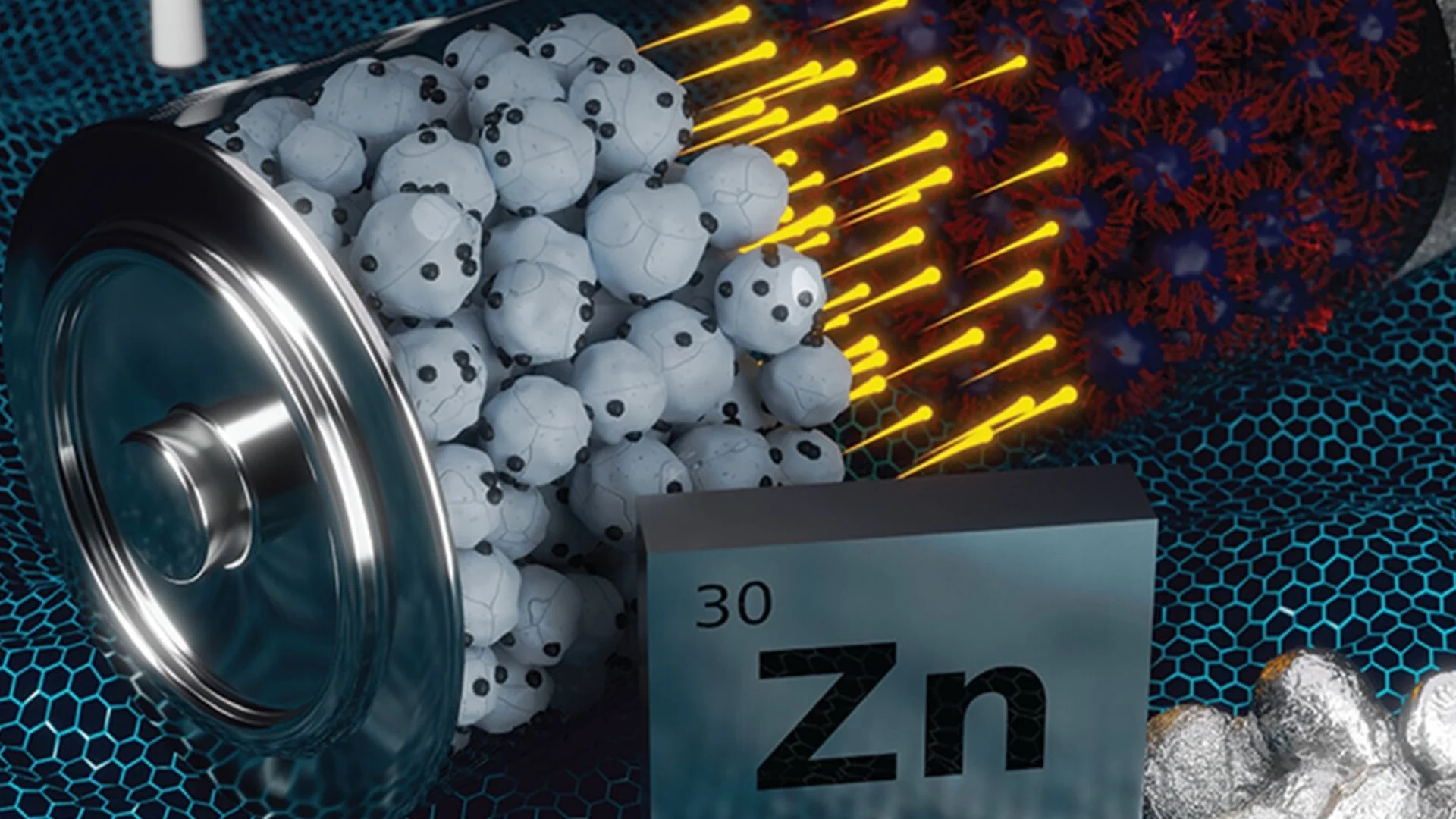
Scientists at Concordia University have extended the lifespan of zinc batteries by using tiny gold particles, making them safer, cheaper, and longer-lasting alternatives to lithium-ion batteries.
Their findings could play an important role in improving large-scale energy storage, especially for renewable power systems.
Zinc batteries have long been seen as a promising option for storing energy from sources like solar and wind. However, they suffer from a major flaw.
Over time, they form microscopic, tree-like structures called dendrites on the battery’s anode. These structures grow gradually and can eventually cause short circuits, leading to battery failure much sooner than expected.
READ ALSO: Japan’s Insect-Inspired Robot Tracks Odors Even with One Sensor
To better understand and solve this issue, the researchers turned to powerful imaging tools at the Canadian Light Source located at the University of Saskatchewan. Using ultra-bright X-rays, they observed how materials behave inside the battery at a very fine scale.
By adding a sparse layer of gold nanoparticles covering less than 10% of the battery’s internal surface, they slowed dendrite growth by up to 50 times compared to standard zinc batteries. This small change had a big impact. In laboratory tests, the modified batteries continued working for more than 6,000 hours.
Lead researcher Seungil Lee explained that coating battery electrodes is not a new idea, but the way these gold particles are used is unique. He said the team used only a tiny amount of gold, arranged in a specific pattern, which made the method both effective and efficient.
WATCH ALSO: U.S. lab advances demo microreactor as Project Pele gets nuclear fuel
His supervisor, Ayse Turak, highlighted another key advantage. She said the process does not require special lab conditions and uses very little gold, making it far more affordable than traditional coating methods. According to her, the cost is roughly one hundredth that of standard gold coatings.
Turak also noted that detecting such a thin layer of particles would normally be very difficult. However, the strong X-ray signals at the Canadian Light Source allowed the team to confirm exactly where the particles were and how they behaved.
The study, published in the Journal of Materials Chemistry A, opens new directions for battery design. The researchers are now exploring whether this particle-coating approach can be applied to other types of batteries, including next-generation anode-free systems using copper electrodes.
READ ALSO: MIT Engineers Develop Breath Test That Can Detect Pneumonia in Minutes Without X-Rays
Beyond batteries, the team believes the same idea could be useful in other technologies, such as sensors, solar cells, and lighting systems. As demand for stable, long-lasting energy storage continues to rise, this small addition of gold may offer a practical way to make zinc batteries more reliable and closer to large-scale use.