Commercial space tourism company Virgin Galactic says it is preparing to restart its suborbital flights by the end of 2026.
The company shared fresh updates during its March 30 earnings call, offering a clearer picture of its next-generation spaceplane and future operations.
The announcement comes at a time when the company is balancing technological progress with financial pressure. Even as losses continue, executives remain confident about the path ahead.
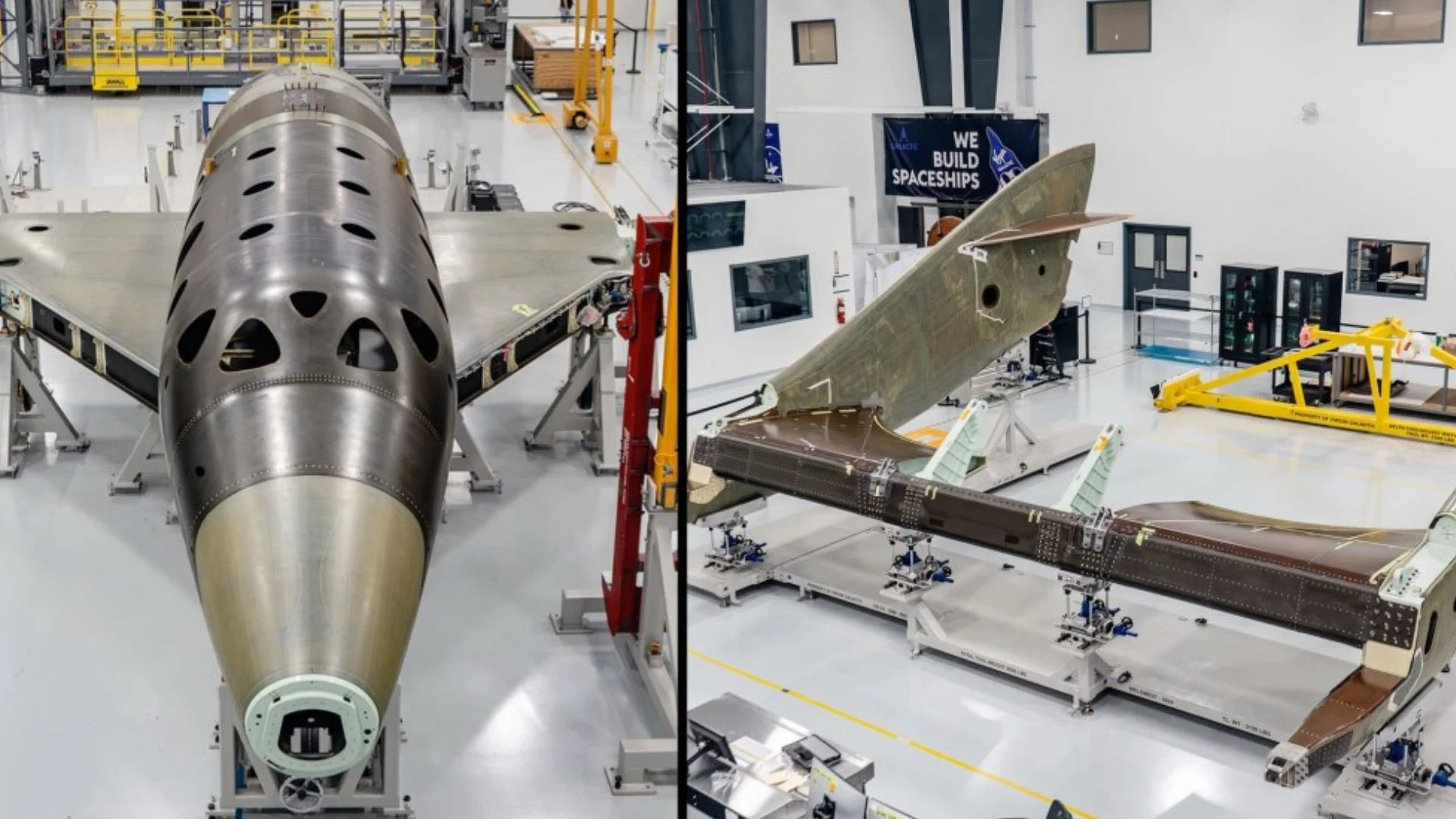
Virgin Galactic’s first next-generation space ship is now in the final stages of assembly. The work is taking place at a manufacturing facility near Phoenix.
READ ALSO: Liftoff to the Moon: Artemis II Launch Marks First Human Lunar Flyby in 50 Years
CEO Michael Colglazier said the vehicle’s structure will be completed very soon. “We expect to finish structural assembly in the next week or two,” he explained. He added that the company plans to begin ground testing in April.
According to Colglazier, this timeline keeps the company on track for its first test spaceflight in the fourth quarter of 2026.
The upcoming ground tests will focus on testing how the vehicle’s different systems work together. Engineers will study both individual components and the full integrated system.
These tests are expected to continue until July. After that, the company will officially unveil the vehicle before moving it to Spaceport America, the company’s main launch site. While these tests are underway, Virgin Galactic will also continue its pilot training programs.
WATCH ALSO: YouTuber captures lightning in a bottle during stunning experiment
Pilots will train using the company’s earlier spaceplane, VSS Unity. This aircraft has a design similar to the new SpaceShip, making it useful for training.
The company is also hiring new pilots. These recruits will use Unity to gain experience before transitioning to the new vehicle. This step is important to ensure smooth operations once commercial flights begin again.
Testing will move into the flight phase later in 2026. Glide tests are scheduled to begin in the third quarter. These tests will allow engineers to study how the vehicle behaves in the air without engine power. After that, the company will conduct powered flight tests.
Mike Moses explained that the first powered test will be a partial-duration flight. It will check how the vehicle performs at speeds between Mach 1 and Mach 1.5.
Two more powered flights will follow. The first full-duration test will include two pilots and research payloads from the NASA Flight Opportunities Program. The second will carry two pilots and six company employees. This mission will focus on testing the cabin experience and operational procedures.
Moses said the company will be ready for commercial service after these three powered tests. He added that the company’s previous experience with Unity allows it to move faster through the testing phase.
Virgin Galactic plans to begin commercial research flights in the fourth quarter of 2026. Private astronaut flights are expected to follow within 6 to 8 weeks. Once operations begin, the company will slowly increase the number of flights.
READ ALSO: Leipzig University Creates Microrobot That Learns to Navigate Flowing Fluids
It plans to start with four flights per month. Over time, this number will increase to eight and eventually reach 10 or more per month by the second quarter of 2027.
The carrier aircraft, VMS Eve, has also received major upgrades. The aircraft is responsible for carrying the spaceplane to high altitude before release.
After upgrades, Eve can now support 12 to 15 flights per month. Its operational life has also been extended to at least 2032.
Virgin Galactic is also working on a future carrier aircraft called LV-X. Colglazier said development work is progressing steadily. The goal is to introduce the first LV-X aircraft by 2030. This new system will support additional spaceplanes and expand the company’s overall capacity.
As the company moves closer to restarting flights, it has decided to reopen ticket sales. Virgin Galactic will initially offer 50 seats priced at $750,000 each. This is a significant increase from the earlier price of $600,000.
Colglazier said these tickets will be assigned after current customers complete their flights. Many of these early customers have been waiting for years.
The company began selling tickets nearly two decades ago. It now has a backlog of more than 650 customers. In its 2024 annual report, the company said the total number of customers had reached around 700 by the end of that year.
WATCH ALSO: Humanoid robot folds towel autonomously after observing human
Despite progress, Virgin Galactic continues to face financial challenges. The company reported revenue of just $2 million for 2025. At the same time, it posted a net loss of $279 million. It ended the year with $338 million in cash and equivalents.
However, its annual report included a “going concern” warning. This means the company may not have enough funds to continue operations for the next 12 months.
Virgin Galactic now stands at an important turning point. The company has spent years developing its technology and building customer interest. Now, it must prove that it can operate regularly and generate steady revenue.
With testing about to begin and ticket sales reopening, the coming months will be crucial. If all goes as planned, commercial space tourism may finally enter a more stable phase by the end of 2026.