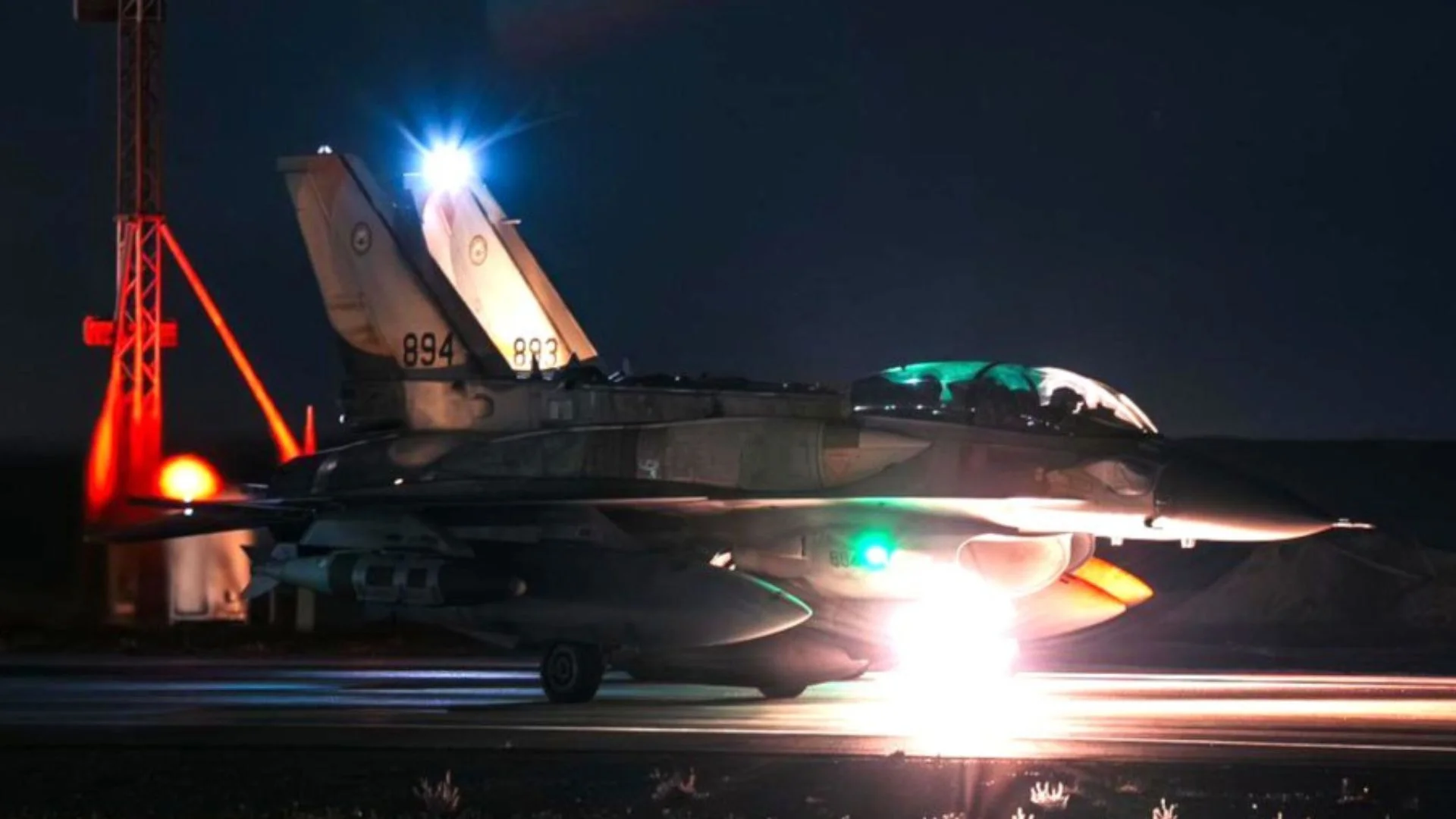
Fresh images released by the Israeli Air Force have drawn attention to a striking detail: its F-16 fighter jets appear to be carrying cluster munitions during recent strikes on Iran.
The aircraft, identified as F-16I Sufa variants, were photographed during night operations. While the low light makes identification difficult, the shape and structure of the weapons under their wings suggest they are not standard precision-guided bombs.
Instead, their blunt noses, visible fuzes, and cylindrical bodies strongly resemble air-dropped cluster munition dispensers.
What Makes Cluster Weapons Different
Cluster munitions are not typical single-impact bombs. They act as containers that open mid-air and release multiple smaller submunitions over a wide area. These submunitions can target vehicles and infrastructure, or even restrict movement within specific zones.
READ ALSO: 14,000-Year-Old Secret in Ancient DNA Rewrites the Human-Dog Story
Experts believe the weapons seen may be part of a Tactical Munitions Dispenser (TMD) family. These systems are flexible and can carry different payloads depending on the mission. This matters because the exact type of submunition inside determines the weapon’s purpose.
Recent claims from Iranian officials suggest that air-dropped anti-tank mines may already be in use. These include the BLU-91/B, a type of scatterable mine designed to disrupt armored movement. Such mines are often paired with anti-personnel variants to create layered denial zones.
If true, this would indicate a focused effort to block or slow the launch of mobile missile platforms.
A Strategy Focused on Missile Denial
The Israeli Air Force has openly stated that its operations are targeting missile storage and launch facilities inside Iran. In a post accompanying the released image, the force said it struck sites used for storing and launching ballistic missiles. It also confirmed attacks on weapons production centers in Tehran.
WATCH ALSO: United Launch Alliance’s Atlas V rocket delivers success for Amazon Leo
The statement said the Air Force continues to hit military industry targets to weaken long-term production capacity. This aligns with the possible use of cluster munitions designed for area denial.
Instead of destroying a single target, such weapons can make large zones unsafe for movement. This is especially effective against mobile missile launchers, which rely on relocation to avoid detection and counterstrikes.
By scattering mines or submunitions across launch zones, these systems can delay or prevent missile deployment altogether.
Why F-16s Are Central to This Role
The F-16 Fighting Falcon has long been a versatile platform capable of carrying a wide range of weapons. Its adaptability allows it to deploy both precision-guided munitions and broader-area weapons like cluster bombs.
The F-16I Sufa, a modified version used by Israel, is optimized for long-range strike missions. It can operate deep inside hostile territory and deliver payloads with high accuracy.
READ ALSO: UF Builds First Liquid 550-Pound Rocket Engine, Achieves Historic Hot-fire Success
Its compatibility with multiple munition types makes it a strong candidate for missions that require both precision and area coverage. In this case, the aircraft’s loadout suggests a deliberate shift from pinpoint strikes to broader tactical suppression.
Past and Present Cluster Arsenal
Israel has used cluster munitions in earlier conflicts. During the 2006 Lebanon war, it deployed older models filled with hundreds of small bomblets. These were mainly anti-personnel in nature.
The country has also received US-made systems like Rockeye cluster bombs, designed to destroy armored targets. However, the shapes seen in the latest images do not match those of the older designs. This indicates the possible use of more modern dispensers with specialized payloads.
Israel has also developed its own systems, including runway attack munitions designed to disable airfields. But there is no clear evidence that such weapons are being used in the current operations.
WATCH ALSO: China’s new massive battle tank takes part in live-fire test
While the exact contents of the cluster munitions remain unconfirmed, the visual evidence points toward a calculated approach. These are not random payloads. Their design suggests a mission to shape the battlefield rather than just strike targets.
By using cluster munitions from F-16s, Israel appears to be focusing on limiting Iran’s ability to launch long-range ballistic missiles. If confirmed, this would reflect a shift toward preemptive denial tactics, targeting not just weapons, but the very conditions required to use them.
However, the images raise more questions than answers. But one thing is clear: the presence of cluster munitions on frontline F-16s signals a deeper layer to the ongoing air campaign.