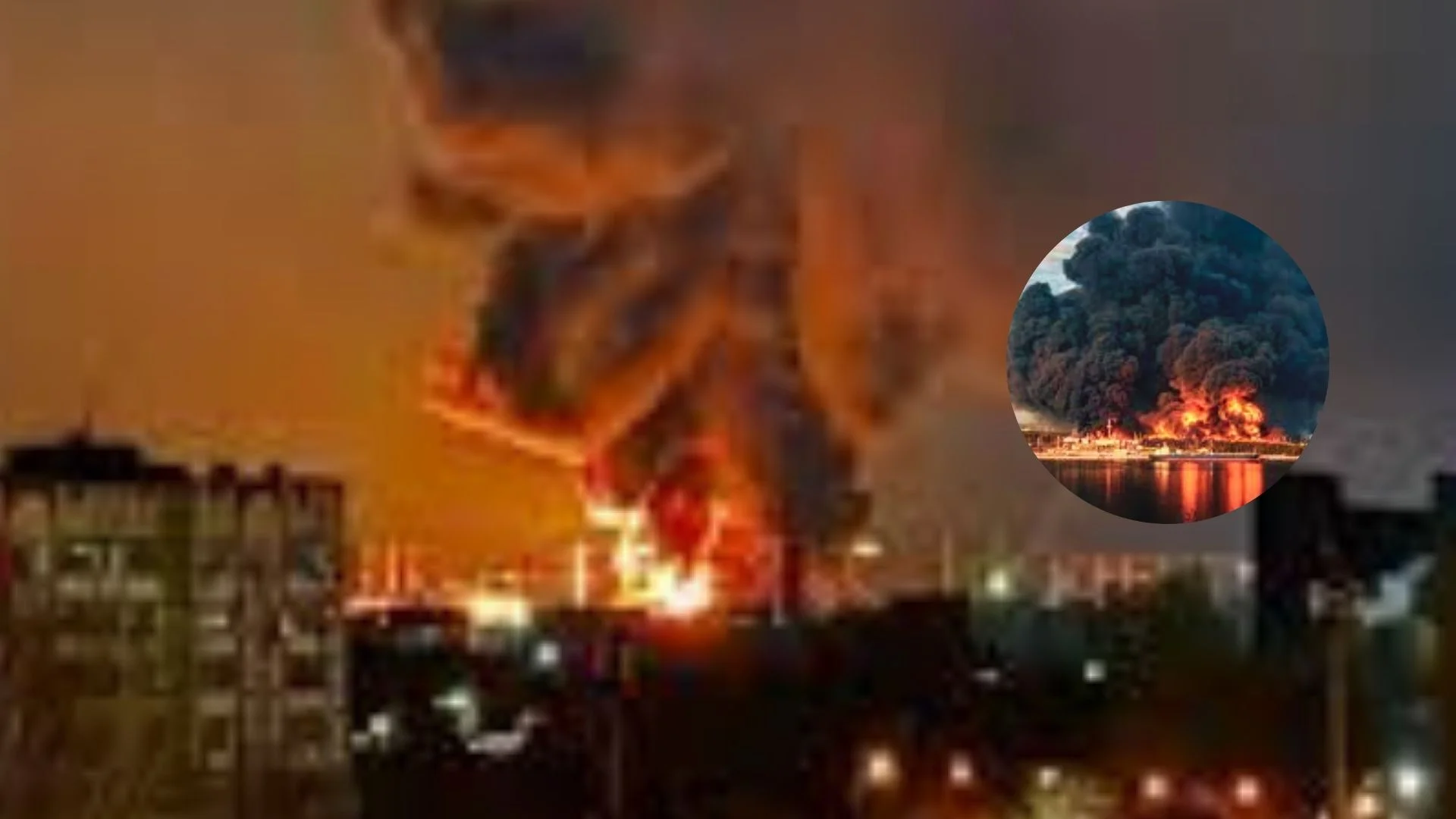
Fires have broken out across key Russian oil facilities near the Baltic Sea after a series of Ukrainian strikes.
Satellite images and verified videos show large flames and thick smoke rising from multiple sites over the past week.
According to BBC Verify, at least three major oil locations in Russia’s Leningrad region have been hit since 23 March. These include the ports of Ust-Luga and Primorsk, as well as the inland Kirishi oil refinery.
READ ALSO: RAI Roadrunner Robot Balances on One Wheel; Then Climbs, Skates, and Turns Fast
The attacks are not just military events. They are now shaping global energy flows.
The Baltic ports of Ust-Luga and Primorsk are vital for Russia’s oil exports. Analysts say about 20% of the country’s total oil shipments pass through Ust-Luga, while about 22% pass through Primorsk.
Recent data shows that no oil tankers were loaded at any of Russia’s Baltic ports on 26 and 27 March. Experts say this is the first such pause since the full-scale war began in 2022.
Satellite images confirm the scale of damage. At least eight storage tanks were destroyed or damaged at both Primorsk and Ust-Luga. Two tanks were also hit at the Kirishi refinery.
WATCH ALSO: Cartoon-like humanoid robot learns everyday kitchen chores from humans
NASA heat detection data shows that fires continued to burn for days. This suggests the damage was not only immediate but also prolonged.
Ukraine has openly stated its goal behind these strikes. Drone forces commander Robert Brovdi said the attacks aim to weaken Russia’s oil system.
He said Ukraine struck Ust-Luga again to keep the fire going. The strategy is clear: hit export routes and reduce revenue.
Ukraine’s military also said the Kirishi refinery is among Russia’s largest. It produces fuel that supports military operations.
From a global energy perspective, this matters. Oil exports are a major source of income for Russia. Any disruption directly affects supply and pricing worldwide.
Early estimates suggest that up to 40% of Russia’s oil export capacity was affected after the first wave of attacks. This has raised concerns in global markets.
READ ALSO: No Motors, No Propellers: These Bird-Like Robots Are Rewriting How Drones Fly
At the same time, oil prices have already been rising due to tensions involving the US, Israel, and Iran. The additional disruption at Baltic ports has intensified supply concerns.
Despite the damage, Russia still earned around £7.1 billion from oil exports in the final weeks of March. Higher prices helped offset lower volumes.
This creates a complex situation. Even when exports slow, rising prices can maintain or even increase revenue.
The strikes have also triggered political pressure. Ukrainian President Volodymyr Zelensky said allies have asked Kyiv to reduce attacks on Russia’s energy infrastructure.
He said Ukraine would only stop if Russia ended its own strikes on Ukrainian energy systems.
Energy stability has become a global concern. Prolonged disruption risks pushing oil prices higher, affecting economies far beyond the conflict zone.
Analysts believe this could influence future decisions.
Alexander Lord, an analyst at Sybelline, said Ukraine is trying to limit Russia’s financial gains. He explained that Kyiv is targeting oil pipelines to reduce export income.
WATCH ALSO: Chinese humanoid robot learns to stitch detailed embroidery patterns autonomously
However, he warned that pressure from the US may grow. He said Washington may push Ukraine to scale back strikes to help control global oil prices.
The conflict is no longer just about territory. It is increasingly about energy control. Burning storage tanks and halted shipments are now part of a larger battle over supply chains and revenue.
As long as the war continues, oil markets will remain sensitive to such attacks. Even a few days of disruption can ripple across global energy systems. The fires in the Baltic region are a reminder of how closely war and energy are now linked.