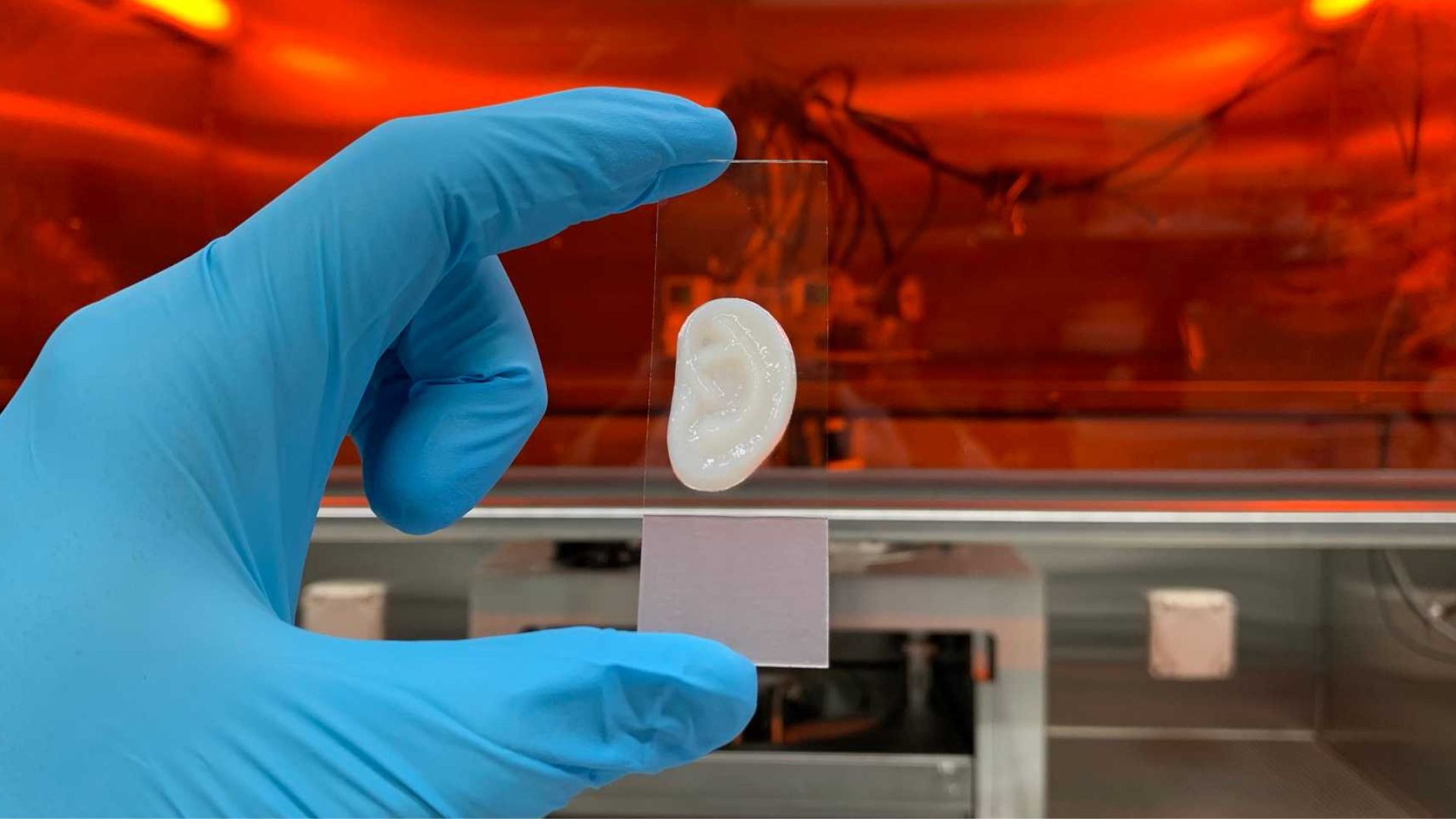
Researchers in Switzerland have engineered elastic ear cartilage in the lab that closely mimics the strength and flexibility of natural human ear cartilage.
The innovation could eventually transform reconstructive surgery for patients who lose ears in accidents or are born with congenital conditions such as microtia.
The research team from ETH Zurich, the Friedrich Miescher Institute, and the Cantonal Hospital of Lucerne has spent years refining methods to produce ear cartilage from a patient’s own living cells.
Their latest study based on regenerative medicine and 3D bioprinting, is published in Advanced Functional Materials and marks a significant step forward.
READ ALSO: https://modernmechanics24.com/post/fun-cars-with-two-fuel-tanks-real-fun/
For more than three decades, scientists worldwide have pursued the ambitious goal of growing a functional human ear in the lab.
In 2016, ETH researchers made headlines after producing a 3D-printed ear structure. Now, the team reports that they have developed engineered cartilage with mechanical properties strikingly similar to those of natural ear tissue and that it retained its shape and elasticity in animal models for 6 weeks.
Ear loss remains more common than many realize. Fires, trauma, and serious accidents frequently result in partial or total ear loss. In addition, congenital deformities affect thousands of children every year. Microtia, a condition in which the outer ear is underdeveloped, affects roughly four in 10,000 newborns.
The gold standard for reconstruction involves harvesting cartilage from a patient’s ribs. Surgeons sculpt that rib cartilage into an ear framework and implant it under the skin.
While effective, the procedure is painful, leaves chest scars, and can cause thoracic deformities. The reconstructed ear is also typically stiffer than a natural one. Now, researchers have long sought a better alternative.
“We aren’t implanting soft tissue in the hope that it remains stable in the body. Instead, we want to achieve that stability in the laboratory,” says Philipp Fisch, senior researcher in the Tissue Engineering and Biofabrication Group at ETH Zurich and lead author of the study.
WATCH ALSO: https://modernmechanics24.com/post/china-launches-80000-ton-fujian-aircraft-carrier/
The Elastin Challenge
At the heart of the challenge lies elastin. It is a protein that gives ear cartilage its flexibility and resilience. Unlike other tissues, ear cartilage must bend and spring back without losing shape.
Producing elastin in the lab is difficult. Even more challenging is organizing it into a stable network that mirrors natural tissue architecture.
“Despite this major success, elastin remains a challenge for us, as we were not able to mature it fully,” Fisch explains. “We observed changes in the tissue. That clearly shows that we need to stabilise it further.”
Without a precise biological blueprint for elastin formation, researchers must rely on systematic experimentation. Only a handful of research groups globally are attempting to engineer stable elastic cartilage, and each experiment can take three to four months.
From Patient Cells to 3D-Printed Ear
The process begins with a small cartilage sample taken during corrective ear surgeries. From a tissue piece just three millimeters wide, researchers can isolate around 100,000 cells. But printing a full ear requires hundreds of millions.
To reach that scale, scientists cultivate the cells in a specialized nutrient solution. They carefully control growth factors to encourage cell division while preventing unwanted transformation into fibroblasts. These are the cells that produce scar-like tissue instead of true cartilage.
If fibroblasts dominate, the result is fibrocartilage, which lacks the stiffness and elasticity of authentic ear cartilage. Natural ear tissue contains type II collagen and elastin, while fibrocartilage is rich in type I collagen.
READ ALSO: https://modernmechanics24.com/post/china-seedance-2-0-ai-shakes-hollywood/
Once multiplied, the cells are embedded into a bioink, a gel-like substance used in 3D bioprinting. The team then prints the ear structure layer by layer.
Immediately after printing, the construct remains extremely soft. “While the input material is crucial, so too is the tissue’s ability to develop,” Fisch says.
The printed ears are placed in an incubator for several weeks, where they receive a continuous supply of nutrients and oxygen. This maturation phase encourages the formation of type II collagen, elastin, and glycosaminoglycans; molecules that bind water and enhance cartilage strength.
Testing in Animal Models
After 9 weeks of in vitro maturation, the researchers implanted the engineered ear cartilage beneath the skin of rats. Over the next six weeks, they monitored stability, elasticity, and structural integrity.
The artificial ears maintained their shape and exhibited mechanical properties comparable to those of natural cartilage.
Fisch credits four key factors for the success. These are optimized cell proliferation, adjusted material properties, increased cell density, and improved control over the maturation environment.
Still, he says that elastin maturation remains incomplete. Stabilizing that network is critical for long-term durability in human patients.
The Tissue Engineering and Biofabrication Group at ETH Zurich has worked on this challenge for over ten years.
WATCH ALSO: https://modernmechanics24.com/post/china-astronauts-mice-space-research-mission/
“We’ve been working on this problem in our group for over ten years,” Fisch says. “When it comes to biofabrication of tissue, swift progress is rare to see.”
Yet interest is growing rapidly. Shortly after publication, Fisch received a message from the parents of a child with microtia asking about clinical timelines.
For families facing reconstructive surgery, the possibility of lab-grown, patient-specific ear cartilage offers hope for less invasive treatment and more natural outcomes.
What Comes Next?
The next milestone involves decoding the biological blueprint for elastin network formation. Fisch remains optimistic.
“If all goes well, we hope to find the blueprint for the elastin network within the next five years,” he says.
Clinical trials would follow, along with rigorous regulatory approvals. Only then could lab-grown ear cartilage move from research labs to operating rooms.
For now, the study represents a powerful proof of concept. It shows that scientists are edging closer to replicating one of the body’s most complex elastic tissues.
READ ALSO: https://modernmechanics24.com/post/oak-ridge-fuel-boosts-reactor-safety/
“Our current study provides a good guide to the current state of research,” Fisch concludes. “It shows how close we already are to recreating the human ear and what’s still missing.”
As tissue engineering advances, the once futuristic idea of lab-made ears is steadily becoming a medical reality. It offers new possibilities for reconstructive surgery, regenerative medicine, and personalized healthcare.