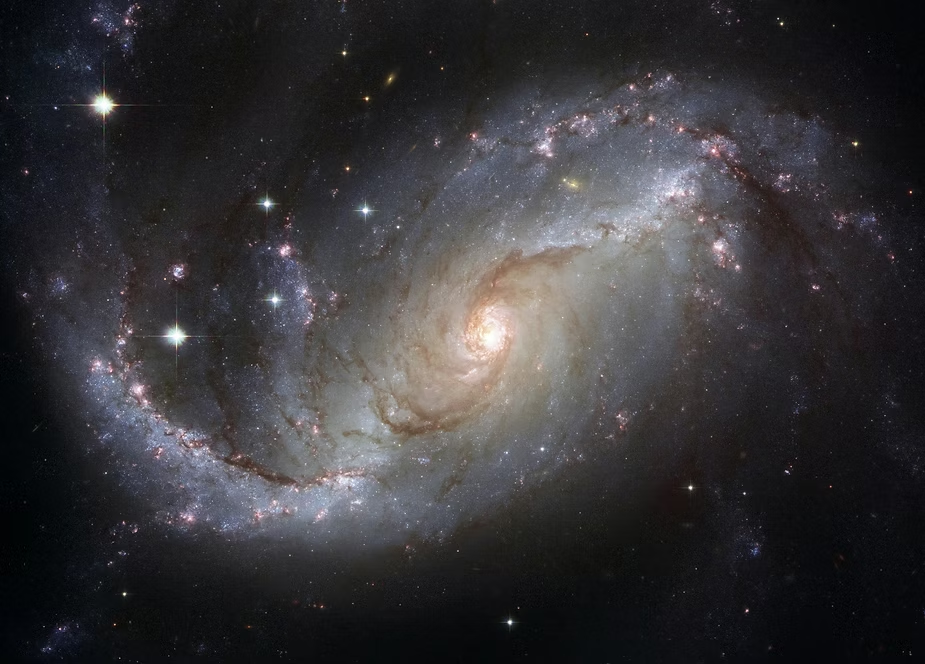
University of Warwick and UCL astronomers have found compelling evidence that ageing stars frequently destroy the giant planets orbiting closest to them. By analyzing nearly half a million star systems, the research reveals a significant lack of close-orbiting planets around red giant stars, pointing to a dramatic process of planetary engulfment as these stars expand.
For years, astronomers have theorized about the fate of planetary systems when their host stars age. We know that a star like our Sun will eventually exhaust its hydrogen fuel, cool down, and dramatically inflate into a red giant. Scientists predict this expansion, due in about five billion years for our Sun, will spell doom for Mercury, Venus, and possibly Earth. However, direct evidence for how common this destruction is has been scarce—until now.
A new study, published in the Monthly Notices of the Royal Astronomical Society (MNRAS), provides the largest-scale observational evidence to date. The research team, led by Dr. Edward Bryant, Warwick Astrophysics Prize Fellow at the University of Warwick, delved into a vast dataset to understand the survival odds of planets when their star enters the red giant phase. What they found was a cosmic feeding frenzy.
READ ALSO: https://www.modernmechanics24.com/post/chinese-geochemical-switch-earth-climate
The investigation focused on stars that had just entered the “post-main sequence” phase, the beginning of the end of their lives. Across this enormous sample, they discovered only 130 planets and planet candidates orbiting closely to these ageing stars. When they specifically examined stars that had fully evolved into red giants, the numbers were even more striking. The chance of a red giant hosting a nearby giant planet was a mere 0.11%, a figure about three times lower than for younger, main-sequence stars.
“This is strong evidence that as stars evolve off their main sequence, they can quickly cause planets to spiral into them and be destroyed,” stated Dr. Edward Bryant, who completed most of the work at UCL’s Mullard Space Science Laboratory, reported the University of Warwick. “This has been the subject of debate and theory for some time but now we can see the impact of this directly and measure it at the level of a large population of stars. We expected to see this effect, but we were still surprised by just how efficient these stars seem to be at engulfing their close planets.”
So, how does this planetary destruction unfold? The researchers point to a gravitational tug-of-war known as tidal interaction. As the star evolves and swells, its gravitational influence changes. The planet, in turn, exerts its own pull on the star, much like the Moon creates tides on Earth. These relentless interactions sap the planet’s orbital energy, slowing it down and causing its path to decay. The planet is then forced into a death spiral, inexorably drawn inward until it is either torn apart by gravitational forces or consumed whole by the star.
WATCH ALSO: https://www.modernmechanics24.com/post/worlds-first-motorbike-backflip-between-moving-trucks
This research has profound implications for our own solar system’s distant future. “In a few billion years, our own Sun will enlarge and become a red giant. When this happens, will the solar system planets survive? We are finding that in some cases planets do not,” explained co-author Dr. Vincent Van Eylen of UCL, according to the study’s press release. He offers a sliver of hope for Earth itself, noting that our planet is farther out than the doomed gas giants in their study. However, he cautions that the safety may be temporary, as the research only covered the first one or two million years of the red giant phase.
“Unlike the missing giant planets in our study, Earth itself might survive the Sun’s red giant phase,” Van Eylen said. “But life on Earth probably would not.”
The study opens a new chapter in understanding stellar evolution. While it confirms that the rate of giant planets decreases as a star ages, the handful of planets that do survive close to red giants present a new puzzle. What makes these worlds special? Dr. Bryant concluded by highlighting the next step: “Once we have these planets’ masses, that will help us understand exactly what is causing these planets to spiral in and be destroyed.”
READ ALSO: https://www.modernmechanics24.com/post/ice-age-trees-suffocated-to-save-earth