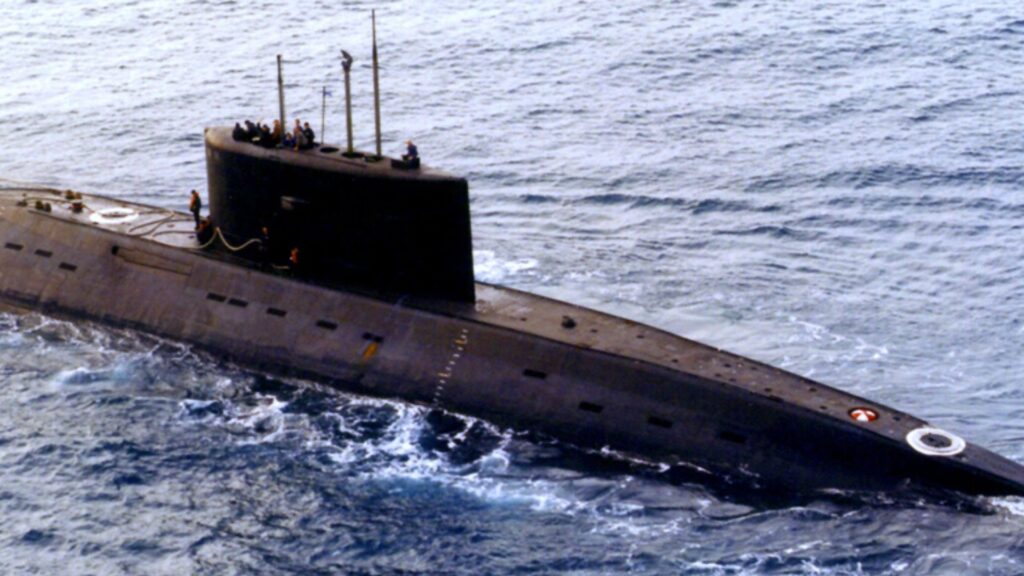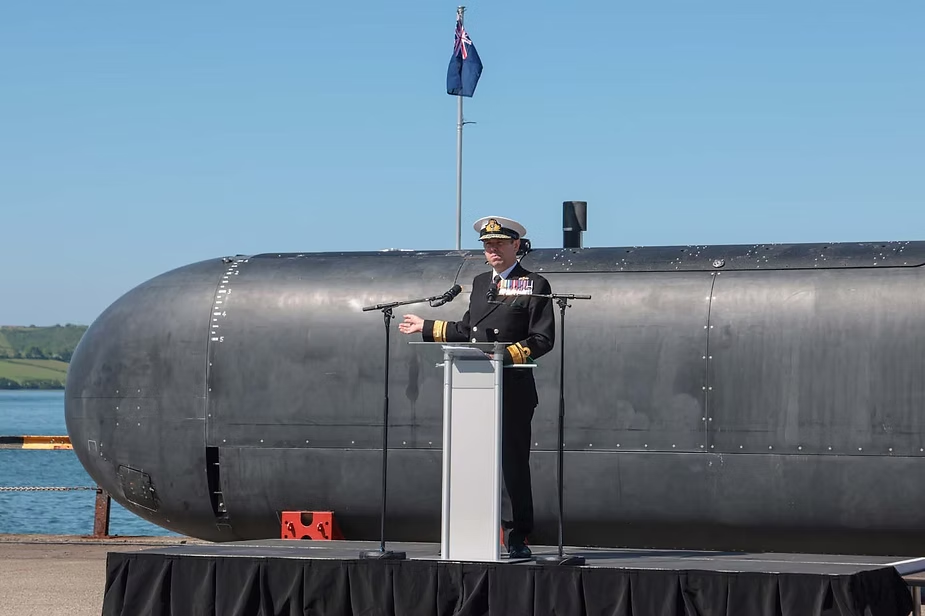
The Royal Navy has officially unveiled Excalibur, a 12-metre-long experimental submarine that marks a bold step into the future of underwater warfare. Displacing 19 tonnes and measuring two metres across, Excalibur is the largest uncrewed underwater vessel the Navy has trialled to date.
The unveiling took place at HM Naval Base Devonport, where the vessel was formally named in front of an audience of more than 200 distinguished guests. Attendees included Rear Admiral James Parkin, Navy Director Develop, representatives from AUKUS partner nations, Royal Navy trainees, and Cadets. The event underscored the significance of the project not only for the UK but also for its allies, as naval forces around the world increasingly look to robotic and autonomous systems to enhance their capabilities.
Culmination of Project Cetus
Excalibur is the product of Project Cetus, a three-year-long effort focused on developing large uncrewed underwater platforms. The programme represents the Royal Navy’s commitment to pushing technological boundaries in the underwater battlespace. By experimenting with a vessel of this size, the Navy hopes to gain valuable insight into how such systems can complement and enhance traditional, crewed platforms.
Over the next two years, Excalibur will undergo rigorous sea trials designed to test its endurance, agility, and operational effectiveness. These trials will provide engineers and naval commanders with crucial data on the challenges of deploying large autonomous systems underwater — challenges ranging from navigation and communication to endurance and stealth. The ultimate aim is to ensure that future uncrewed submarines can operate seamlessly alongside manned ships and submarines in complex missions.
READ ALSO: Medieval Revelations: A Lost English Tale, a Chaucerian Mystery, and the Birth of a Meme
READ ALSO: New Begonia Species Found in Guangxi
Strategic Importance
The introduction of Excalibur reflects the Royal Navy’s wider effort to stay ahead of potential adversaries beneath the waves. Submarine warfare remains one of the most strategically sensitive domains, vital for safeguarding undersea infrastructure such as communication cables and energy pipelines, protecting allied ships and submarines, and conducting covert intelligence-gathering operations.
By investing in uncrewed technology, the Navy is preparing for a future where mixed fleets of manned and unmanned systems work in concert to extend reach, increase flexibility, and reduce risks to human life.
Industry Collaboration
The vessel was designed and built by MSubs, a Plymouth-based company specialising in automated submersibles. The collaboration showcases how partnerships between the Royal Navy and the UK’s defence industry can drive innovation at speed.
Commodore Marcus Rose, Deputy Director for Underwater Battlespace Capability, emphasised the importance of the project:
“The naming of Excalibur is a significant milestone for the Royal Navy, and the upcoming sea trials will allow us to rapidly develop our understanding of operating uncrewed vessels of this size underwater. The lessons learnt from this exciting programme will build on our experience from existing programmes, such as the Mine Hunting Capability programme, to inform more extensive use of these technologies in a mixed force of crewed and uncrewed systems. Successful delivery of this programme is testament to what can be achieved in collaboration with our industrial partners.”
READ ALSO: Study reveals Arabia’s rainfall was five times more extreme 400 years ago
READ ALSO: Scientists Discover Adorable Panda-Like Sea Creature off Japan’s Coast
Building on Experience
The Royal Navy has already gained valuable experience with uncrewed surface and subsurface systems through projects like the Mine Hunting Capability programme, which has demonstrated how robotic platforms can safely clear minefields without putting sailors at risk. Excalibur represents the next step in scaling up this technology to larger, more complex missions.
By integrating lessons learned from Excalibur’s trials, the Navy hopes to establish a framework for deploying autonomous submarines as part of a hybrid fleet, where uncrewed systems take on high-risk or endurance-heavy tasks, freeing up crewed platforms for operations requiring human decision-making.
Looking Ahead
As global naval competition intensifies, the development of large uncrewed underwater vessels is expected to play a central role in future maritime strategy. For the UK, Excalibur is both a symbol and a testbed — a sign of intent that the Royal Navy is committed to remaining a leader in underwater capability while also providing a platform for innovation and experimentation.
Over the coming years, the trials of Excalibur will not only inform the Navy’s future force structure but could also influence broader defence cooperation with allies through frameworks such as AUKUS. If successful, Excalibur may pave the way for a new generation of autonomous submarines capable of undertaking missions that today would be too dangerous or costly for crewed vessels.
With Excalibur, the Royal Navy has taken a decisive step toward blending tradition with cutting-edge technology, ensuring that Britain remains at the forefront of underwater operations in an increasingly contested maritime domain.