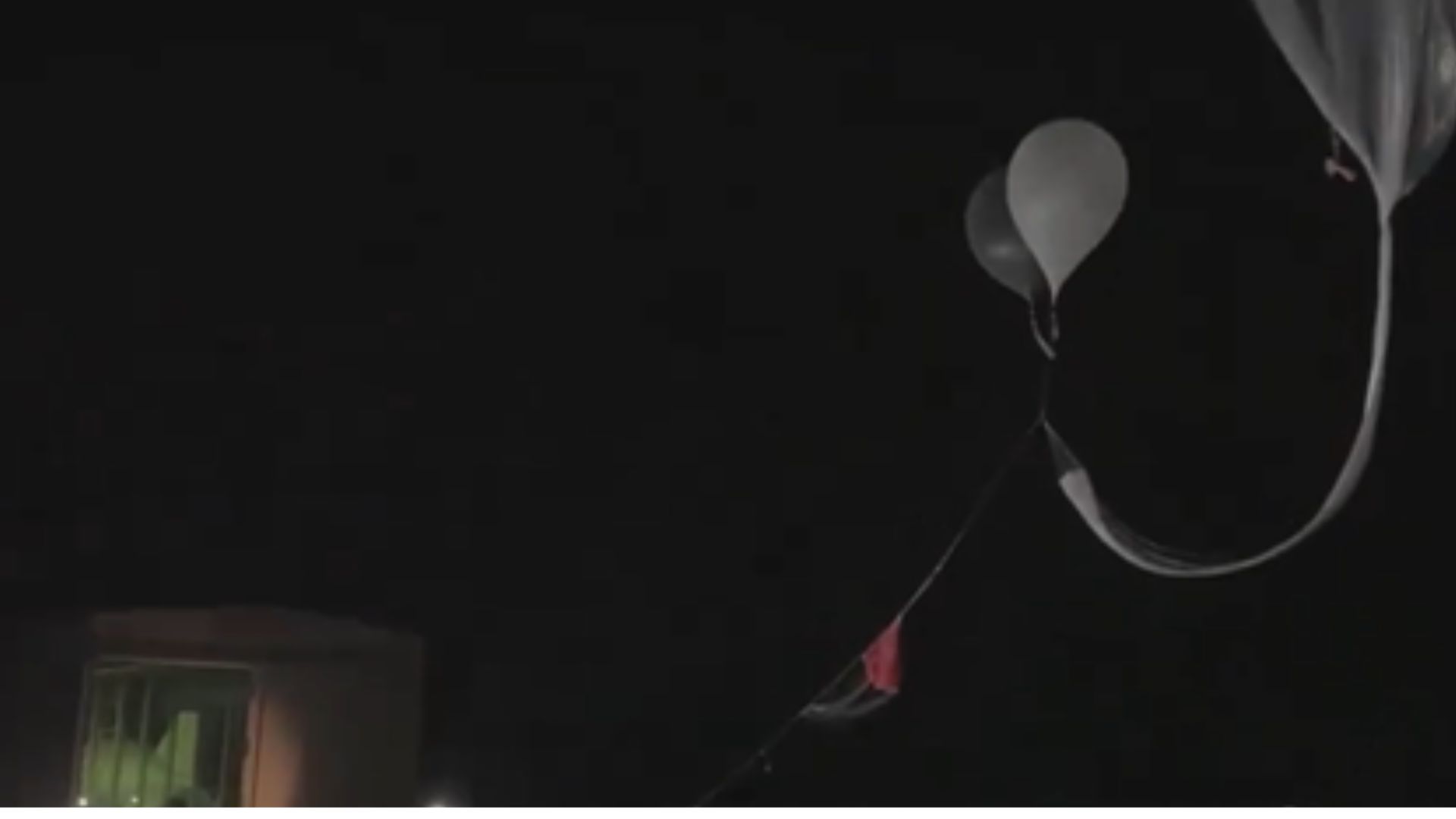
Russia is developing a high-altitude balloon communications system in an urgent bid to plug a widening battlefield connectivity gap after losing access to SpaceX’s Starlink satellite network.
The new platform, called Barrage-1, is being tested by Russia’s Foundation for Advanced Studies (FFAS).
The system is designed to float at altitudes up to 20 kilometers (about 12 miles) while carrying communications payloads capable of providing high-speed data links to ground forces.
The move comes after SpaceX restricted Russian access to Starlink terminals by implementing a verified-user system. The restriction disrupted Russian battlefield communications, drone coordination, and logistics operations.
What Is Balloon Communication System?
A balloon communication system uses high-altitude aerostats or stratospheric balloons as airborne relay stations. It is positioned far above the Earth’s surface but well below satellites in low Earth orbit (LEO). These platforms can transmit radio, 5G, or data signals across wide areas.
READ ALOS: https://modernmechanics24.com/post/pentagon-spy-satellites-for-satellites/
While satellite constellations orbit hundreds of miles above Earth, high-altitude balloons operate within the stratosphere. At around 20 kilometers high, a single balloon can provide line-of-sight connectivity across a broad region. Multiple balloons working together in a mesh network can extend that coverage further.
The Barrage-1 balloon is equipped with a pneumatic ballast system that allows operators to adjust altitude and ride wind currents to reposition it.
According to FFAS, the system can maneuver and remain in a specified area or follow the trajectory required for the payload.
One of the primary payloads under consideration is 5G NTN (non-terrestrial network) equipment. It could enable high-bandwidth data transmission for battlefield use.
Why Is Russia Turning to Balloons?
The introduction of Starlink into the Russia-Ukraine war transformed modern combat by enabling secure, high-speed internet access in contested zones. Both Ukrainian and Russian forces relied heavily on portable Starlink terminals for command and control, drone operations, and real-time battlefield coordination.
However, SpaceX’s move to restrict Russian access earlier this month disrupted that dependency. According to reports, Russian troops experienced communication breakdowns that affected offensive operations.
Lt. Denis Yaroslavsky, a commander in Ukraine’s armed forces, said that for three to four days after the shutdown, they really reduced the assault operations. Ukrainian officials also claimed that the disruption slowed Russian advances and increased their vulnerability.
Retired Australian Major General Mick Ryan said the loss forced Russian logistics units to revert to traditional methods.
WATCH ALSO: https://modernmechanics24.com/post/wing-expands-walmart-drone-delivery/
“The loss of Starlink has now forced Russian military logistics troops to return to the use of manned trucks, cars, motorcycles, or quad-cycle vehicles,” he stated, adding that these are more vulnerable to drone strikes.
Russian officials acknowledged the impact. Andrey Medvedev, deputy chairman of the Moscow City Duma, wrote on Telegram that instead of a planned strike against the enemy, where our communications are instantly cut off while theirs remain operational, we have a hellish mess.
Faced with these constraints, Russia is seeking faster alternatives to restore connectivity, even as its own satellite constellation plans face delays.
Barrage-1 vs. Starlink
While Barrage-1 offers a potential workaround, it cannot match Starlink’s global reach.
Starlink operates through thousands of interconnected satellites orbiting between roughly 300 and 340 miles above Earth. These satellites use laser interlinks to transmit data across continents.
On the other hand, Barrage-1 operates at just 12 miles high. Its coverage area would be regional rather than global. To achieve prominent coverage, Russia would likely need a network of clustered balloons.
Serhiy Flash Beskrestnov, an advisor to Ukraine’s Defense Ministry on drone and electronic warfare, acknowledged the concept’s potential. “The platform is seen as an accessible and efficient alternative to expensive satellite constellations in LEO,” he stated. “Placing transmitters at an altitude of 20 km will allow providing high-speed internet and communication to vast territories where the construction of ground towers is impossible.”
He added that by controlling the altitude of an aerostat, it can be steered, not precisely, but enough to stay over any territory.
Beskrestnov also pointed out vulnerabilities. “What’s most important for us? To have the means that can detect such objects over our territory and to have the ability to shoot down such targets if they pose a threat,” he said. He noted that systems like the S-300 surface-to-air missile can, in theory, reach those altitudes.
READ ALSO: https://modernmechanics24.com/post/chernobyl-wild-horses-radiation-zone/
Military Risks and Countermeasures
High-altitude balloons present a mixed security profile. While their radar signature may be smaller than conventional aircraft, they are far slower and more exposed than satellites. Ukraine could potentially target them with surface-to-air missiles or specialized long-range drones.
Electronic warfare could also pose a threat. Because the balloons would emit communication signals, they could become electronic beacons for adversaries seeking to jam or track them.
Targeting a balloon at stratospheric altitude is not straightforward. During the Cold War, both superpowers studied methods to intercept high-altitude platforms, but engagement remains technically challenging.
Russia’s Satellite Ambitions
Russia’s long-term answer to Starlink was expected to be the Rassvet low Earth orbit constellation, developed by Bureau 1440 under Roscosmos oversight. But production delays have pushed the initial deployment of 16 satellites from late 2025 to 2026.
Reportedly, manufacturing shortfalls have slowed the rollout. Although officials previously claimed the satellites were ready, only six experimental satellites are currently in orbit, testing laser interlinks and 5G compatibility.
Even once operational, analysts doubt Rassvet will match Starlink’s scale or performance for years to come.
The current limitations cannot be ignored. But there are no alternatives right now.
WATCH ALSO: https://modernmechanics24.com/post/hmnd-01-alpha-simulation-humanoid-robot/
Gazprom Space Systems offers satellite connectivity, but, according to critics, its network lacks the speed and scalability required for modern battlefield operations.
The communications setback arrives at a sensitive moment. With peace talks underway in Switzerland, battlefield momentum carries diplomatic weight. Any sustained reduction in Russian offensive capacity could weaken its negotiating position.
As the war evolves, both sides continue to innovate technologically. From drone swarms to electronic warfare, rapid adaptation has defined the conflict. Russia’s pivot toward high-altitude balloon communications reflects this urgent need.
Barrage-1 will not replace a satellite constellation overnight. It just shows an immediate, lower-cost attempt to regain high-speed battlefield connectivity. Whether it can withstand countermeasures and deliver reliable performance remains uncertain; time will tell.